Sitemap
A list of all the posts and pages found on the site. For you robots out there, there is an XML version available for digesting as well.
Pages
About
About me
Posts
FeelIT lives again — 14 years later
Published:
FeelIT lives again
Week in review: From developer portfolios to executive narratives
Published:
This week’s biggest change wasn’t technical – it was narrative. I restructured six industry portfolio entries to lead with business impact instead of algorithms. The shift reflects a real career evolution: from implementing models to owning their business outcomes.
Week in review: Vectorization, numerical stability, and biological accuracy
Published:
Modernizing eight research codebases at once sounds like a terrible idea, and some weeks it feels like one. But working across optics, biophysics, robotics, and geostatistics in parallel has surfaced a pattern: the same three engineering challenges keep showing up in every domain, wearing different clothes.
The first SOFI implementation in Chile, modernized
Published:
In 2012, I started working on Super-resolution Optical Fluctuation Imaging at SCIAN-Lab, Universidad de Chile, collaborating remotely with researchers at the III Physics Institute of the University of Gottingen in Germany. Working across continents and time zones with the Gottingen team was both challenging and exhilarating – SOFI was a relatively new technique at the time, and there was limited local expertise in Chile to draw on. Every implementation decision, from the cumulant computation pipeline to the deconvolution strategy, required careful coordination through emails and video calls, often debugging numerical issues with a six-hour time difference. The goal was to implement SOFI from the ground up – cumulant computation, synthetic quantum dot simulators, deconvolution – and apply it to biological samples. After months of work, we achieved the first successful SOFI super-resolution imaging in Chile, resolving structures below the diffraction limit using nothing more than temporal statistics from blinking fluorescent emitters. The pride of being the first group in Chile to produce these results was immense – it proved that cutting-edge computational optics could be done here, not just in European labs with larger budgets and established traditions in the field. That work contributed to a publication at SPIE Photonics West, presenting the cumulant-based framework and validation results.
Giving Legacy Research Code a Second Life
Published:
I recently pushed five old research projects to GitHub, modernized and documented. It felt like reopening time capsules.
Building a crusher wear management platform from scratch
Published:
Over the past few months I have been building an end-to-end software platform for managing crusher liner wear in minerals processing, working as a consultant for a mining equipment services company. It has been one of the most technically demanding projects I have taken on.
Publication in Scientific Data (Nature): The HIDSAG Hyperspectral Database
Published:
Our HIDSAG database paper has been published in Scientific Data, a Nature journal. Read the paper (DOI). This one feels special.
Presentation at Procemin 2022: Topic Modelling for Hyperspectral Geometallurgy
Published:
I presented our work “Geometallurgical Estimation from Hyperspectral Images and Topic Modelling” at the 18th International Conference on Mineral Processing and Geometallurgy (Procemin 2022). Procemin is the premier international conference for mineral processing in Latin America, bringing together researchers and practitioners from across the global mining industry to discuss advances in geometallurgy, comminution, flotation, and process optimization.
Publication in Minerals: Hyperspectral Analysis for Geometallurgy
Published:
Our paper “A Robust Stochastic Approach to Mineral Hyperspectral Analysis for Geometallurgy” has been published in Minerals. Read the paper.
My doctoral dissertation defense
Published:
The end of my doctoral studies in electrical engineering has finally come.
Publication in Natural Resources Research: Ore-Waste Discrimination with Adaptive Sampling
Published:
Our paper “Ore-Waste Discrimination with Adaptive Sampling Strategy” has been published in Natural Resources Research. Read the paper (DOI).
Publication in Mathematical Geosciences: Sampling Strategies for Uncertainty Reduction
Published:
After years of research, our paper “Sampling Strategies for Uncertainty Reduction in Categorical Random Fields” has been published in Mathematical Geosciences. Read the paper (DOI).
portfolio
Robotic Writer
Published:
Simulation and control of a 5-DOF robotic arm that picks letter blocks and spells words — kinematics, trajectory planning, and hardware integration.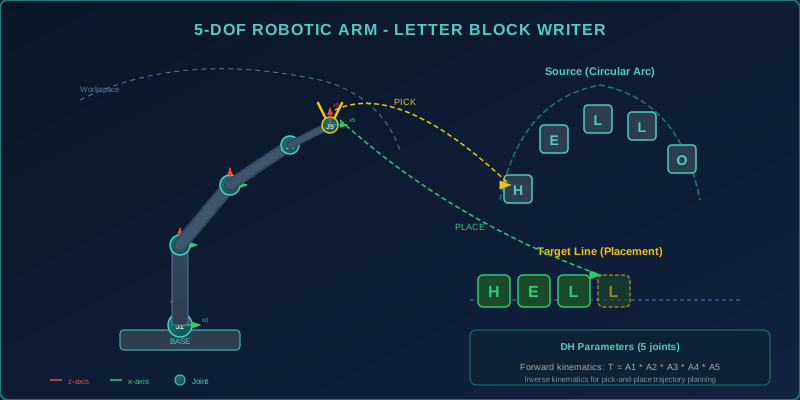
3D Haptic Simulation with Octree Collision Detection
Published:
Web-based 3D haptic simulation with octree spatial partitioning, SAT collision detection, and spring-damper force feedback.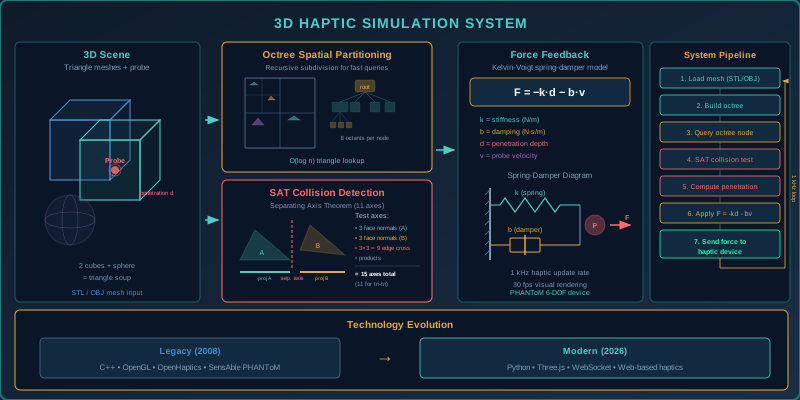
Dynamic Holographic Optical Tweezers
Published:
Real-time holographic phase mask computation for optical particle trapping using the Gerchberg-Saxton algorithm.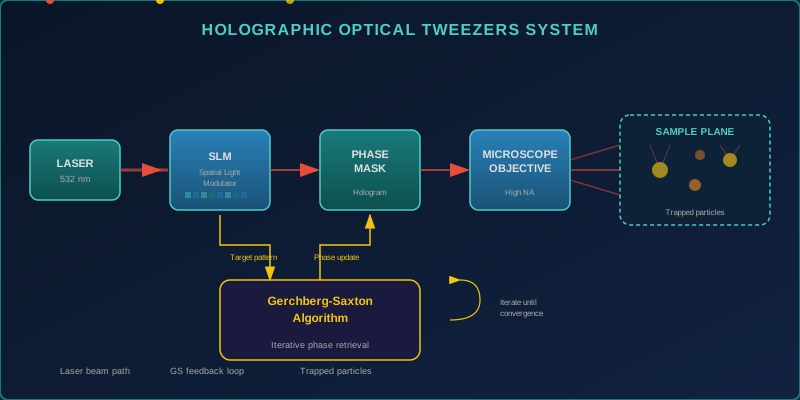
3D Embryo Cell Migration Simulator
Published:
Interactive 3D simulation of collective cell migration on a spherical zebrafish embryo surface during gastrulation.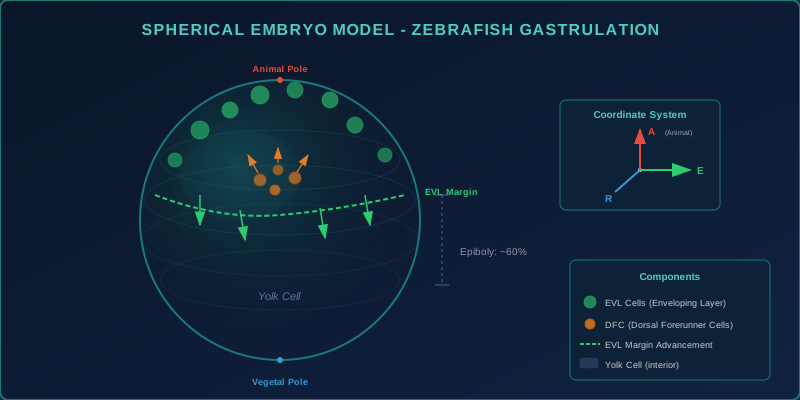
Super-Resolution Microscopy via Optical Fluctuation Imaging
Published:
SOFI implementation for quantum dot fluorescence analysis — achieving sub-diffraction resolution through higher-order cumulant computation.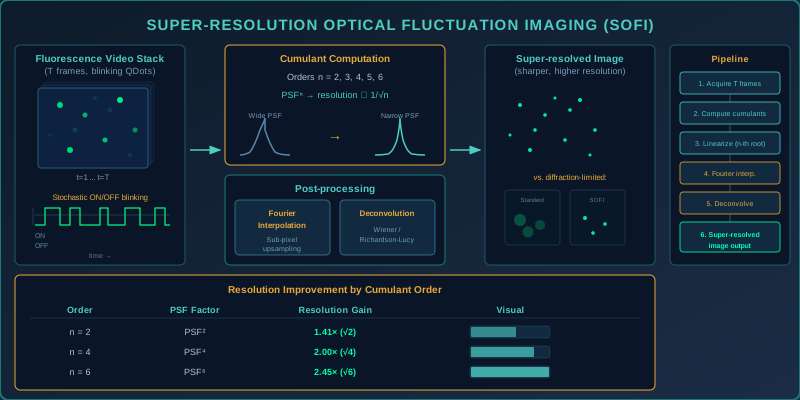
FeelIT
Published:
Haptic and VR interactive platform for visually impaired people — exploring tactile feedback for virtual objects.
Cellular Potts Model Simulator
Published:
Interactive simulator for zebrafish embryonic cell migration using deformable cell bodies and filopodia-driven motility.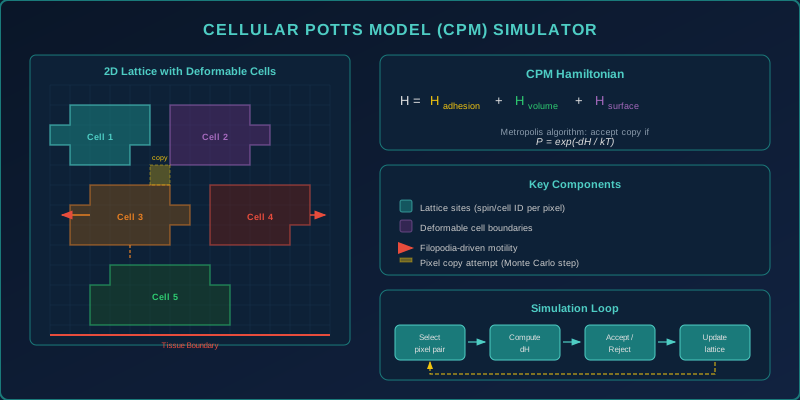
Micromundo — Virtual Microscopy & Science Education Platform
Published:
Educational platform integrating virtual microscopy, collaborative science teaching, and 3D-printed microscope technology for schools and universities.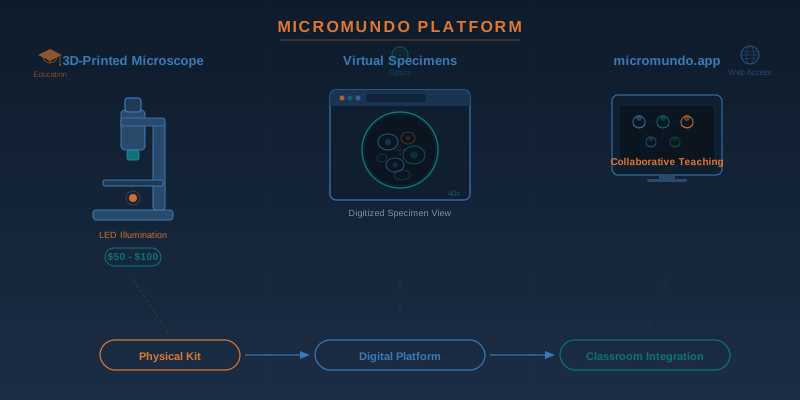
Optimal Spatial Sampling via Information Theory
Published:
Information-theoretic framework for optimal well placement in geological reservoirs using adaptive sequential entropy maximization.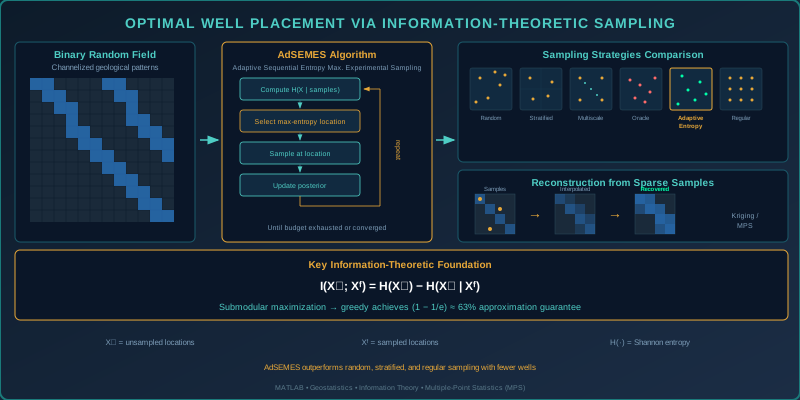
3D Distance Profiler — Depth Maps for Granulometry
Published:
RGB-D depth profiling for mineral sample surface characterization — enabling granulometry detection from 3D surface reconstruction, curvature analysis, and ISO 4287 roughness metrics.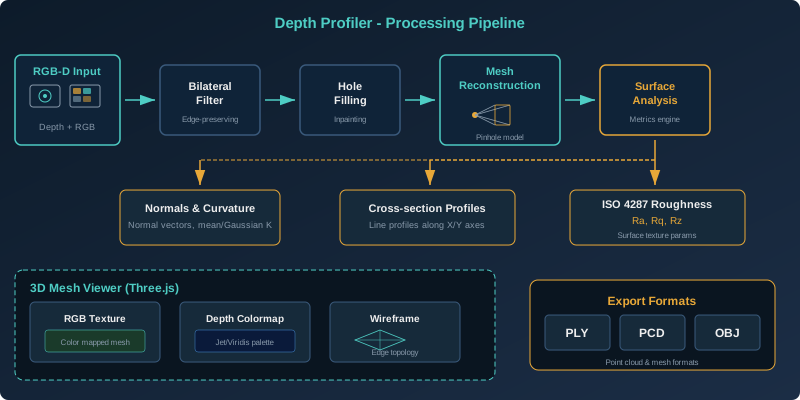
GrainSight — Particle Size Distribution from RGB-D Data
Published:
3D granulometry analyzer using marker-based watershed segmentation, per-grain geometric measurement, and Rosin-Rammler PSD fitting from depth camera data.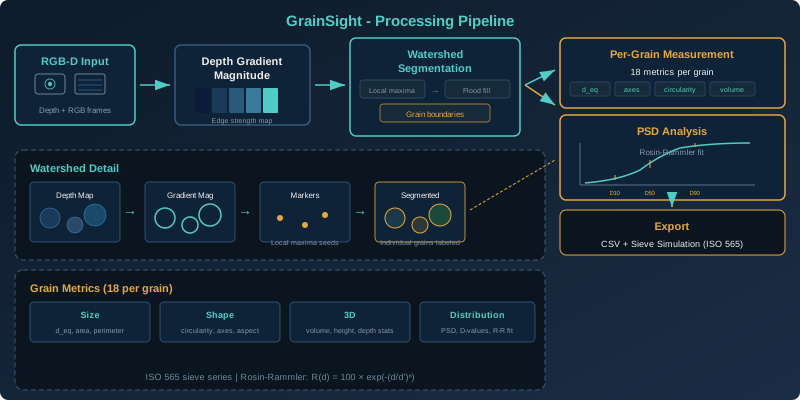
HyClus Viz
Published:
A short Undergraduate Project for HSI Clustering Visualization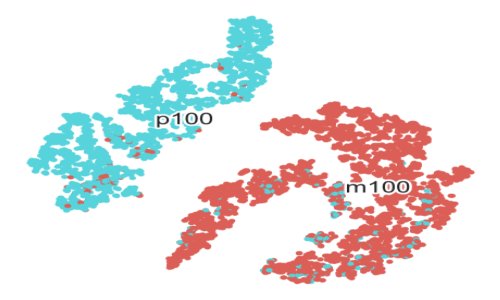
Information-Theoretic Sampling for Geological Image Recovery
Published:
Doctoral thesis formalizing the Optimal Sensor Placement problem using Shannon entropy, conditional information, and adaptive sequential strategies for mining exploration.
Dual Photography Lab
Published:
Computational imaging that reconstructs a scene from the projector’s viewpoint using light transport matrices and Helmholtz reciprocity.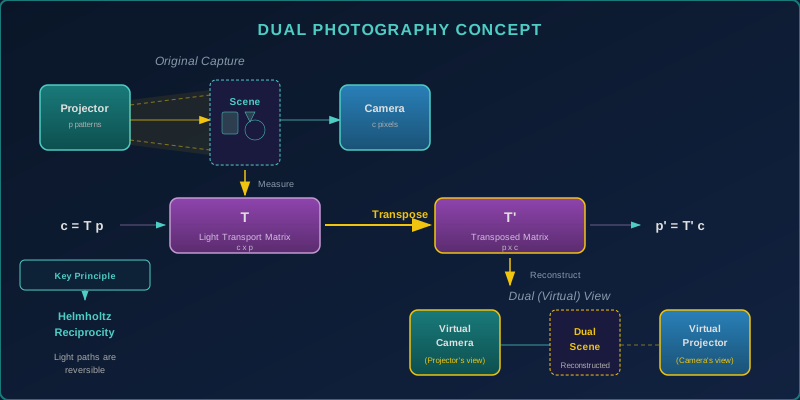
Mining Process Optimization Platform
Published:
End-to-end ML platform for optimizing SAG milling, flotation, and thickening operations across multiple mining divisions.
Real-Time Material Tracking & Blending System
Published:
Digital twin for ore flow tracking, stockpile management, and blending optimization in mining operations.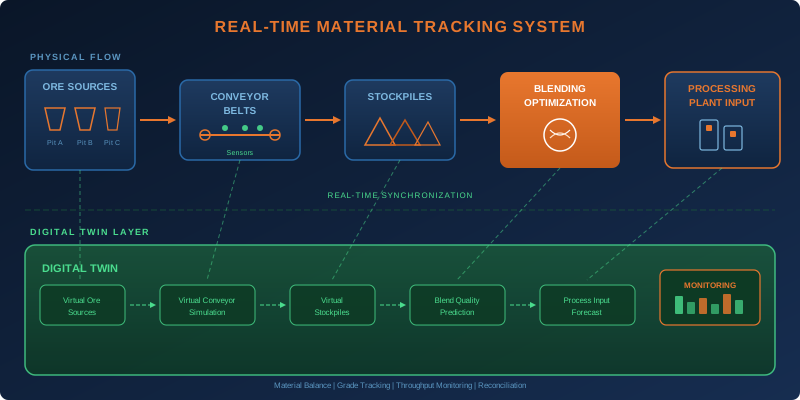
Environmental Monitoring & Mitigation System
Published:
Computer vision and Generative AI for real-time pollution monitoring, prediction, and natural-language operational recommendations.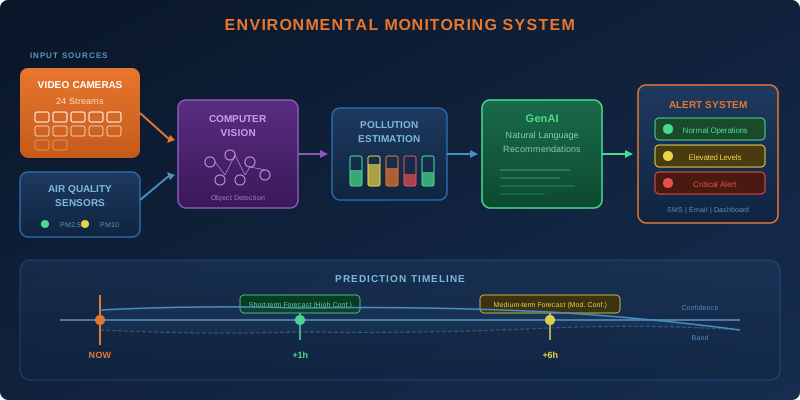
Geotechnical Risk Prediction System
Published:
ML-based prediction of geotechnical hazards in underground mining using seismic data, spatial features, and 3D block models.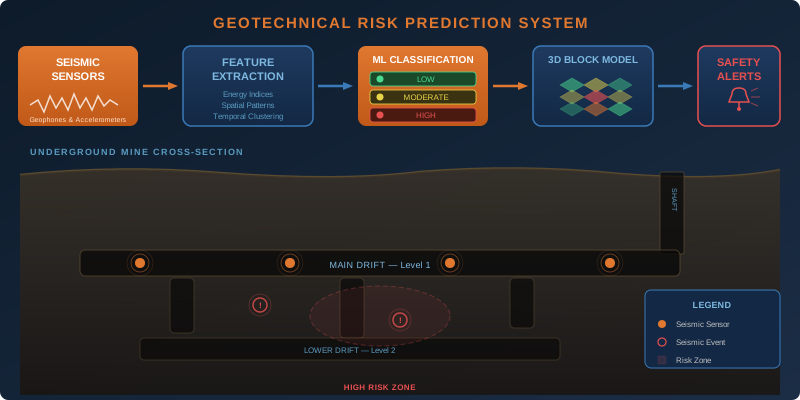
Crusher Liner Wear Management System
Published:
Full-stack platform for 3D point cloud analysis, wear profile tracking, and remaining-life forecasting of industrial crusher liners.
Hyperspectral Mineral Classification Platform
Published:
ML platform for mineral identification and abundance estimation from hyperspectral imagery using ensemble methods, CNNs, and compositional constraints.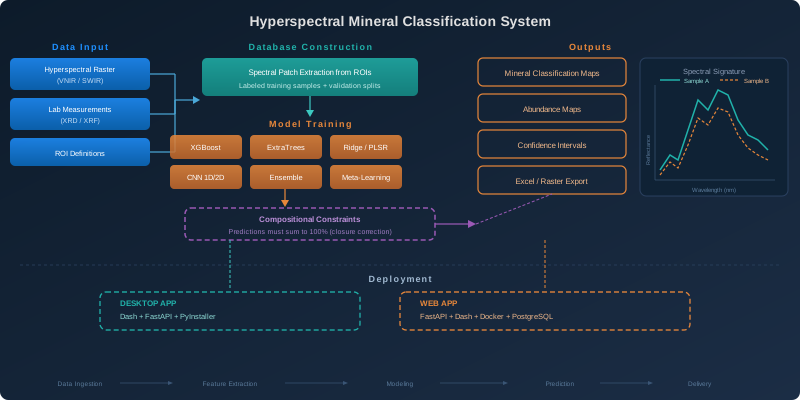
FeelIT 2.0 — Haptic Accessibility Workbench
Published:
Modern web-based haptic accessibility platform for tactile 3D object exploration, Braille reading, and haptic desktop interaction — resurrecting and expanding a 2008 accessibility vision.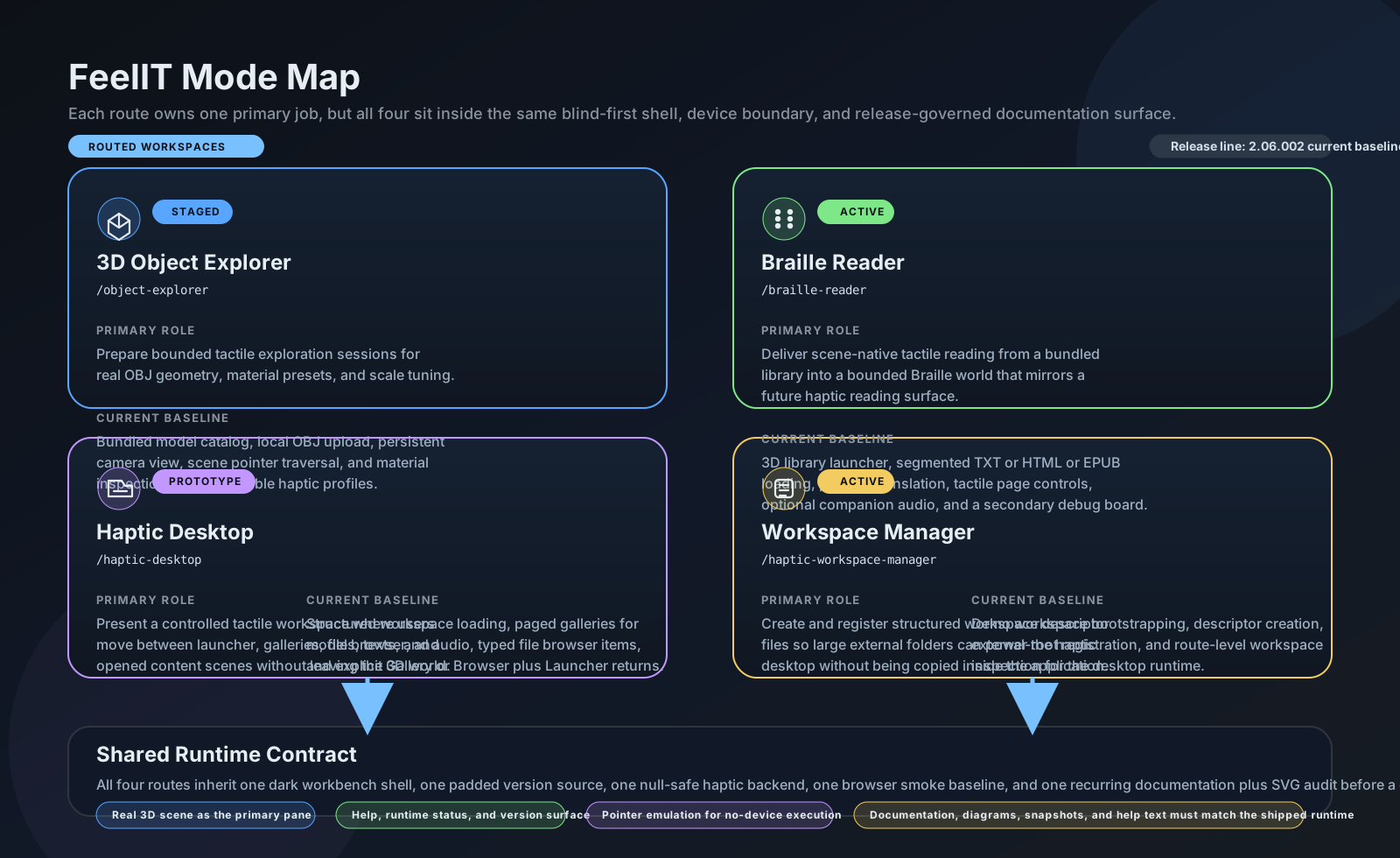
Mine Pile Visualizer — Stockpile & Circuit Topology Explorer
Published:
Local-first web application for exploring mining circuit topology, live material state, stockpile voxel structure, and profiler history from a mineral tracking simulation engine.
publications
SOFI of GABAB neurotransmitter receptors in hippocampal neurons elucidates intracellular receptor trafficking and assembly
Published in Proceddings SPIE, 2013
The assembly of the GABABRs in hippocampal neurons with dual-color, 3D super-resolution optical fluctuation imaging (SOFI) is studied. SOFI is a fluorescence imaging modality which yields superresolved spatial resolution, 3D-sectioning and high image contrast.
Recommended citation: Anja Huss, Omar Ramírez, Felipe Santibáñez, Andrés Couve, Steffen Härtel, and Jörg Enderlein. (2013). "SOFI of GABAB neurotransmitter receptors in hippocampal neurons elucidates intracellular receptor trafficking and assembly." Proc. SPIE 8590, Single Molecule Spectroscopy and Superresolution Imaging VI. 85900N.
Download Paper
Computational methods for analysis of dynamic events in cell migration
Published in Current Molecular Medicine, 2014
Image processing approaches for quantitative description of cell migration in 2- and 3-dimensional image series, including registration, segmentation, shape and topology description, tracking and motion fields are presented. We discuss advantages, limitations and suitability for different approaches and levels of description.
Recommended citation: Castañeda V, Cerda M, Santibáñez F, Jara J, Pulgar E, Palma K, Lemus CG, Osorio-Reich M, Concha ML, Härtel S. (2014). "Computational methods for analysis of dynamic events in cell migration." Current Molecular Medicine. 14(2). PMID: 24467201.
Download Paper
Channelized facies recovery based on weighted compressed sensing
Published in 2016 IEEE Sensor Array and Multichannel Signal Processing Workshop (SAM), 2016
A new image reconstruction algorithm is proposed based on weighted compressed sensing (WCS) for the problem of channelized facies recovery from pixel-based measurements.
Recommended citation: H. Calderón, F. Santibañez, J. F. Silva, J. Ortiz and Á. Egaña. (2015). "Channelized facies recovery based on weighted compressed sensing." 2016 IEEE Sensor Array and Multichannel Signal Processing Workshop (SAM). Rio de Janerio, pp. 1-5.
Download Paper
Sampling Strategies for Uncertainty Reduction in Categorical Random Fields: Formulation, Mathematical Analysis and Application to Multiple-Point Simulations
Published in Mathematical Geosciences, 2019
The task of optimal sampling for the statistical simulation of a discrete random field is addressed from the perspective of minimizing the posterior uncertainty of non-sensed positions given the information of the sensed positions.
Recommended citation: Felipe Santibañez, Jorge F. Silva, and Julián M. Ortiz. (2019). "Sampling Strategies for Uncertainty Reduction in Categorical Random Fields: Formulation, Mathematical Analysis and Application to Multiple-Point Simulations." Mathematical Geosciences . 51. pp 579 - 624
Download Paper
Geological Facies Recovery Based on Weighted ℓ1-Regularization
Published in Mathematical Geosciences, 2019
A weighted compressed sensing (WCS) algorithm is proposed for the problem of channelized facies reconstruction from pixel-based measurements.
Recommended citation: Hernan Calderon, Felipe Santibañez, Jorge F. Silva, Julián M. Ortiz, and Alvaro Egaña. (2015). "Geological Facies Recovery Based on Weighted ℓ1-Regularization." Mathematical Geosciences. 52. pp 593 - 617.
Download Paper
An information-theoretic sampling strategy for the recovery of geological images:modeling, analysis, and implementation
Published in Doctoral dissertation, Universidad de Chile, 2019
In this work, the formulation and experimental analysis of the Optimal Sensor Placement (OSP) problem has been investigated in the context of categorical 2-D models with spatial dependence.
Recommended citation: Santibáñez Leal, Felipe Andrés. (2019). "An information-theoretic sampling strategy for the recovery of geological images:modeling, analysis, and implementation." Doctoral dissertation, Electrical Engineering, Universidad de Chile. pp 1 - 153.
Download Paper
Ore-Waste Discrimination with Adaptive Sampling Strategy
Published in Natural Resources Research, 2020
In this paper, a method to select sampling locations is proposed in an advanced drilling grid for short-term planning and grade control in order to improve the correct assessment (ore-waste discrimination) of blocks.
Recommended citation: Felipe A. Santibáñez-Leal, Julián M. Ortiz, and Jorge F. Silva. (2020). "Ore-Waste Discrimination with Adaptive Sampling Strategy." Natural Resources Research. 29. pp 3079 - 3102
Download Paper
Multi Pixel Stochastic Approach to Mineral Samples Spectral Analysis for Geometallurgical Modeling
Published in Procemin Geomet, 2020
This work proposes a novel approach for analysis of spectra data for the mining industry, that uses multi pixel hyperspectral images and statistical analysis techniques to overcome the effects of ambient conditions and geological context variability to estimate critical geological and geometallurgical interest variables.
Recommended citation: Cristian F. Jara, Alejandro Ehrenfeld, Álvaro F. Egaña, Christian Vidal, Felipe A. Santibáñez-Leal. (2020). "Multi Pixel Stochastic Approach to Mineral Samples Spectral Analysis for Geometallurgical Modeling." Procemin Geomet. pp 1 - 17.
Download Paper
A Robust Stochastic Approach to Mineral Hyperspectral Analysis for Geometallurgy
Published in Minerals, 2020
This work summarizes the research carried out for the characterization of geometallurgical samples, through the use of signal and image processing tools, with the use of hyperspectral data.
Recommended citation: Alvaro F. Egaña, Felipe A. Santibáñez-Leal, Christian Vidal, Gonzalo Díaz, Sergio Liberman, and Alejandro Ehrenfeld. (2020). "A Robust Stochastic Approach to Mineral Hyperspectral Analysis for Geometallurgy." Minerals, Special Issue: Advanced Spectral Techniques for Mineralogical and Elemental Analysis in Mining and Mineral Processing. Online first.
Download Paper
Analysis of seismic tomography and geological data to identifying spatial relationships between large ore deposits in northern Chile using machine learning methods: Preliminary results
Published in AGU Fall Meeting, 2021
This work shows that machine learning techniques are useful to understand the spatial relationships between large porphyry copper deposits within other data sources towards mineral exploration.
Recommended citation: Comte, D., “Analysis of seismic tomography and geological data to identifying spatial relationships between large ore deposits in northern Chile using machine learning methods: Preliminary results”, vol. 2021, Art. no. H35M-1172, 2021.
Download Paper
Geometallurgical estimation of mineral samples from hyperspectral images and topic modelling
Published in 18 International Conference on Mineral Processing and Geometallurgy, 2022
The problem of characterizing the spatial-spectral variability of mineral samples is formalized as a topic modelling task, a central technique from the field of natural language processing.
Recommended citation: Felipe A. Santibáñez-Leal, Alejandro Ehrenfeld, Felipe Garrido, Felipe Navarro and Álvaro Egaña (2022). Geometallurgical estimation of mineral samples from hyperspectral images and topic modelling. 18 International Conference on Mineral Processing and Geometallurgy, Sept 2022.
Download Paper
HIDSAG: Hyperspectral Image Database for Supervised Analysis in Geometallurgy
Published in Scientific Data (Nature), 2023
A publicly available hyperspectral image database for supervised analysis in geometallurgy, enabling reproducible research in mineral characterization from spectral data.
Recommended citation: Santibañez-Leal, F.A., Ehrenfeld, A., Garrido, F., Navarro, F., & Egaña, A. (2023). "HIDSAG: Hyperspectral Image Database for Supervised Analysis in Geometallurgy." Scientific Data, 10, 167.
Download Paper
rollings
Feeling Virtual Objects
Published:
The octree collision detection is finally working properly with the PHANToM Omni device. You move the stylus and when it hits a virtual object, you actually feel resistance. It is one thing to see it on screen, another to feel it in your hand.
Trapping Light
Published:
Working on the holographic optical tweezers system at CEFOP. The Gerchberg-Saxton algorithm computes the phase mask that the SLM needs to display, and when it works, you can see multiple laser traps forming at the focal plane — each one capable of holding a microscopic particle.
Heidelberg in Santiago
Published:
Started as project coordinator at the Heidelberg Center for Latin America, right here in Santiago. The role is about supporting the first Medical Informatics summer school – a collaboration between Chilean and German universities. It’s my first real taste of project coordination and academic administration, and it’s a lot more logistics than I expected. Organizing schedules, managing international participants, making sure the German professors have everything they need. The connection between Chile and Germany in health informatics is surprisingly strong, and being at the center of that exchange is fascinating. I’m learning how academic projects actually run behind the scenes – the emails, the budgets, the last-minute changes. It’s not glamorous work, but it’s the kind of experience that teaches you how things get done in the real world.
First SOFI Results
Published:
After weeks of debugging MATLAB code and calibrating the microscope, we got the first SOFI super-resolution images working. Second-order cumulants on quantum dot samples. The resolution improvement is visible — structures that were blurred blobs in the widefield image become distinguishable points in the SOFI reconstruction.
The Beginning
Published:
So this is it. I moved from Concepcion to Santiago to start the PhD in Electrical Engineering at Universidad de Chile, funded by the CONICYT scholarship. New city, new lab, new everything. Santiago feels enormous compared to what I’m used to – louder, faster, more of everything. The first meeting with my advisors was a mix of excitement and intimidation. They laid out what the next few years would look like, and honestly, the scope of it felt overwhelming. But there’s also this feeling that I’m exactly where I need to be. The lab is small but the people are sharp, and the problems they’re working on are genuinely interesting. I keep reminding myself that everyone who’s done this felt lost at the beginning. The CONICYT scholarship takes the financial pressure off, which is huge – I can actually focus on the research without worrying about rent. One step at a time.
Entropy and Sampling
Published:
The adaptive entropy sampling algorithm is starting to converge to something useful. The idea is simple in principle — place your next measurement where the posterior uncertainty is highest — but implementing it efficiently on large fields with complex spatial dependencies is another story.
A Microscope from a Printer
Published:
A microscope from a printer
Visiting Parque Tumbes
Published:
After several years, I revisited some places from my childhood in Talcahuano, Chile. I came to visit my girlfriend, Gloria, who lives in this region.
Detail from my fiancee
Published:
My girlfriend, Gloria, sent me gifts from afar, so as not to forget us.
Start of the change of our workspace
Published:
Goodbye chair and desk. Start of workspace renovation.
Sorting ideas
Published:
Attempt to organize the theme related to the thesis.
Habia una vez
Published:
Trying a new place for breakfast.
Improving workspaces
Published:
My advisor sent us a new decoration for the lab.
Accident on my byke
Published:
Hard moorning. A taxi driver reached my bicycle with his vehicle. a slight flight and a strong hit against the pavement is my memory of the event.
Cummulating force to work
Published:
Hard day. A snap is required
Travel to SAM 2016
Published:
2016 IEEE Sensor Array and Multichannel Signal Processing Workshop, SAM 2016.
SAM Brazil
Published:
I just presented at the IEEE SAM workshop in Brazil. My first international conference presentation, and I’m still processing it. The paper was on channelized facies recovery based on weighted compressed sensing – months of work condensed into a 15-minute talk and a handful of slides. The nerves beforehand were brutal. Standing in front of a room full of signal processing researchers, most of them with way more experience, and trying to convince them your work matters. But it went well. The questions were tough but fair, and the feedback was genuinely useful – people pointed out angles I hadn’t considered. The travel grant from DIE made it all possible; there’s no way I could have afforded this otherwise. Brazil itself was incredible. The food, the warmth, the energy of the place. It’s one thing to publish a paper, but presenting it in person, defending it live – that’s when it feels real.
Donating blood
Published:
Donate blood!!!
Post 2016-10-08-01
Published:
Daily Post 2016-10-08-01
Post 2016-10-19-01
Published:
Daily Post 2016-10-19-01
Post 2016-11-22-01
Published:
Daily Post 2016-11-22-01
Post 2016-12-02-01
Published:
Daily Post 2016-12-02-01
Post 2016-12-24-01
Published:
Daily Post 2016-12-24-01
Post 2016-12-26-01
Published:
Daily Post 2016-12-26-01
Post 2016-12-30-01
Published:
Daily Post 2016-12-30-01
Post 2017-01-05-01
Published:
Daily Post 2017-01-05-01
Post 2017-01-17-01
Published:
Daily Post 2017-01-17-01
Post 2017-01-23-01
Published:
Daily Post 2017-01-23-01
Post 2017-01-25-01
Published:
Daily Post 2017-01-25-01
Post 2017-01-31-01
Published:
Daily Post 2017-01-31-01
Post 2017-02-04-01
Published:
Daily Post 2017-02-04-01
Post 2017-02-15-01
Published:
Daily Post 2017-02-15-01
Post 2017-08-25-01
Published:
Daily Post 2017-08-25-01
Post 2017-09-05-01
Published:
Daily Post 2017-09-05-01
Post 2017-09-11-01
Published:
Daily Post 2017-09-11-01
Post 2017-09-12-01
Published:
Daily Post 2017-09-12-01
Micromundo
Published:
We actually did it. Micromundo Chile Spa is a real company now. The idea started as one of those “wouldn’t it be cool if…” conversations – building affordable microscopes from 3D-printed parts and bringing them to schools so kids could actually see the invisible world around them. Then Start-Up Chile said yes, and suddenly it wasn’t hypothetical anymore. The excitement of getting that funding was immediately followed by the terror of realizing we had to deliver. I’m still deep in my PhD, so the juggling act is intense – one day I’m writing a paper on compressed sensing, the next I’m assembling microscope prototypes and pitching to schools. But watching a kid look through a lens for the first time and genuinely lose their mind over what a leaf looks like up close – that makes all the chaos worth it. Building something from scratch is addictive. Exhausting, but addictive.
Post 2017-09-27-01
Published:
Daily Post 2017-09-27-01
Post 2017-09-28-01
Published:
Daily Post 2017-09-28-01
Post 2017-10-10-01
Published:
Daily Post 2017-10-10-01
Adding the Third Dimension
Published:
Adding the third dimension
Post 2017-10-20-01
Published:
Daily Post 2017-10-20-01
Post 2017-10-30-01
Published:
Daily Post 2017-10-30-01
Post 2017-11-02-01
Published:
Daily Post 2017-11-02-01
Post 2017-11-10-01
Published:
Daily Post 2017-11-10-01
Post 2017-11-16-01
Published:
Daily Post 2017-11-16-01
Post 2017-11-19-01
Published:
Daily Post 2017-11-19-01
Post 2017-11-20-01
Published:
Daily Post 2017-11-20-01
Post 2017-11-25-01
Published:
Daily Post 2017-11-25-01
Post 2017-11-26-01
Published:
Daily Post 2017-11-26-01
Post 2017-12-01-01
Published:
Daily Post 2017-12-01-01
Post 2017-12-07-01
Published:
Daily Post 2017-12-07-01
Post 2017-12-12-01
Published:
Daily Post 2017-12-12-01
Post 2017-12-14-01
Published:
Daily Post 2017-12-14-01
Post 2017-12-28-01
Published:
Daily Post 2017-12-28-01
Post 2018-01-11-01
Published:
Daily Post 2018-01-11-01
Post 2018-01-15-01
Published:
Daily Post 2018-01-15-01
Post 2018-02-05-01
Published:
Daily Post 2018-02-05-01
Post 2018-03-14-01
Published:
Daily Post 2018-03-14-01
ISO 4287 on Mineral Surfaces
Published:
ISO 4287 on mineral surfaces
Post 2018-03-22-01
Published:
Daily Post 2018-03-22-01
Post 2018-03-27-01
Published:
Daily Post 2018-03-27-01
Post 2018-04-04-01
Published:
Daily Post 2018-04-04-01
Post 2018-04-06-01
Published:
Daily Post 2018-04-06-01
Post 2018-04-13-01
Published:
Daily Post 2018-04-13-01
Post 2018-04-19-01
Published:
Daily Post 2018-04-19-01
Post 2018-05-30-01
Published:
Daily Post 2018-05-30-01
Post 2018-06-04-01
Published:
Daily Post 2018-06-04-01
Post 2018-06-07-01
Published:
Daily Post 2018-06-07-01
Post 2018-06-14-01
Published:
Daily Post 2018-06-14-01
Post 2018-06-19-01
Published:
Daily Post 2018-06-19-01
Post 2018-06-29-01
Published:
Daily Post 2018-06-29-01
Post 2018-07-05-01
Published:
Daily Post 2018-07-05-01
Counting Grains from Depth
Published:
Counting grains from depth
Post 2018-08-01-01
Published:
Daily Post 2018-08-01-01
Post 2018-08-02-01
Published:
Daily Post 2018-08-02-01
Post 2018-08-30-01
Published:
Daily Post 2018-08-30-01
Post 2018-09-01-01
Published:
Daily Post 2018-09-01-01
Post 2018-09-11-01
Published:
Daily Post 2018-09-11-01
Post 2018-09-27-01
Published:
Daily Post 2018-09-27-01
Post 2018-10-19-01
Published:
Daily Post 2018-10-19-01
Post 2018-10-31-01
Published:
Daily Post 2018-10-31-01
Post 2018-11-21-01
Published:
Daily Post 2018-11-21-01
Post 2018-11-27-01
Published:
Daily Post 2018-11-27-01
Post 2018-11-29-01
Published:
Daily Post 2018-11-29-01
Post 2018-12-05-01
Published:
Daily Post 2018-12-05-01
Post 2018-12-06-01
Published:
Daily Post 2018-12-06-01
Post 2018-12-15-01
Published:
Daily Post 2018-12-15-01
Post 2018-12-16-01
Published:
Daily Post 2018-12-16-01
Post 2018-12-21-01
Published:
Daily Post 2018-12-21-01
Post 2018-12-26-01
Published:
Daily Post 2018-12-26-01
Post 2019-01-10-01
Published:
Daily Post 2019-01-10-01
Post 2019-01-30-01
Published:
Daily Post 2019-01-30-01
Post 2019-02-05-01
Published:
Daily Post 2019-02-05-01
Post 2019-02-06-01
Published:
Daily Post 2019-02-06-01
Post 2019-02-08-01
Published:
Daily Post 2019-02-08-01
Post 2019-02-14-01
Published:
Daily Post 2019-02-14-01
Post 2019-03-14-01
Published:
Daily Post 2019-03-14-01
Post 2019-03-26-01
Published:
Daily Post 2019-03-26-01
Post 2019-04-05-01
Published:
Daily Post 2019-04-05-01
Post 2019-04-08-01
Published:
Daily Post 2019-04-08-01
Post 2019-04-17-01
Published:
Daily Post 2019-04-17-01
Post 2019-04-22-01
Published:
Daily Post 2019-04-22-01
Post 2019-04-30-01
Published:
Daily Post 2019-04-30-01
Post 2019-05-23-01
Published:
Daily Post 2019-05-23-01
Post 2019-06-07-01
Published:
Daily Post 2019-06-07-01
Post 2019-06-30-01
Published:
Daily Post 2019-06-30-01
Post 2019-08-08-01
Published:
Daily Post 2019-08-08-01
Post 2019-08-13-01
Published:
Daily Post 2019-08-13-01
Post 2019-08-19-01
Published:
Daily Post 2019-08-19-01
Post 2019-08-30-01
Published:
Daily Post 2019-08-30-01
Post 2019-09-09-01
Published:
Daily Post 2019-09-09-01
Post 2019-09-16-01
Published:
Daily Post 2019-09-16-01
Post 2019-09-21-01
Published:
Daily Post 2019-09-21-01
Post 2019-10-03-01
Published:
Daily Post 2019-10-03-01
Post 2019-10-11-01
Published:
Daily Post 2019-10-11-01
Post 2019-10-15-01
Published:
Daily Post 2019-10-15-01
Post 2019-10-18-01
Published:
Daily Post 2019-10-18-01
Post 2019-10-24-01
Published:
Daily Post 2019-10-24-01
Post 2019-10-25-01
Published:
Daily Post 2019-10-25-01
Post 2019-10-28-01
Published:
Daily Post 2019-10-28-01
Post 2019-11-12-01
Published:
Daily Post 2019-11-12-01
Post 2019-11-14-01
Published:
Daily Post 2019-11-14-01
Post 2019-11-28-01
Published:
Daily Post 2019-11-28-01
Post 2019-12-01-01
Published:
Daily Post 2019-12-01-01
Post 2019-12-03-01
Published:
Daily Post 2019-12-03-01
It’s Over
Published:
A few days after the defense and it still doesn’t feel real. I’m Dr. Santibanez now, apparently. The relief is indescribable – years of work, late nights, moments where I genuinely thought I wouldn’t make it. There were personal losses along the way that almost broke the whole thing. But I persisted, and here we are. The defense itself went better than I expected; the committee was rigorous but supportive, and I could tell they respected the work. My family was there and that meant everything. But now there’s this strange emptiness. For years, the PhD was the thing – the goal, the identity, the daily obsession. And now it’s done. What do you do when the thing that defined your days just… ends? I’m sure the answer will come, but right now I’m just going to sit with the relief for a while.
Post 2020-01-08-01
Published:
Daily Post 2020-01-08-01
New Portrait
Published:
I am decorating my workspace with memories of my wife and La Bita.
Love portraits
Published:
For a year, together with Gloria, we have started to have personalized portraits made from photographs of our trips and experiences.
The holidays are coming, to work!
Published:
This beautiful time of year is coming, the holidays! Where everyone stops coming to university and I can work alone and calm.
Personal Water Dispenser
Published:
During this month the university is in recess. Students do not come and only minimal essential staff, and I who do not take vacations XD, we stay here.
Lockdown
Published:
Chile just entered quarantine. The timing is surreal – I defended my PhD barely three months ago, and now the entire world is shutting down. I’m working from home at ALGES, which at least keeps me busy, but the isolation is something else. It feels like I closed one chapter of my life and then the world decided to close the next one for me. The streets are empty, the news is relentless, and nobody knows how long this will last. Strange days.
Community health and safety measures
Published:
Currently I am part of the committee of co-owners of the Don Nicolas Building community. We have been trying to keep the supply of sanitary supplies to a minimum, but it is complex due to the lack of control by the government.
Pandemic Love
Published:
The city regulations have established the mandatory use of masks. So my wife has had different masks made to cope with the situation.
Cleaning the Lab
Published:
Due to the pandemic, the laboratories have been without use for a few months. It is necessary to do a general cleaning and reorder the samples and materials.
Loving Keto Food
Published:
In an attempt to improve our health, we and Gloria have been trying to cut down on carbohydrates for several months.
Now I have my Grade
Published:
Finally, the electrical engineering doctorate process is closed.
Teaching Online Classes
Published:
Due to the pandemic, the medical informatics classes that I teach at Universidad San Sebastian had to move entirely online.
New samples after the pandemic
Published:
Daily Post 2020-11-03-01
The beautiful clays
Published:
We began hyperspectral acquisition of clay samples using the available VNIR and SWIR cameras.
Starting a new batch of experiments
Published:
A new evaluation of our systems for classification and prediction in real time of process variables from hyperspectral images begins.
Taking pictures of gravel
Published:
Continuing with the taking of images of bags 1 and 3. These bags have 20 samples that consider arid material (gravel, fine gravel, coarse sand and fine sand).
Keto Sushi
Published:
Sushi without rice is a low-carb alternative that allows you to continue enjoying the good things in life.
Christmas scene
Published:
Making Christmas preparations for this pandemic year
Finding the Outlier of the day
Published:
Starting with the data curation from rocks and sand samples.
Interacting With CoWorkers
Published:
Just a normal day.
Little Music Box
Published:
Attempting to assemble small parts for a Christmas present.
Hardware Issues
Published:
Our SWIR hyperspectral camera have some consistent Outliers XD.
Back to the University
Published:
Despite not having a vacation this year, it’s time to go back to school!
Geologic Units Samples
Published:
Just performed the acquisition of Hyperspectral data for a set of 30 samples associated to geological units of a mine under explotation.
Boring and Working
Published:
Continuing with the activities of sample organization and acquisition of hyperspectral images.
Playing with Pellets
Published:
New day, new session of spectral photography. Today to work with copper pellets.
Blue Fingers
Published:
To change the pellet air a bit I will start processing a new data set.
New Device Data
Published:
We are exploring potential collaborations with the pyrometallurgical laboratory of our university.
Easter Eggs
Published:
Free day to share with family.
Second Set of Clays
Published:
New set of clays for hyperspectral charcterization.
Ramen Day
Published:
Resting day attempting a Delivery Ramen!.
Spider Day
Published:
Resting day without any scheduled activity.
New Containers
Published:
Looking for new containers for some samples.
Sampling Cements
Published:
Starting the characterization of our industrial partner’s cement samples — the first step in building a spectral database for material classification.
New Beginnings at Alaya
Published:
Today was my first real week at Alaya Digital Solutions, leading the analytics teams. It feels strange to step out of the academic bubble and into the world of industry consulting. The pace is completely different – no more waiting months for paper reviews, now it’s deliverables and client calls. The variety is wild though. One day I’m looking at mining data, the next it’s aquaculture, then retail. I’m still figuring out how to context-switch between such different industries, but honestly, it’s refreshing. The office itself is small – a startup vibe, everyone knows everyone, decisions happen fast. After years of carefully designing experiments and waiting for simulation results, now there are clients waiting for answers by Friday. The shock of going from academic research timelines to commercial deadlines is real. You learn to ship things that are good enough instead of obsessing over perfection, which is a lesson I probably needed. Let’s see where this goes.
First Weeks at CODELCO
Published:
Started at CODELCO and the scale of everything here is hard to describe. This is the national copper corporation – the biggest copper producer in the world – and you feel it the moment you step on site. Nothing in my university lab prepared me for processes that run 24 hours a day, 7 days a week, 365 days a year. The challenge now is optimizing something that never stops. You can’t just pause a concentrator plant to test a hypothesis. The security protocols alone took me by surprise – badges, safety inductions, restricted areas. This is a state-owned company and they take it seriously. Going underground for the first time was something else entirely. The darkness, the noise, the sheer weight of rock above you – it changes how you think about the data. Meeting the operations teams was humbling too; these are people who’ve spent decades keeping this machine running, and here I come with my Python scripts. I’m excited and slightly terrified, which I think is a good sign.
A Good Day in Flotation
Published:
Today the optimization model showed its first significant results in the flotation circuit. I can’t even explain the feeling. Months of data cleaning, feature engineering, model tuning, endless meetings with operators – and then suddenly the numbers move in the right direction. Seeing your model actually improve a real industrial process, not just a metric on a Jupyter notebook, is something else entirely. The operators were surprised. I was surprised. A genuinely good day.
HIDSAG is Out
Published:
The HIDSAG paper was finally published in Scientific Data (Nature). Read the paper. I keep opening the page just to see it there. All those hours in the lab acquiring hyperspectral images, carefully organizing and labeling mineral samples, writing documentation so others could actually use the dataset – it all paid off. It feels great to contribute something to the open data community. If someone somewhere uses this dataset to push their research forward, that’s the best outcome I could ask for.
Closing a Chapter at CODELCO
Published:
Last days at CODELCO. More than two years here and it’s hard to summarize everything. The projects delivered, the processes optimized, but honestly what I’ll remember most are the people. Engineers, operators, geologists – everyone taught me something. I came in as a data scientist and I’m leaving as someone who actually understands how a mine works – the gap between what a model says and what an operator needs is enormous, and bridging that gap became my real job. I learned that the best algorithm in the world is useless if the guy running the plant at 3 AM doesn’t trust it. I learned how flotation actually works, why grind size matters, what metallurgists worry about. The people are what made it, though. The engineers who stayed late explaining processes, the operators who patiently showed me what the numbers actually meant on the ground. Grateful for the experience. Time to move on to new challenges, but this chapter will stay with me.
One Month Solo
Published:
For a brief window between leaving CODELCO and joining Accenture, I went solo. Independent consulting, just me and my laptop. The project was interesting – clay classification using hyperspectral drone imagery, which is exactly the kind of niche problem I love. The freedom of being your own boss is intoxicating: no meetings about meetings, no corporate overhead, just the work. But the uncertainty is real too. You’re one client away from having nothing. It gave me a new respect for people who do this full-time. A short chapter, but a useful one – sometimes you need to taste independence to appreciate what structure gives you.
Consulting Life
Published:
Started at Accenture Industry X. The corporate world is a different beast – more structured, more processes, more acronyms than I can keep track of. But there’s something exciting about working at the intersection of technology and strategy for mining companies. The problems are similar to what I’ve seen before, but the perspective is wider now. Instead of being inside one operation, I’m looking across multiple clients and industries. Different pace, but I think I’ll like it here.
Back to School
Published:
Started the Master’s program in Project Management at Universidad de Vina del Mar. After years of leading projects mostly by instinct and whatever I picked up along the way, it felt like the right time to formalize those skills. The irony of a PhD going back for a professional master’s is not lost on me. After leading analytics teams, data science projects, and client engagements for years – mostly figuring it out as I went – I realized I needed the formal toolkit. Scope, risk, stakeholder management, all the things I’d been doing by gut feel. There’s something funny about sitting in a classroom again after defending a doctoral thesis, but honestly, the PhD taught me how to research, not how to manage a budget or a Gantt chart. The first classes were surprisingly practical. Less theory than I expected, more real-world frameworks. Balancing work at Accenture and classes again is going to be interesting, but I’ve done the work-study juggle before. Here we go again.
The Desert
Published:
Working at Minera Centinela in Antofagasta and the Atacama desert is something you have to see in person. Coming from the forests of southern Chile, this is the opposite end of the country in every sense. Dry, vast, and strangely beautiful. The mine itself is massive – you feel small standing next to those trucks. The flight from Santiago to Antofagasta is barely two hours, but it feels like arriving on another planet. Where I grew up everything is green and wet; here, it hasn’t rained in years. The mine camp life takes some getting used to – wake up, bus to site, work, bus back, dinner at the camp cafeteria, sleep, repeat. The food is surprisingly decent though, you can’t complain about that. The dry air hits you immediately; your lips crack, your nose bleeds if you’re not careful. The sunsets out here are unreal though. Not a bad office view.
120 TPH
Published:
The SAG mill optimization model delivered scenarios exceeding +120 TPH. One hundred and twenty tons per hour of additional throughput. That number kept bouncing around in my head all day. Months of work – data pipelines, model iterations, validation with the operations team – and now it’s showing up in production numbers. There’s a particular satisfaction in seeing real tonnage move because of something you built. Today was a good day.
New Side Project
Published:
New Side Project
Full Circle
Published:
Life has a funny way of bringing you back to familiar places in new roles. I’m now I&F Decision Science Associate Manager at Accenture, and guess where I’m assigned – back working with CODELCO through the MinCo-Hidro project. Same company, completely different perspective. Last time I was inside the operation, now I’m on the consulting side helping shape strategy. It feels like full circle. The faces are familiar but the conversations are different this time around. Being inside the operation versus consulting from the outside are two completely different experiences – when you’re inside, you live the problems daily; from consulting, you see the patterns across multiple operations. As Associate Manager now, I’m less in the code and more in the strategy, which is a shift I’m still adjusting to. The responsibility is bigger – it’s not just about building a good model anymore, it’s about making sure the whole engagement delivers value. I miss the hands-on data science sometimes, but I think this is where I’m supposed to be growing.
Back to Hyperspectral
Published:
Back to Hyperspectral
Point Clouds Everywhere
Published:
Point Clouds Everywhere
Going Live
Published:
Going Live
Two Products Running
Published:
Two Products Running
Partition Counting at 2 AM
Published:
Partition Counting at 2 AM
When Cells Bounce Forever
Published:
When Cells Bounce Forever
Overflow at 10¹⁶ Radians
Published:
Overflow at 10¹⁶ Radians
Smooth Moves
Published:
Smooth Moves
Cells on a Sphere
Published:
Cells on a Sphere
Making Equations Visible
Published:
Making equations visible
Eight Repos, One Night
Published:
Fixing bugs in 8 repos simultaneously is like being a doctor treating 8 patients with different conditions but the same underlying immune system. They all share the same architectural spine — FastAPI + WebSocket + NumPy — but each one lives in a completely different scientific domain. The haptic simulator speaks in triangles and force vectors. The optical tweezers think in Fourier transforms and phase masks. The well placement optimizer dreams of Darcy flow and permeability fields. And yet, a bug in one teaches you something about all the others.
Light Goes Both Ways
Published:
There is something philosophically satisfying about the idea that every observation contains, embedded within it, the reverse observation. Helmholtz saw this in 1856. Light paths are reversible — if a photon can travel from point A to point B through a scene, bouncing off surfaces and scattering through media, then a photon can travel the exact same path from B back to A. The physics does not care about direction.
Where Can the Robot Reach?
Published:
The Scorbot III has 5 degrees of freedom, and you might think that means it can reach anywhere in a sphere around its base. It cannot. The reachable workspace is a complex torus-like volume carved out by joint limits, link lengths, and the coupling between joints. Some orientations are simply unreachable at certain positions. The workspace is not a sphere — it is a strange, asymmetric solid that you only truly understand by sweeping through all joint combinations and plotting the result.
Synthetic Geology
Published:
Synthetic geology
The Executive Lens
Published:
Rewrote the industry portfolio entries today. Realized that the way I described these projects – starting with XGBoost hyperparameters and Kedro pipelines – was the view from the developer’s chair. But I haven’t sat in that chair for a while now. The +100 TPH isn’t interesting because of the model architecture; it’s interesting because of what it means for the operation’s annual throughput. The 15% alert reduction matters because a mine that violates environmental regulations can be shut down. Added business impact sections, KPI tables, strategic context. The technical details are still there – they just come after the “why it matters” part. It’s a small reordering that changes the entire story. The same work, viewed through a different lens, tells you something different about who did it and why. Feels more honest about where I actually spend my time these days.
Super-Resolution from a Single Frame
Published:
Standard SOFI needs hundreds of frames of blinking emitters to beat the diffraction limit. You acquire a long temporal stack, compute cumulants across time, and the nonlinear statistics sharpen the point spread function beyond what any single exposure can resolve. It works beautifully — but it demands fluorophores that blink stochastically, and it demands patience while you collect enough frames for the statistics to converge.
The Robot Learns Cursive
Published:
The original robotic writer picks up letter blocks and places them one at a time. It is a pick-and-place operation — move to the letter, grasp, move to the writing line, place, return. Each letter is a discrete event with its own approach, grasp, and retract cycle. For printed text, this works. For cursive, it is fundamentally wrong. Cursive means the pen never leaves the paper between letters. The trajectory is one continuous, flowing curve.
Light at Every Wavelength
Published:
The original dual photography transport matrix treats light as a single channel — or at most three channels for RGB. You project white patterns, capture color images, and the transport matrix T maps projector pixels to camera pixels as if all wavelengths behave the same way through the scene. For many materials, this is a reasonable approximation. For many others, it is not even close.
Cells That Grip
Published:
The Cellular Potts Model already had filopodia — Gaussian-shaped membrane protrusions that extend, retract, and sense the local environment. But they were floating. They could push into the substrate, detect chemical gradients, and influence the Hamiltonian, but they had no concept of gripping. A real filopodium that contacts a stiff substrate forms focal adhesion complexes — clusters of integrin receptors that physically anchor the cell to the extracellular matrix. And those adhesions are not passive anchors. They are mechanosensors.
Fourteen Years Later
Published:
Fourteen years later
Manager-First READMEs
Published:
Manager-first READMEs
The Bridge to Hardware
Published:
The bridge to hardware
First Touch
Published:
First touch
When Voxels Go Black
Published:
When voxels go black
talks
Channelized facies recovery based on weighted compressed sensing
Published:
Presented at IEEE SAM 2016 in Rio de Janeiro. This was Felipe’s first international conference presentation, supported by a travel grant from the Department of Electrical Engineering (DIE) at Universidad de Chile. The paper proposes a weighted compressed sensing (WCS) algorithm for channelized facies recovery, integrating signal structure in the DCT transform domain with multiple-point statistics. Results show excellent reconstruction even with 0.3%-1.0% sampling rates. Joint work with Hernan Calderon, Jorge F. Silva, Julian Ortiz, and Alvaro Egana.
Talk of my doctoral dissertation defense
Published:
Slides of the presentation associated with the defense of the dissertation of my doctoral thesis, An information-theoretic sampling strategy for the recovery of geological images: modeling, analysis, and implementation.
Talk for Procemin Geomet 2020
Published:
Slides of the presentation associated with the oral presentation for the Conference Procemin Geomet 2020.
Analysis of seismic tomography and geological data using ML methods
Published:
Poster presented at AGU Fall Meeting 2021. Demonstrates ML techniques for understanding spatial relationships between large porphyry copper deposits in northern Chile using seismic tomography and geological data. The work shows connections between subduction processes and mineralization patterns. Contribution to ML methodology in collaboration with D. Comte and others.
Geometallurgical estimation from hyperspectral images and topic modelling
Published:
Presented at Procemin Geomet 2022, the premier mineral processing conference in Latin America. Formalizes mineral sample characterization as a topic modelling task using Latent Dirichlet Allocation (LDA) on hyperspectral pixels. The analogy: minerals are “topics”, spectral signatures are “words”, each pixel is a “document”. Provides experimental evidence on SWIR and VNIR wavelengths. Joint work with Alejandro Ehrenfeld, Felipe Garrido, Felipe Navarro, and Alvaro Egana.
teaching
Teaching at Graduate Master Program of Medical Informatics
Graduate course, University of Chile, Department of Anatomical Pathology, 2012
This was my first formal teaching experience, undertaken while working as a Research Engineer at SCIAN-Lab (Scientific Image Analysis Laboratory), part of the Biomedical Neuroscience Institute (BNI) at the Faculty of Medicine, Universidad de Chile. The course was a module within the Graduate Diploma in Medical Informatics, a joint academic program between Universidad de Chile and Heidelberg University (Germany), coordinated through the Heidelberg Center for Latin America.
Teaching at Graduate Master Program of Medical Informatics
Graduate course, University of Chile, Department of Anatomical Pathology, 2014
Second iteration of my teaching module within the Graduate Diploma in Medical Informatics, the joint program between Universidad de Chile and Heidelberg University coordinated through the Heidelberg Center for Latin America. As in 2012, the course was hosted at the Department of Anatomical Pathology, Faculty of Medicine, and I delivered it while working as a Research Engineer at SCIAN-Lab/BNI.
Teaching Medical Informatics and Informatics Pathology 2017-2019
Undergraduate course, University San Sebastian, Department of Medical Technology, 2017
Teaching of undergraduate Medical Technology students at Universidad San Sebastian (Campus Los Leones, Santiago) across three consecutive academic years (2017, 2018, 2019). Unlike the graduate-level Medical Informatics module I taught at Universidad de Chile, this was an undergraduate course for students whose primary career orientation was clinical laboratory practice, not research or engineering. The pedagogical challenge was fundamentally different: making optics, image acquisition, and digital image processing accessible and relevant to students focused on becoming clinical professionals.
Professional Internship Supervision: Geotechnical Risk Prediction in Underground Mining
Professional internship supervision, Accenture Industry X – Mining Operations, 2026
Supervision and mentoring of a 9-week professional internship (Práctica Profesional) for an Industrial Civil Engineering student, focused on the industrialization and scaling of a geotechnical risk prediction system for underground mining operations.