Optimal Spatial Sampling via Information Theory
Published:
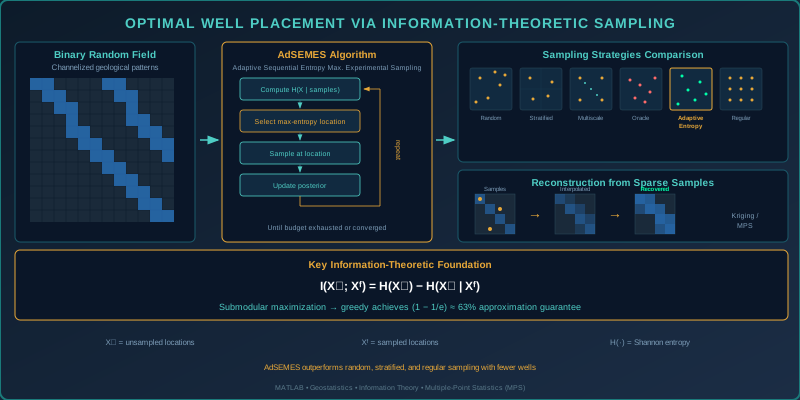
This project implements the AdSEMES (Adaptive Sequential Empirical Maximum Entropy Sampling) algorithm for optimal spatial sampling in binary random fields, specifically channelized geological reservoirs. It is the computational companion to my doctoral thesis and published papers in Mathematical Geosciences and Natural Resources Research.
The core problem
| Given a limited budget of K measurements on a binary random field X of size H x W, where should you sample to minimize posterior uncertainty about the field’s structure? The problem is formalized through Shannon entropy: the optimal placement f* = argmax_f H(X_f), which is equivalent to minimizing the posterior uncertainty min_f H(X^f | X_f) since H(X) = H(X_f) + H(X^f | X_f) by the chain rule. The combinatorial search over C(H*W, K) candidate sets is NP-hard, but since entropy is a monotone submodular function, the greedy algorithm (AdSEMES) achieves a (1 - 1/e) ~ 63.2% approximation guarantee to the optimal solution (Nemhauser, Wolsey & Fisher, 1978). At each step, the algorithm selects the next sampling location that maximally reduces the conditional entropy of the unobserved field, estimating conditional probabilities P(X_i = 1 | neighbors) through multi-point pattern matching against training images. |
Implementation
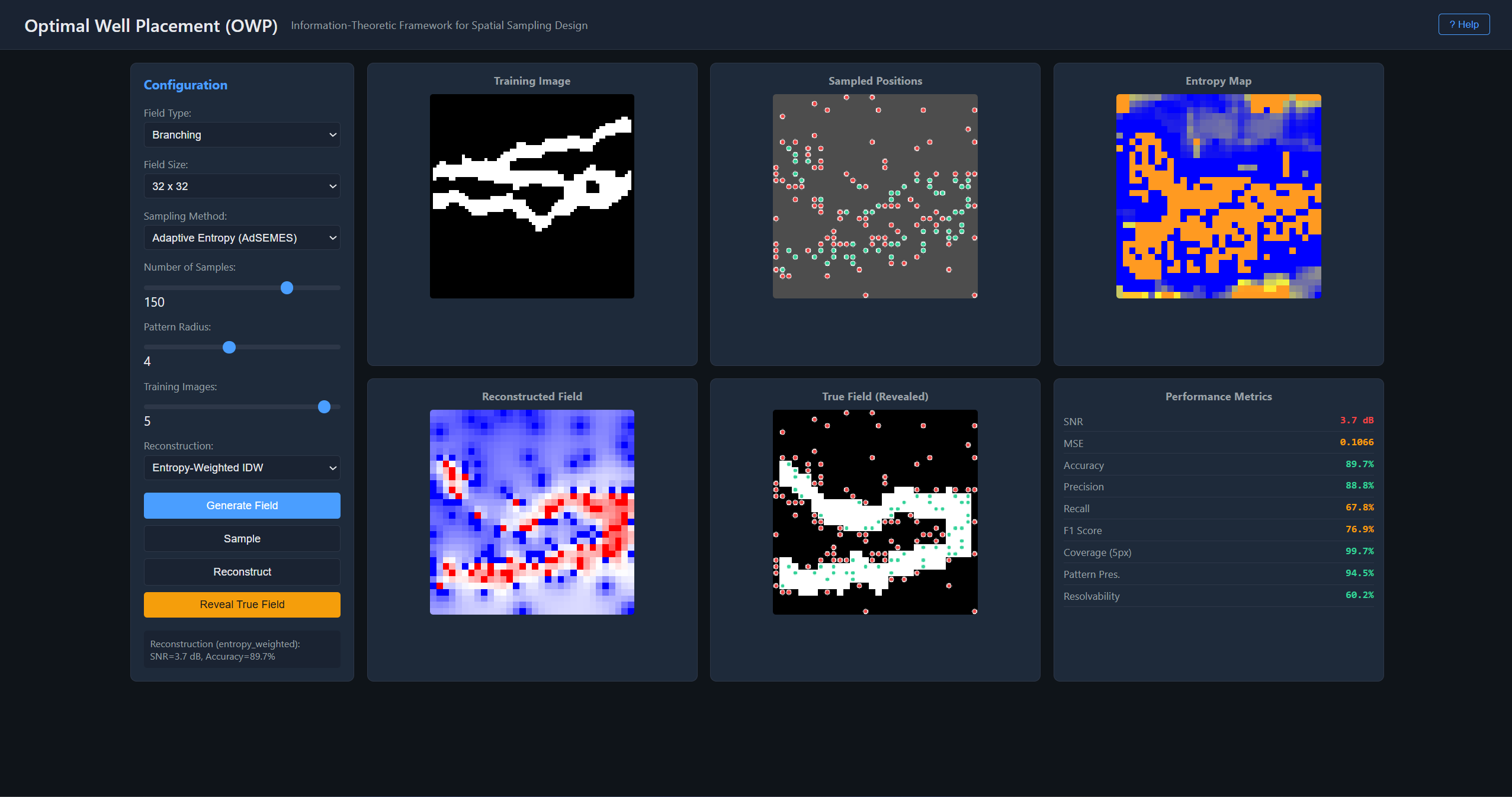
The system implements six sampling strategies for comparison: random, stratified, multiscale, oracle (full-information upper bound), adaptive entropy maximization (AdSEMES), and regular grid. A Gaussian spatial penalty function H_penalized(i’) = H(i’) * (1 - alpha * exp(-d^2 / (2R^2))) prevents the locality trap where greedy selection clusters samples in one region, and a hybrid two-phase approach seeds stratified samples for minimum coverage before running the adaptive phase. Three reconstruction methods recover the full field from sparse observations: nearest neighbor interpolation, indicator kriging (solving the kriging system Cw = c with exponential variogram), and entropy-weighted inverse-distance reconstruction. Synthetic field generation covers multiple geological patterns – single channels, branching systems, and multi-channel configurations. Performance is evaluated through SNR (dB), classification accuracy, and resolvability capacity C_k = I(f*_k)/H(X) that quantifies the fraction of total field uncertainty resolved after k measurements.
Origin and modernization
This work was developed during 2014-2016 at the IDS Group (Information and Decision Systems), Universidad de Chile, under Fondecyt Grant 1140840 (PI: Prof. Jorge F. Silva). The original MATLAB codebase has been modernized as a Python/FastAPI web application with interactive visualization of the sampling process and reconstruction results.
Live application
▶ Live demo, owp.fasl-work.com, optimal sampling visualizer, AdSEMES algorithm in action.