
Synthetic Geology
Published:
Synthetic geology
Added three new geological field generators to the optimal sampling framework. The existing channelized and branching models were good for testing the entropy-based sampling algorithms, but they only captured one type of geological pattern. Real mineral deposits have much more variety.
New field types
Porphyry copper deposit: Concentric rings with radial veins, mimicking the alteration zones around a copper porphyry intrusion. The center is offset randomly to avoid the algorithm “learning” that the interesting zone is always in the middle.
Vein networks: Thin branching structures generated by random walks with 5% branching probability at each step. These are the hardest for regular grid sampling to capture, the veins are narrow and the information is spatially concentrated along sparse linear features.
Faulted blocks: Angular fault-bounded domains with distinct properties in each block. The faults are linear discontinuities that regular sampling often misses entirely unless a sample happens to land near the boundary.
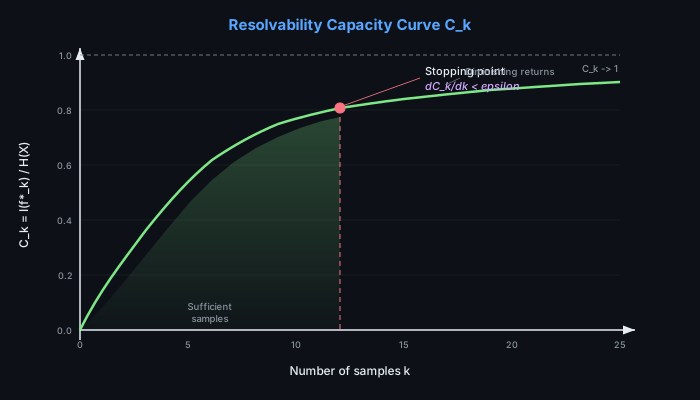
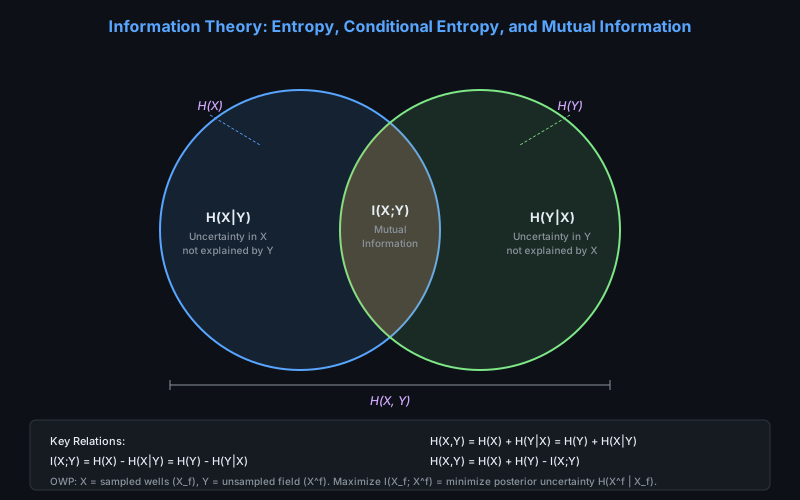
Given N measurements, where do you place them to minimize H(Xf | Xf)?
H = posterior entropy. Xf = sampled locations. Xf = unsampled field.
The adaptive entropy algorithm (AdSEMES) should excel on veins, it concentrates samples along high-uncertainty boundaries, exactly where the thin structures are. Regular grids waste most of their budget on empty background.
Also built a comparison page where you can see all field types side by side with different sampling strategies. The visual difference between random sampling and entropy-driven sampling on a vein network is striking.
The porphyry generator uses np.sin(r * 0.3) > 0.3 for the concentric rings and np.sin(angle * k) > 0.7 for radial veins, where k is randomly chosen between 3 and 8. Simple trigonometry producing surprisingly realistic-looking alteration halos.
Here’s the adaptive sampling algorithm in action on these fields: