
Environmental Monitoring & Mitigation System
Published:
An environmental monitoring system that combines computer vision, predictive modeling, and Generative AI to detect, forecast, and mitigate pollution events at mining operation sites.
Business impact
The system achieved a 15% reduction in severe environmental alert events, shifting the operation from reactive incident response to proactive pollution mitigation. Natural-language recommendations made the system accessible to non-technical operators and environmental managers, removing the interpretive barrier between predictive analytics and operational action.
| Metric | Result |
|---|---|
| Alert reduction | 15% fewer severe events |
| Forecast horizons | 1-hour and 6-hour predictions |
| Video streams | 24 continuous camera feeds |
| Recommendations | Natural language, real-time |
Strategic context
Environmental compliance in mining is not optional, it is a license to operate. Regulatory violations can halt production, generate fines, and damage community relationships irreversibly. This system transformed environmental management from reactive (respond after the alert) to predictive (act before the event), protecting both surrounding communities and operational continuity. The integration of Generative AI for operator-facing recommendations was a deliberate decision to maximize adoption by the people who actually control dust-generating activities.
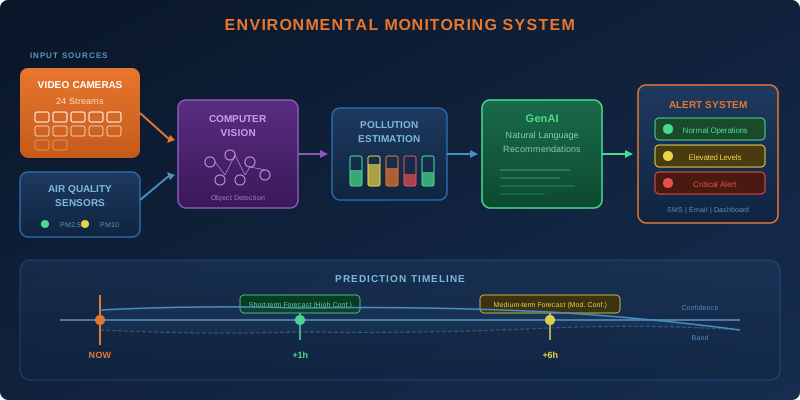
Key Performance Indicators, Process impact
The system transforms environmental management from reactive alerting to prescriptive anticipation, expanding the decision window from minutes to hours.
| KPI | Baseline (reactive) | With system | Impact |
|---|---|---|---|
| Response paradigm | Reactive: response plans triggered post-peak | Prescriptive: anticipate mitigation measures 1-3 hours ahead | From damage control to prevention |
| Decision window | Minutes (after alert fires) | 1-3 hours (forecast-based) | Time for planned, cost-effective mitigation |
| Management approach | Passive alert monitoring | Active tools for early management and mitigation planning | Operational ownership of environmental outcomes |
| Spatial coverage | Sparse fixed sensors | 24-stream video + sensor fusion | Dense pollution map, not point measurements |
The challenge
Open-pit mining operations generate airborne particulate matter that can impact surrounding communities and worker safety. Traditional monitoring relies on sparse sensor networks with significant spatial gaps and delayed reporting. Events can escalate from acceptable to critical levels faster than manual response protocols allow.
Approach
The system operates in three integrated stages:
1. Real-time estimation
24 video camera streams are processed continuously using deep learning models (convolutional neural networks trained on labeled visibility/opacity data) to estimate pollution levels across the operational area. The vision models perform regression from image patches to concentration estimates, calibrated against co-located particulate matter sensors. This provides spatial coverage far beyond what point sensors alone can achieve, creating a dense pollution map updated in near real-time.
2. Predictive forecasting
Time-series models generate forecasts at 1-hour and 6-hour horizons, combining current pollution estimates with meteorological data, operational schedules, and historical patterns. This gives operators advance warning to take preventive action before events reach critical thresholds.
3. Intelligent recommendations
A Generative AI module synthesizes the current situation, forecasts, and operational context to produce natural-language recommendations, specific, actionable guidance written in the language that operators and environmental managers actually use. Instead of abstract dashboards, they receive clear instructions adapted to the current operational state.
Results
- 15% reduction in severe environmental alert events
- Shift from reactive to proactive mitigation strategies
- Real-time spatial pollution maps complementing fixed sensor networks
- Operator-friendly natural-language guidance replacing complex dashboard interpretation
Technology stack
- Vision: Deep learning models for video stream analysis
- Prediction: Ensemble time-series models with meteorological integration
- GenAI: Large language models fine-tuned for operational context
- Infrastructure: Streaming pipelines on Azure Databricks
This project is part of proprietary corporate work. Source code is not publicly available.