
Entropy and Sampling
Published:
The adaptive entropy sampling algorithm is starting to converge to something useful. The idea is simple in principle, place your next measurement where the posterior uncertainty is highest, but implementing it efficiently on large fields with complex spatial dependencies is another story.
Spent the last month implementing the conditional entropy estimator from scratch in MATLAB. The multiple-point statistics backend is slow but it works. Comparing against regular grids and random sampling, the information-theoretic approach consistently recovers the field better with fewer samples. The (1-1/e) approximation guarantee from the submodularity property is elegant, theory and practice agreeing for once.
Professor Silva’s guidance on the information-theoretic formulation has been invaluable. This might actually become a publishable framework.
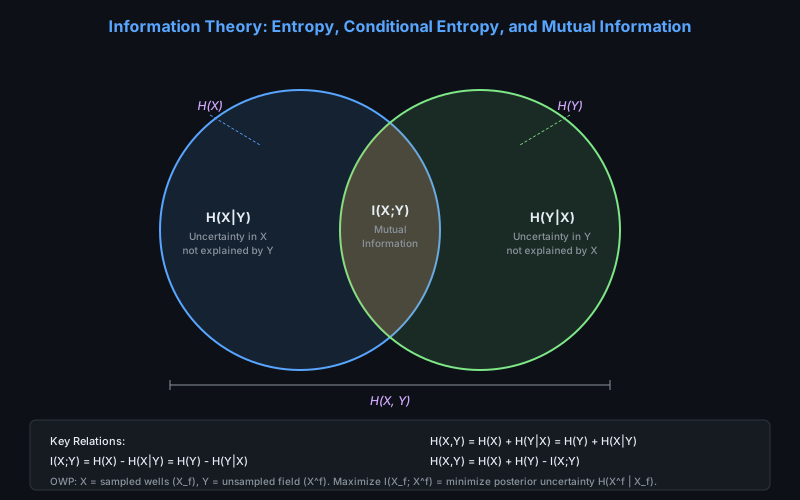
H(X|Y) = H(X,Y) − H(Y)
Posterior uncertainty decreases as we sample