
Professional Internship Supervision: Geotechnical Risk Prediction in Underground Mining
Professional internship supervision, Accenture Industry X – Mining Operations, 2026
Supervision and mentoring of a 9-week professional internship (Práctica Profesional) for an Industrial Civil Engineering student, focused on the industrialization and scaling of a geotechnical risk prediction system for underground mining operations.
The problem
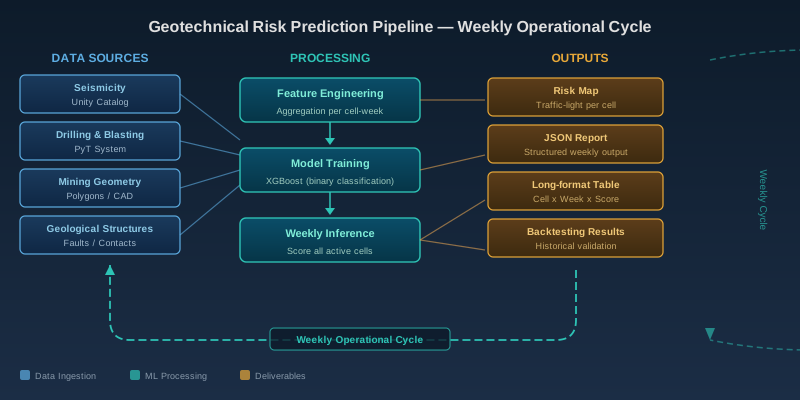
Underground mining operations face inherent geotechnical hazards. Rock mass under stress can fail suddenly, events known as rockbursts, creating risks for personnel and infrastructure. Traditional monitoring relies on seismic sensor networks and expert interpretation, but the volume and complexity of data often exceed what manual analysis can handle in operational timescales.
The challenge is to transform raw seismic monitoring data into actionable, weekly risk assessments that support tactical decisions: where to inspect, where to restrict access, and how to adjust blasting sequences to manage induced seismicity.
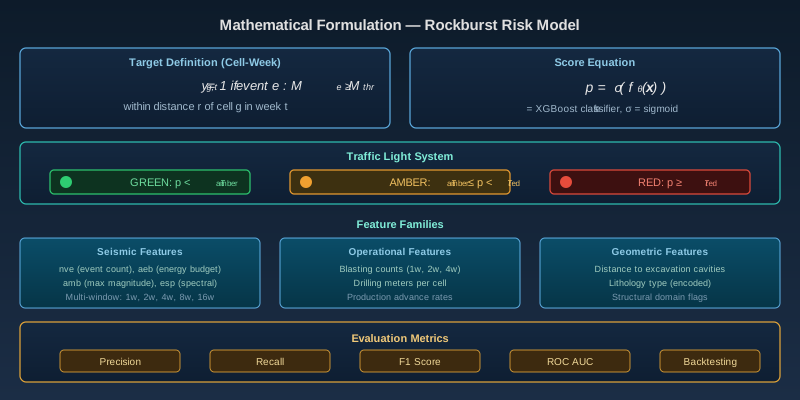
Mathematical formulation
The system operates on a spatial grid where each cell is classified weekly as safe or at-risk. The target variable for cell $g$ in week $t$ is defined as:
\[y_{g,t} = \mathbb{1}\left[\exists\, e : M_e \geq M_{thr} \;\land\; d(e,g) \leq r \;\land\; t \leq t_e < t + 7d\right]\]where $M_e$ is the event magnitude, $M_{thr}$ is the relevance threshold, and $r$ is the spatial neighborhood radius. The model produces a probability score $p = \sigma(f_\theta(x))$ that feeds a Traffic Light System (Green / Amber / Red) calibrated per sector.
Feature engineering
Features are constructed from four data families:
- Seismic: event counts, accumulated radiated energy, seismic moment, maximum specific energy, corner frequency, distance-time propagation ratios, aggregated over spatiotemporal windows (e.g., 30 days, ±50m)
- Operational: drilling and blasting event counts and magnitudes at 1-day and 7-day horizons
- Geometric: distances to cavities and active faces, sector geometry
- Geological: lithology group encodings, structural complexity (fault counts by type)
The baseline model uses XGBoost with weighted log-loss to handle severe class imbalance (~1:100), evaluated on Precision, Recall, F1, and ROC AUC.
Internship scope and deliverables
The internship combined two complementary tracks over 9 weeks:
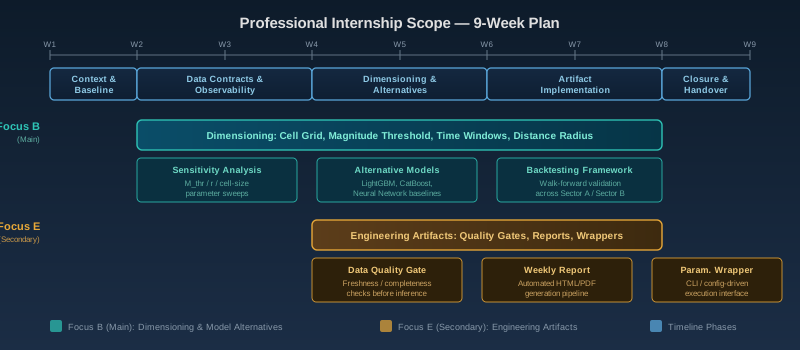
Focus B (Principal), Dimensioning and Design:
- Operational diagnosis of the current system (dependencies, failure points, data freshness)
- 2-3 industrialization alternatives with trade-off analysis
- Capacity dimensioning (Data Science / Data Engineering / Platform roles per milestone)
- Roadmap with priorities and risk assessment
Focus E (Secondary), Executable Artifact: The intern selected and implemented one of three options:
- Data Quality Gate: validates critical inputs before publication, applying severity-based gates
- Weekly Automated Report: generates performance packages (metrics, drift detection, input freshness)
- Parametrized Wrapper: standardizes execution with full traceability and version control
Outcomes
The intern delivered a comprehensive industrialization roadmap, a functional artifact integrated into the weekly operational cycle, and documentation enabling continuity for subsequent development phases. The work demonstrated how a well-structured internship can contribute meaningfully to production-grade ML systems while providing the intern with exposure to the full lifecycle of an industrial data science product.
Intern
Martín Puebla, Industrial Civil Engineering, Professional Practice (2026)
Personal reflection
This internship was supervised as part of my work at Accenture Industry X, within a project for a major underground mining client. It was my first time designing a structured mentorship program around a production ML system, and it required a different kind of teaching than lecturing in a classroom.
The main challenge was translation: taking a complex, evolving machine learning system (with its messy data pipelines, domain-specific feature engineering, and operational constraints) and decomposing it into a coherent 9-week learning experience that was both educational and productive. The intern needed to understand enough of the system’s architecture and domain context to contribute meaningfully, without getting lost in the full complexity that the team had built over months.
What surprised me was how much the process of mentoring clarified my own understanding. Explaining design decisions to someone encountering the system for the first time forced me to articulate assumptions I had internalized and question choices I had stopped examining. The intern’s fresh perspective also surfaced blind spots in documentation and workflow robustness that the team had overlooked.
The most satisfying outcome was seeing Martin deliver work of genuine production quality, artifacts that were integrated into the operational cycle, not discarded after grading. That distinction matters: it meant the internship was not a simulation but a real contribution, and the intern left with the experience of having built something that runs in production for a mining operation.