
When the Deep Model Loses to Physics
Published:
When the Deep Model Loses to Physics
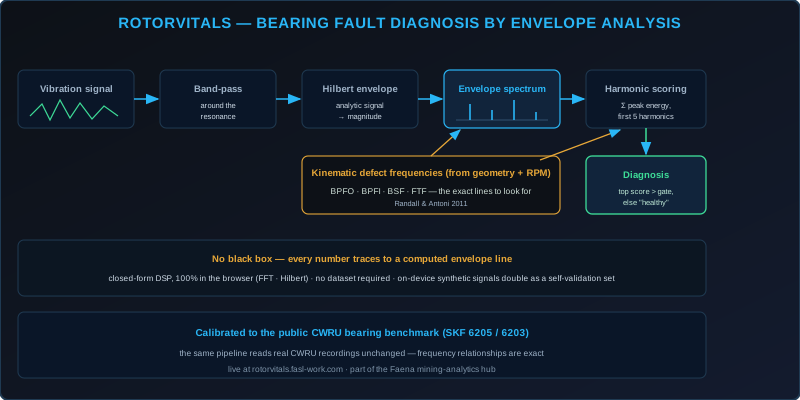
RotorVitals has grown well past the “envelope analysis of a bearing” it started as: it now runs a source selector over real measured data (CWRU, Ottawa, MaFaulDa for diagnosis; FEMTO/XJTU/IMS run-to-failure for prognosis), a learned WDCNN classifier and autoencoder, and a four-model remaining-useful-life ladder, all live in the browser. But the result I keep coming back to isn’t the deep model winning. It’s the deep model losing, in a way worth showing.
I trained a WDCNN on the Case Western (CWRU) bearing rig and then asked it to work on a different rig, the MFPT set. It fell apart:
the CWRU-trained WDCNN scores near chance (~49%), with 0% recall on outer-race faults, it calls them "normal".
The training-free envelope/SES analysis, reading energy at the correct MFPT defect frequencies, transfers almost perfectly on the same files.
There’s a matching story within CWRU: the network trained only on 0.007″ faults nails 0.021″ but collapses on 0.014″ (27.8%) (an atypical signature, not a bug. The lesson I put on screen, rather than assert: deep learning wins in-distribution, physics wins out-of-distribution. It’s exactly the kind of thing a single flattering accuracy number would hide, and it’s the reason I show the SNR-robustness curve and the cross-dataset transfer test instead. The RUL side is a real ladder too) closed-form first-passage, particle filter, Gaussian process, deep-RUL CNN, benchmarked over 36 real run-to-failure trajectories, where the Gaussian process gives the lowest aggregate error and the transparent exponential is a close second. Bearings-first, honestly scoped, in the browser · source.