
A Mill’s Power Without a DEM Run
Published:
A Mill’s Power Without a DEM Run
The charge inside a tumbling mill is where a concentrator spends most of its energy, and its behaviour (where the load cascades, where it cataracts onto the toe, when it centrifuges) usually gets studied one of two ways: a static textbook diagram, or a heavyweight discrete-element (DEM) simulation. I wanted the fast, tunable middle, so I built ChargeCascade: move a slider and watch the regime and the power move, live in the browser.
The thing I want to be precise about is that the authority is closed-form physics, not a particle solve. The engine implements the published equations exactly and recomputes on every change:
Nc = 42.3 / √(D − d)
# Davis departure: cascade → cataract → centrifuge
cos α = φc² · (r / R)
# net power = centre-of-mass torque arm
P = ω · M · g · arm (Hogg-Fuerstenau · Morrell-form · Bond)
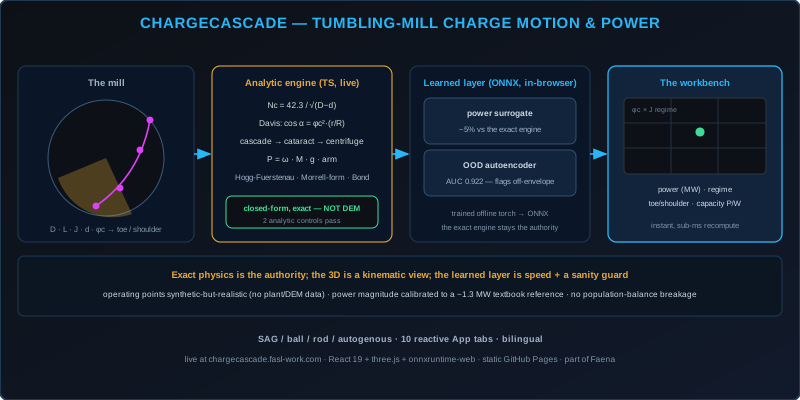
The 3D is a kinematic animation of that engine, I say so plainly, because it is not DEM and pretending otherwise would be the whole point missed. Two exact analytic controls keep me honest: an empty mill has to draw 0 kW, and at critical speed the charge has to centrifuge; both pass. On top, a small ONNX layer adds convenience without authority: a power surrogate (about 5% off the exact engine) for instant envelope sweeps, and an out-of-distribution autoencoder that flags when you’ve dragged the sliders somewhere the training envelope never went. The operating points are synthetic-but-realistic and the power magnitude is calibrated to a ~1.3 MW textbook reference, not to a real mill, it’s a design-intuition studio, and it stays inside those lines. Part of the Faena hub · source.