
Seven more mining tools crossed the bar, each with a negative result on it
Published:
Seven more mining tools crossed the bar, each with a negative result on it
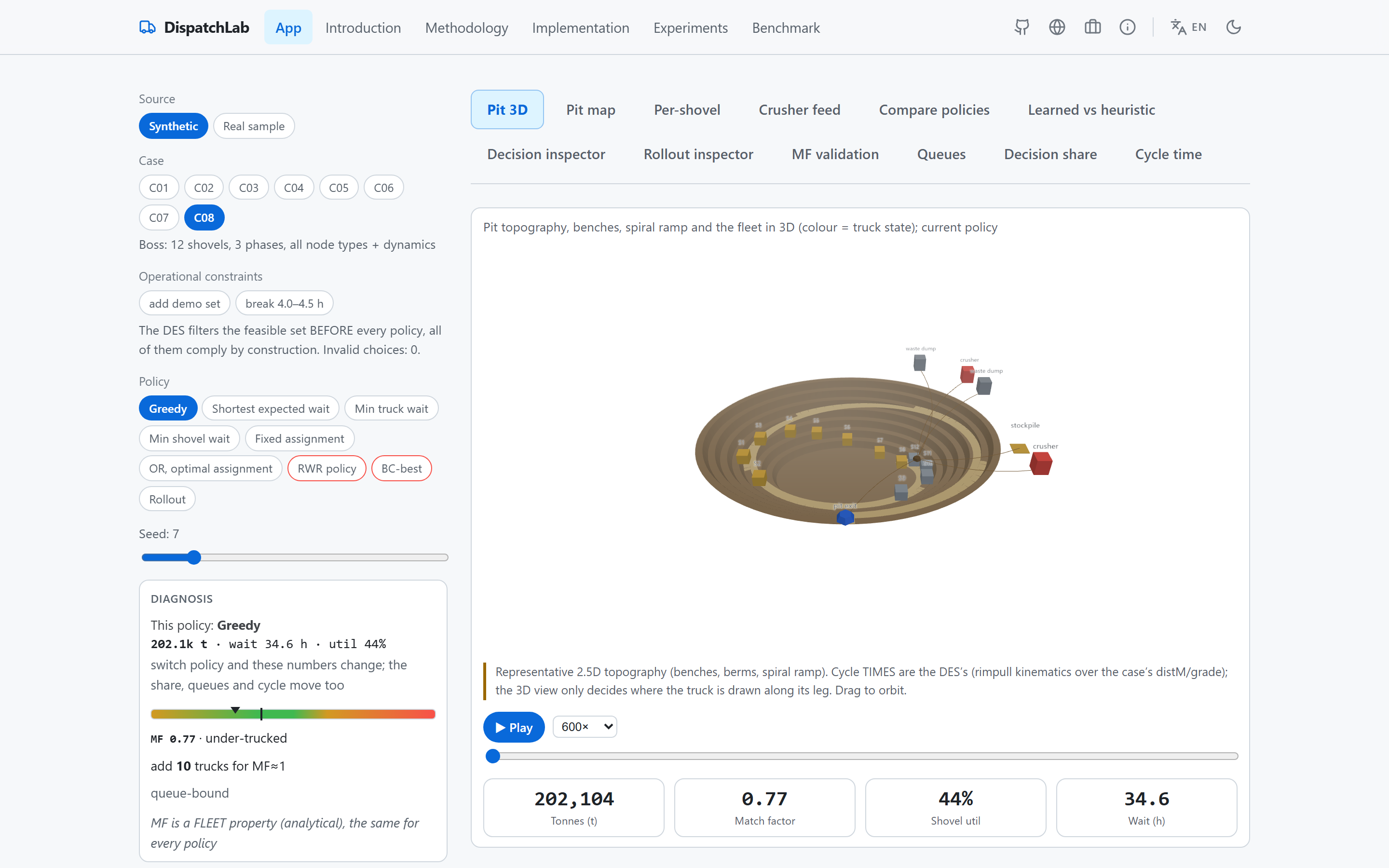
The Faena hub went from three live tools to eleven. The seven that just crossed the bar span most of the value chain: TailWatch (InSAR ground deformation), DispatchLab (truck-shovel dispatch), ChancaDEM (crusher comminution), CoreLog (drill-core lithology), PitForge (ultimate pit limit), ProspectMap (prospectivity) and FragmentIQ (fragmentation).
What I want to note is not that they are live. It is what each one puts on screen when the learned model does not help:
TailWatch: the classical velocity map (AUC 0.968) beats the learned anomaly autoencoder (0.898).
DispatchLab: the Monte-Carlo rollout policy wins 0 of 8 seeds under cycle-time uncertainty.
PitForge: the grade neural net loses to ordinary kriging (R2 0.8757 vs 0.9333); it never beats it.
ProspectMap: on real MVT data, a trivial distance-to-deposit null (0.783) ties the best model.
ChancaDEM keeps its name honest too: despite "DEM", the engine is a closed-form population balance, and the 3D chamber is a kinematic animation, not a physics solve.
Each tool still has its exact or classical core doing the real work (a Dinic min-cut solving PitForge’s pit to within 2e-9 of three published MineLib optima; a Whiten population balance calibrated to ten HP500 crusher surveys; a Fukuzono inverse-velocity forecaster with conformal bands). The learned layer sits on top and is measured against that core, in public, including when it loses. That is the whole point of building them this way: a single flattering accuracy would hide exactly the thing an operator needs to know. Eleven live, the rest planned, honestly counted.