
Two More Labs, and the Honesty Tax
Published:
Two More Labs, and the Honesty Tax
Two more open, in-browser labs are live, and both made me pay what I’ve started calling the honesty tax, the cost of reporting the result that doesn’t sell.
QLab is a quantum-computing lab that runs the real frameworks (Qiskit, PennyLane, Cirq, Stim) on 20 worked cases, and for each one it runs the classical baseline right next to the quantum one. The honest finding, with the numbers on screen, is the one nobody markets:
At lab scale, classical still wins. QLab does flag the genuinely quantum stuff (CHSH really violates the classical bound, S = 2√2 > 2) but it labels that as nonlocality, not a speedup. Every committed trace ran on a simulator; there is no real-hardware claim hiding anywhere.
The interesting engineering is the Problem × Solver shape: a method-agnostic problem meets a thin adapter over each framework, so the same MaxCut or Grover case runs through five engines and you compare them like-for-like. The browser runs an exact TypeScript state-vector simulator for the small cases (≤ 12 qubits) live; the rest are precomputed and replayed.
PINN-Lab is the other one, a runnable catalogue of 19 Physics-Informed Neural Network cases. The architecture I like: train each PINN offline with DeepXDE, validate it against an analytic / FEM / real-data anchor, export to ONNX, and then let the browser re-infer it live with onnxruntime-web. Because the physical parameter is a network input, you drag a slider and the trained network re-solves the PDE in real time.
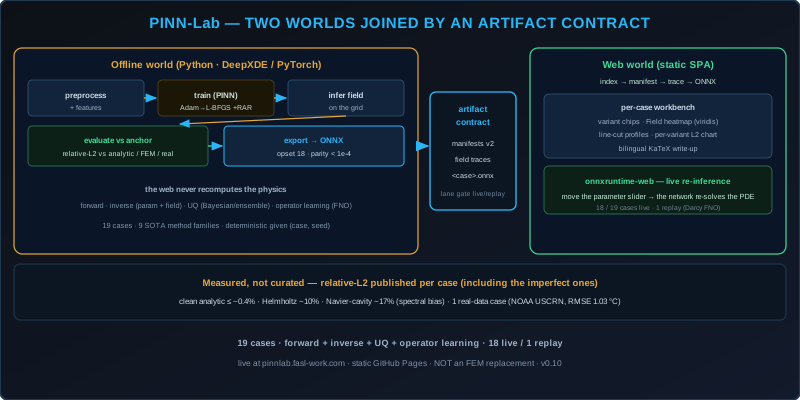
And the honesty tax again: I publish the relative-L2 for every case, including the ones that sit at the known PINN limits (Helmholtz around 10%, the lid-driven cavity around 17%) because pretending PINNs are uniformly accurate would make the whole catalogue useless as a map of where they actually work. Only one of the 19 cases is trained on real data (NOAA soil temperatures); the rest are honest synthetic anchors, labeled as such. It is not a replacement for a good FEM solver, and it says so. QLab source · PINN-Lab source.