
ProspectMap, Mineral Prospectivity Workbench with a Published Null Result
Published:
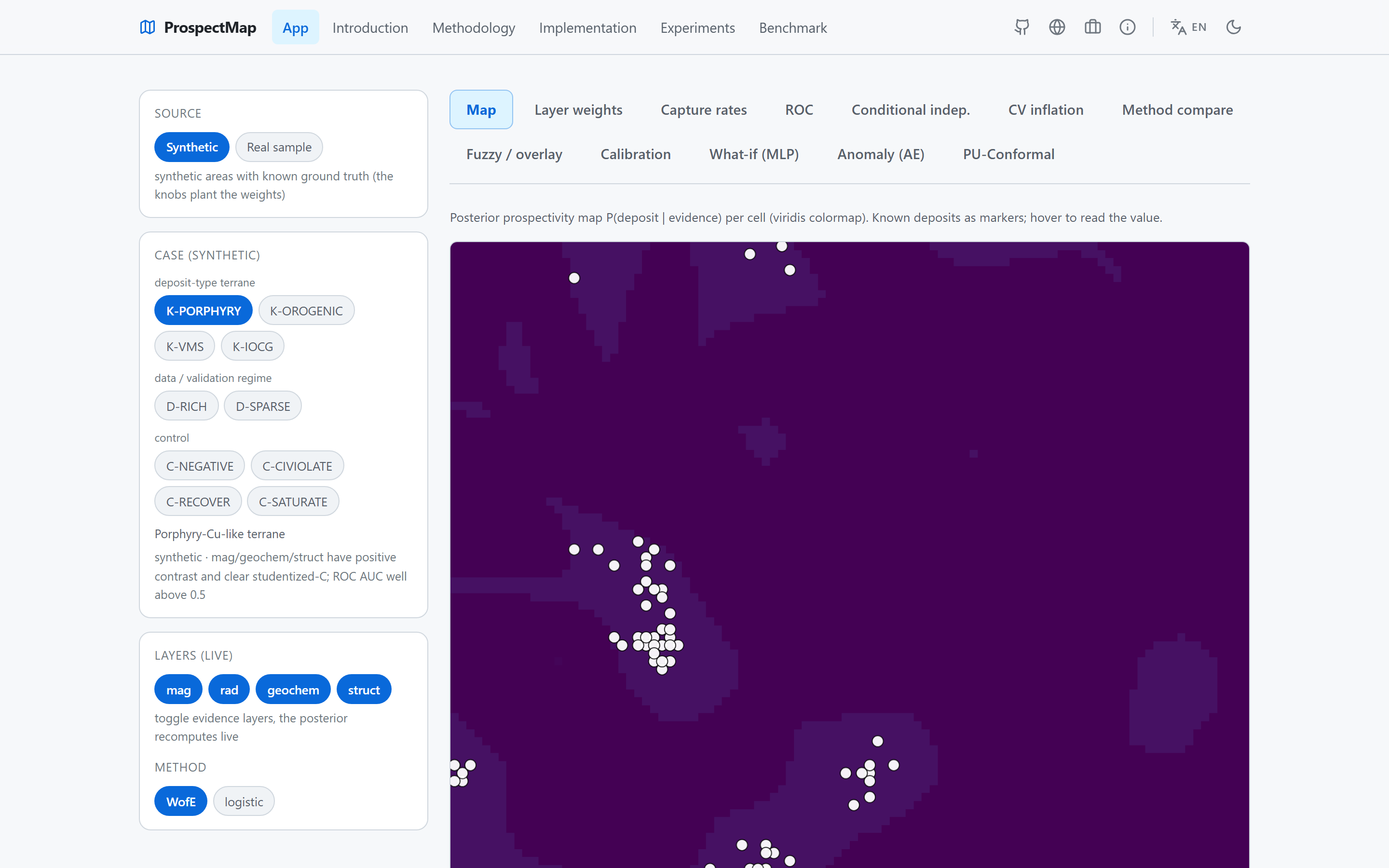
| ProspectMap is a mineral-prospectivity workbench. It computes a Weights-of-Evidence posterior P(deposit | evidence) live in the browser over stacked geophysical, geochemical and structural layers, and its reason to exist is testing its own skill: it makes first-class the two ways prospectivity maps lie (conditional-independence violation and random-CV inflation), and it publishes a recorded null result on real data. Live at prospectmap.fasl-work.com, part of the Faena mining-analytics hub. |
No AlphaEarth, no foundation-model embeddings
To be exact about scope: AlphaEarth is not used, anywhere. It appears once, in an attribution file, as a candidate future dataset. There is no embedding, no Earth Engine call, no 64-D feature in the pipeline. Random forest and gradient boosting are computed offline only; they never run live.
The real-data story is a null result
On the US Midcontinent MVT Zn-Pb belt (Lawley et al. 2022, USGS public domain; 25,344 cells, 4 real measured geophysical layers plus 2 derived proximity layers), six models are scored on identical contiguous spatial-block folds with bootstrap confidence intervals: Weights of Evidence 0.732, logistic regression 0.846, random forest 0.745, gradient boosting 0.725, naive MLP 0.783, PU-Conformal 0.656. The committed verdict is ranking_win: false: the proposed PU-Conformal method does not beat 1989-vintage Weights of Evidence. And the trivial distance-to-known-deposit null already scores 0.783, so most apparent skill is spatial proximity, not learned geology. The leaky 0.9456 headline that a lenient interleaved-fold protocol produces is never quoted.
The limit
Negative controls collapse as they must: label permutation drops WofE to 0.506 and PU to 0.490, and a pure noise layer earns zero lift. The split-conformal band delivers its coverage guarantee (empirical 0.977 vs nominal 0.90), but only by flagging 88 percent of the belt, a near-vacuous set that correctly reports that regional geophysics cannot localize MVT under spatial transfer, rather than a false-confidence point map. This is target generation with its uncertainty stated, not a JORC or NI 43-101 resource estimate.