
PitForge, Exact Ultimate Pit Limit & Nested Whittle Pit-Shell Workbench
Published:
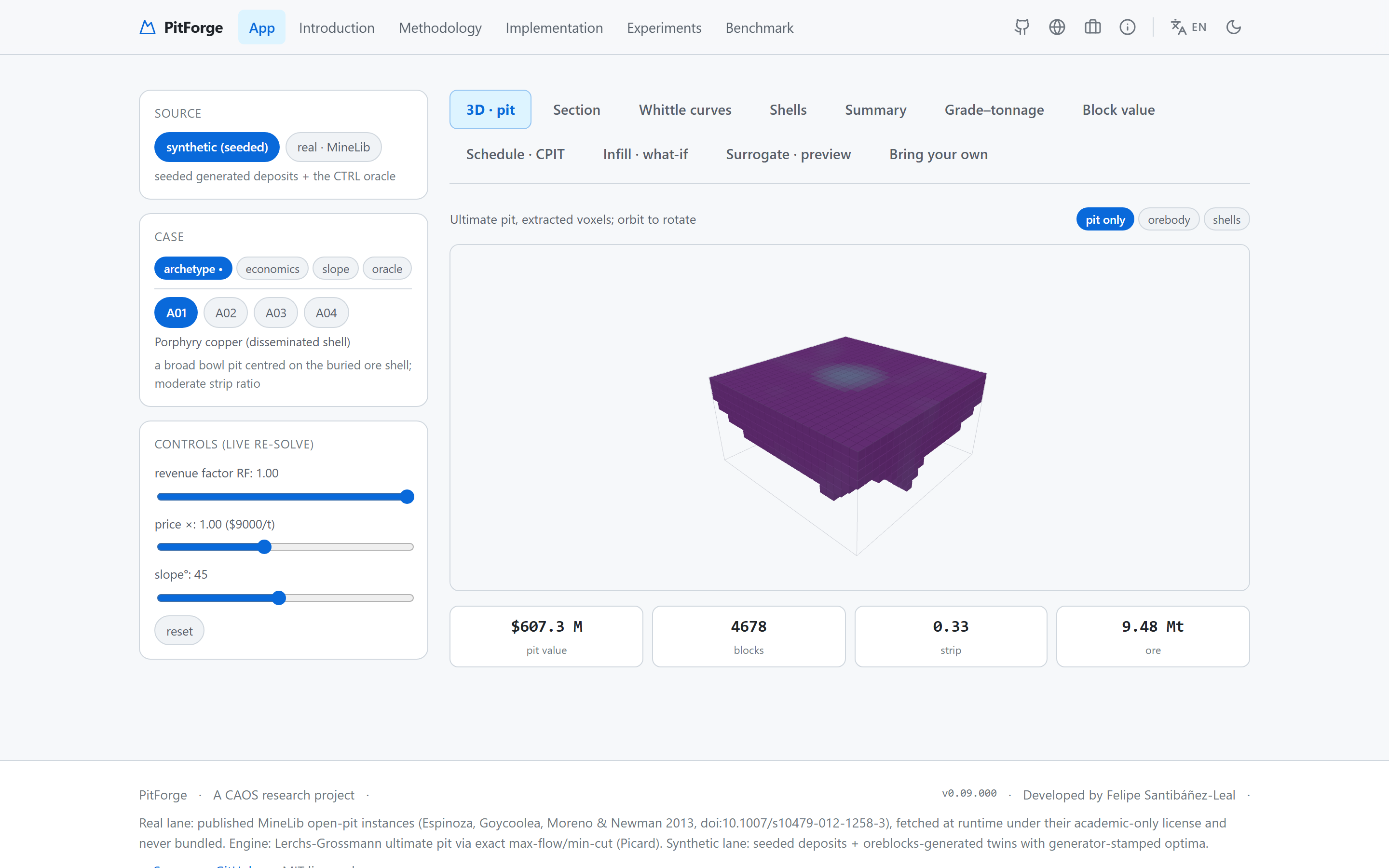
PitForge is an open-pit mine-design workbench. It solves the ultimate pit limit exactly, as a maximum-weight closure of the block-precedence graph reduced to a minimum cut on a Dinic max-flow engine, running live in the browser, and derives the nested Whittle pit shells by revenue factor. Live at pitforge.fasl-work.com, part of the Faena mining-analytics hub.
Say what the engine is
The exact result is the max-closure / min-cut equivalent of Lerchs-Grossmann, via Picard’s 1976 reduction on a Dinic engine. It is not a re-implementation of Lerchs-Grossmann. Dinic is the live engine, and an independent Hochbaum normalised-tree pseudoflow rung runs beside it, reproducing the same optimal value and the same block set on every validated instance; identical cuts are not claimed for tied optima in general. From the exact pit, nested Whittle shells over an ascending revenue-factor schedule give value, tonnage and strip-ratio curves. Grade estimation runs two ways live (IDW and a grade-nn ONNX surrogate), with ordinary kriging as the offline benchmark baseline.
Validated against MineLib, not against itself
The exact pit reproduces the published optima of three real MineLib instances: newman1 (1,060 blocks, relative error 9.96e-10), zuck_small (9,400 blocks, 1.86e-10), and kd (14,153 blocks / 219,778 precedences, 1.30e-10). They solve in milliseconds to a fraction of a second under Node on the same TypeScript engine the browser runs, though that figure is machine-dependent: repeat runs on one laptop varied by a factor of several, so the artifact records its environment and no decimal is quoted here. All three match. Three further instances (marvin, mclaughlin_limit, mclaughlin) are excluded with committed reasons rather than silently dropped. In real mode the scenario knobs are locked, because the instances publish their own net values and precedences and re-deriving them would break comparability with the published optimum.
The limit
The duality identity pitValue = sum(positive) minus maxflow is asserted in the explicit-precedence MineLib lane and displayed as a live check on the interactive lane, so the optimiser checks itself against its own dual. The learned grade-nn trails kriging: R2 0.8757 versus ordinary kriging 0.9333 and IDW 0.8591, on a split that leaves one whole geology out, and the artifact calls it a fast approximation that never beats the exact result. Both learned models are trained and evaluated on synthetic seeded deposits, with no real drillholes. Scheduling is a CPIT LP relaxation computed offline with scipy HiGHS, rendered from JSON, never live; on the published newman1.cpit scenario (6 periods, 8 percent discount, two resource constraints) it reproduces MineLib’s published LP bound to 3.7e-9 and publishes a 3.81 percent bound-to-feasible gap, with a separate synthetic twin at 11.29 percent labelled non-comparable, and it states plainly that the rounded schedule is a heuristic and is never optimal. It is a design optimiser, not a JORC or NI 43-101 resource estimate.