
FragmentIQ, Post-Blast Muckpile Fragmentation Analysis Workbench
Published:
FragmentIQ is a post-blast fragmentation workbench. It delineates muckpile fragments by watershed in the browser and derives a mass-weighted particle-size distribution with a Rosin-Rammler fit and P10/P50/P80. Live at fragmentiq.fasl-work.com, part of the Faena mining-analytics hub.
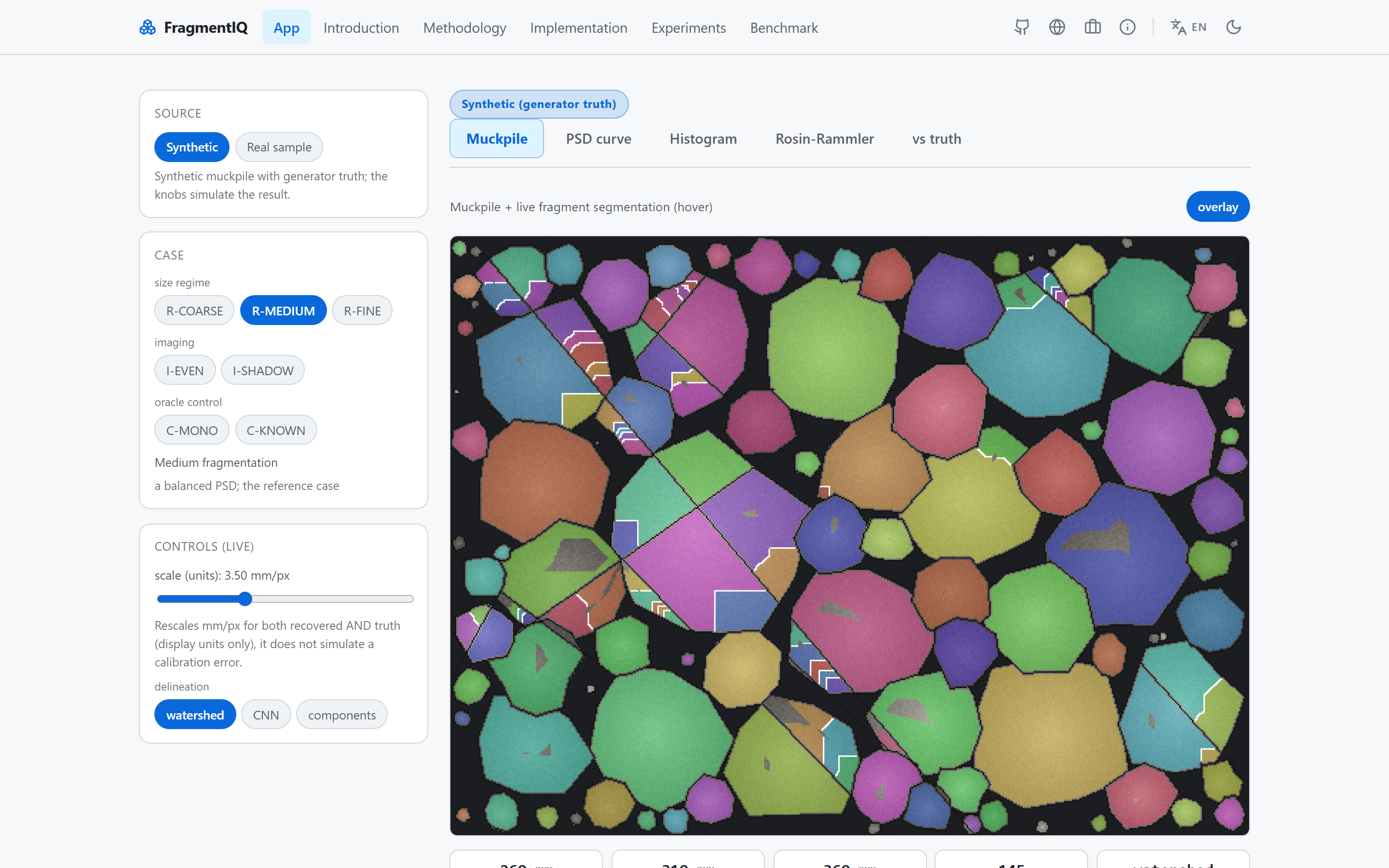
The full classical chain, run live
Grayscale foreground and Otsu thresholding, a distance transform, marker non-maximum suppression (one marker per fragment), a descending-flood watershed to labelled fragments (the WipFrag / Split-style method), connected components and morphological granulometry. Areas become equivalent diameters, percent-passing is built proportional to diameter cubed, and a Rosin-Rammler least-squares fit gives P10/P50/P80 with xc, n and r-squared. A learned frag-edge CNN (ONNX) refines the foreground to reduce over-segmentation and is the one learned model that runs live; a separate fines-bias regressor is committed but evaluated offline only.
What is cited, and what is not built
To be exact: Kuz-Ram, Swebrec and Segment Anything (SAM) are cited but not implemented. FragmentIQ fits Rosin-Rammler (which underlies Kuz-Ram) and delineates by watershed; there is no SAM, no SAM weights, no SAM inference. The real images come from a public mirror that happens to be named for SAM, and FragmentIQ borrows only the images.
The limit
The over-segmentation bias is shown directly in the artifact: on one coarse case the method recovers 116 fragments against 70 true, skewing the curve fine, a known property of image-based delineation. The learned refinement cuts P50 error 27.2 percent to 23.8 percent with boundary F1 0.9974, but this is stated as indicative not significant at n=8, with hyperparameters selected on a disjoint tune bank and reported on a disjoint test bank. And the 5 real Gole-Gohar photos (CC BY 4.0, DOI 10.17632/z78ghz96bn.1) ship as an explicitly RELATIVE lane: the scale is unset, no sieve ground truth exists, and the app says so in English and Spanish, so no millimetre P80 is ever printed for a real photo.