
CoreLog Vision, Drill-Core Logging & Lithology Classification Workbench
Published:
CoreLog Vision is a browser-native drill-core logging workbench. It classifies sliding windows along core-tray channels into six lithologies with a CNN, merges adjacent same-class patches into a depth-stitched strip log with confidence shading, and flags out-of-distribution core instead of forcing a class. Live at corelog.fasl-work.com, part of the Faena mining-analytics hub.
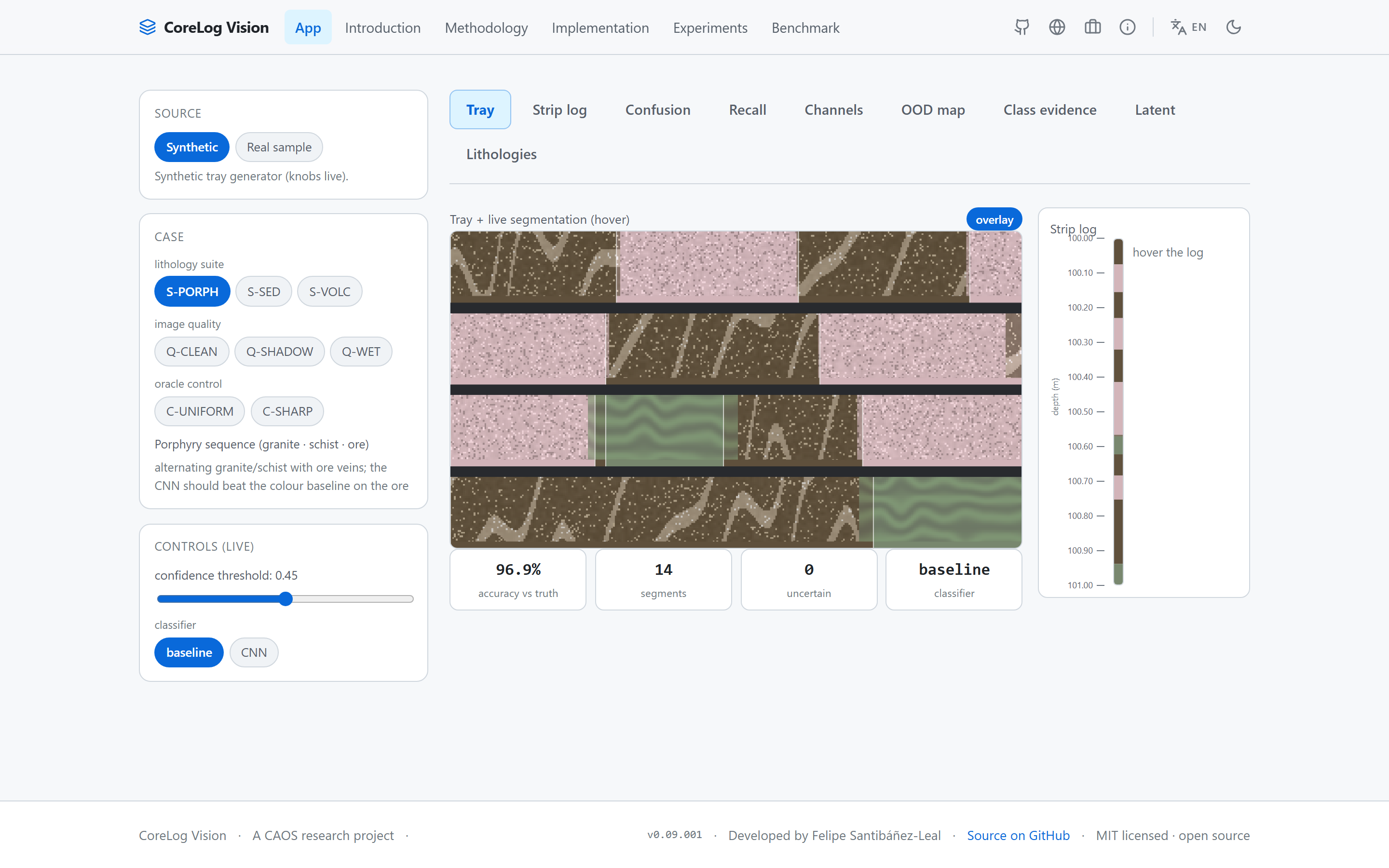
Three rungs, run live
A classical rung (a colour/texture baseline plus a run-merge segmentation that emerges from the classifier), a learned rung (the 6-class lithology CNN, ONNX, softmax plus a 64-d penultimate feature in one pass), and out-of-distribution flagging via a Mahalanobis detector in that 64-d feature space. Everything runs client-side over onnxruntime-web on the WASM backend, with a graceful fallback to the classical method if a model is absent.
What it runs on
- Synthetic trays (the main lane, and the training data): 8 procedurally generated cases, three lithology suites, three imaging-quality regimes, and two closed-form analytic controls. There is no in-app upload.
- Real DCID photos (evaluation only): the Drill Core Image Dataset is loaded as the out-of-distribution and real-head evaluation set, never as training data. 21 verbatim CC BY-NC patches are committed with DOI-level provenance.
The limit
The CNN reaches 0.994 accuracy against a 0.9286 colour baseline on a grouped-by-hole split (14 train / 4 test holes), and this is stated for what it is: synthetic-vs-synthetic, the CNN scored against the generator’s own ground truth, not real-core accuracy. A label-permutation null collapses to chance (top-1 0.1387 vs a 0.1429 baseline), the leakage control the grouped split is meant to guarantee. And the shipped OOD detector is named for what it is: a Mahalanobis detector at AUROC 0.9463, which replaced an incumbent pixel-autoencoder that scored 0.3078 (worse than chance); the offline benchmark winner (0.9995) is not the one that ships. The real DCID head reaches top-1 0.9916, but DCID-7 contains no schist and no ore class, so it is an evaluation lane, not a mine-lithology claim.