
TailWatch, InSAR Ground-Deformation Studio for Tailings Dams & Slopes
Published:
TailWatch is an in-browser InSAR ground-deformation studio for tailings dams and slopes. It renders a multi-temporal line-of-sight displacement cube (velocity, coherence, cumulative series) and runs classical failure forecasting plus two small neural nets over it. Live at tailwatch.fasl-work.com, part of the Faena mining-analytics hub.
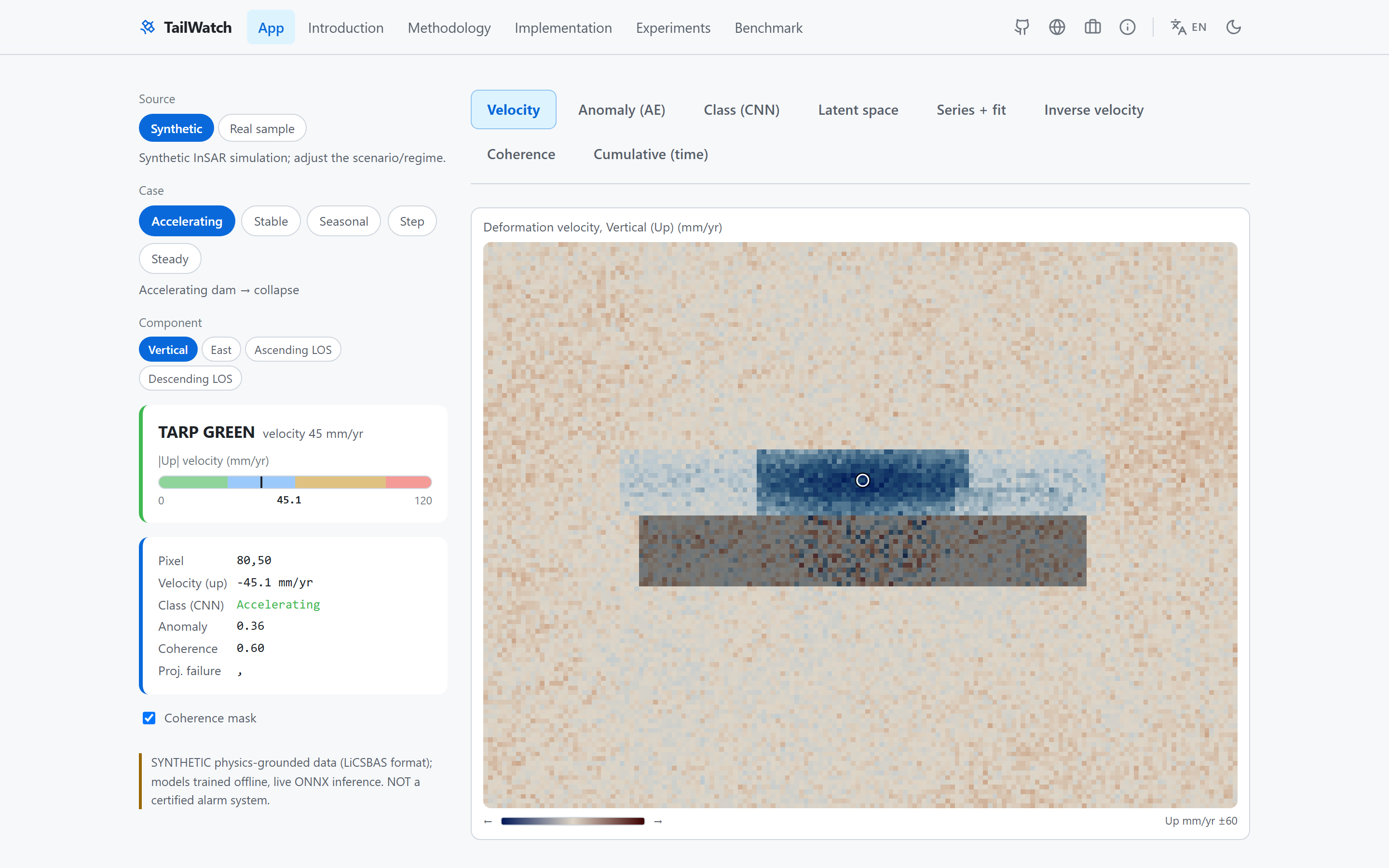
What runs on the selected case
- Classical tier (training-free): per-pixel OLS velocity with a slope t-statistic significance test, two-geometry LOS decomposition into Up and East, and a Fukuzono inverse-velocity time-of-failure forecaster (EWMA velocity, onset-of-acceleration detection, r-squared gate). A split-conformal interval (Vovk) wraps the failure time, calibrated per lead-time bucket and validated on a disjoint held-out set.
- Learned tier (ONNX, in-browser): a 1-D CNN six-class time-series classifier runs live on every clicked pixel, and a denoising conv-autoencoder trained on normal-only patches produces an unsupervised anomaly map.
The data, stated plainly
Five of six cases are simulated from a physically-grounded forward model: true 3-D motion projected on real Sentinel-1 look geometry, plus stratified and turbulent atmosphere, DEM-error, orbital ramp and coherence-driven decorrelation. Every error term is a real InSAR error source, but the dam, the pit and the collapse are invented. One case is real: a COMET LiCSAR / LiCSBAS Sentinel-1 clip over the Campi Flegrei caldera. That is a volcano, not a tailings dam, used as a domain-transfer probe, and the repo says so.
The limit
| On a held-out split the classical velocity map beats the learned anomaly detector: | v | AUC 0.968 versus the AE anomaly AUC 0.898, and the Benchmark page reports it rather than hiding it. The inverse-velocity forecaster reaches 5.7% median time-of-failure error with 0 false alarms over 60 control scenes, and the split-conformal interval reaches 0.892 empirical coverage against a 0.900 nominal. TailWatch is not calibrated to any real dam, not a real-time ingest system, and makes no full SBAS network-inversion or map-fused-alarm claim. |