
Materials-damage vision: the mask is never the deliverable
Published:
Materials-damage vision: the mask is never the deliverable
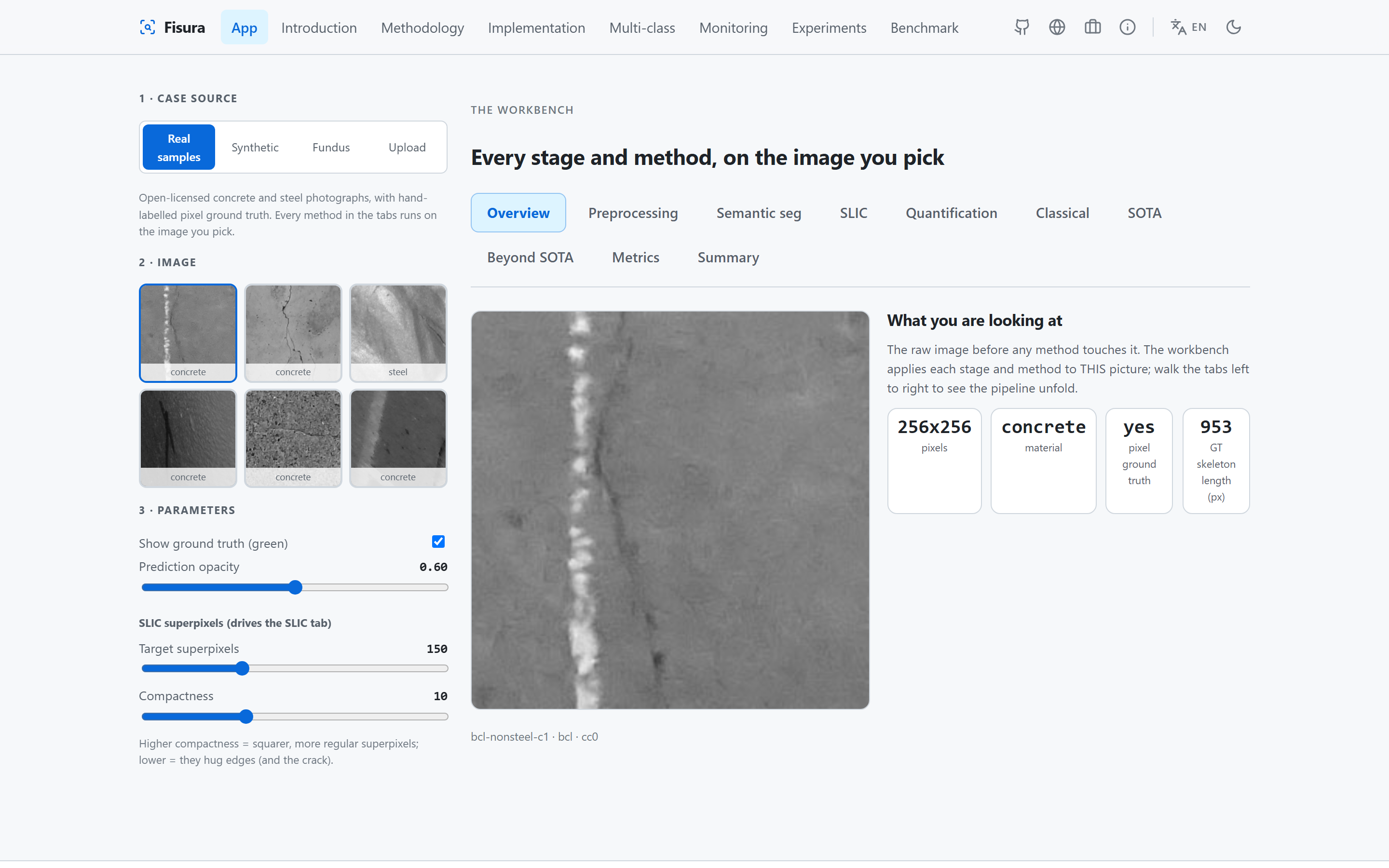
Fisura is a lab on seeing damage in built materials: one image of a concrete wall, a pavement or a facade goes in, and it detects cracks, spalling and surface defects. The thing I care about is what comes after the segmentation. Computer-vision papers stop at a mask and a benchmark score; an inspector needs a number in millimetres, with a stated method.
So masks are only ever the input to measurement: pixel-to-mm calibrated crack width and length, orientation, density, growth between inspection epochs, and vision-based deformation via 2D digital image correlation. And the method families are compared honestly on the same open cases with the same metrics.
classical pipelines (ridge filters, morphology, skeleton geometry) · learned SOTA segmentation · promptable foundation models · unsupervised anomaly detection
Accuracy and measurement reported separately. A method-comparison lab, not a certified inspection tool.
It runs an offline heavy lane plus a browser live lane where the photo never leaves the device, and it is dataset-honest: the full open datasets live outside the repo. It is under active build-out, one vertical slice at a time, and the app says so. Live · source.