
TruckVitals, Onset Detection on Haul-Truck Telemetry (Regime First, Then Residual)
Published:
Onset detection on haul-truck fleet telemetry, built on regime-conditional residuals. Live at truckvitals.fasl-work.com, part of the Faena hub.
Detect the fault, not the ramp
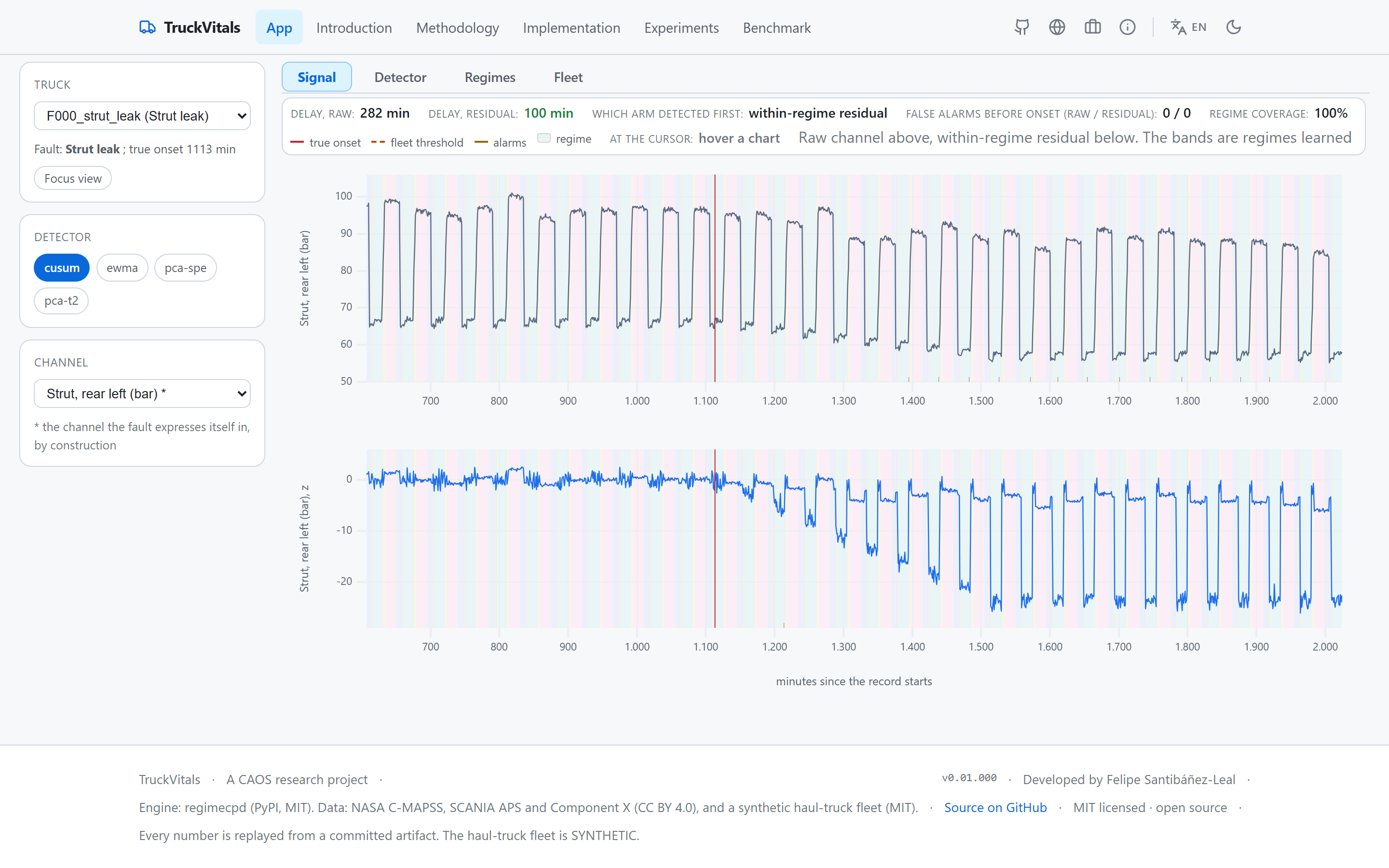
Every channel on a haul truck moves with payload, road grade and speed. Run a change detector on raw telemetry and the largest changes it finds are the truck loading, climbing and tipping. So the pipeline puts segmentation first:
raw telemetry -> REGIME SEGMENTATION -> within-regime residual -> change point -> onset
with the regimes learned from context channels (payload, grade, speed) that are disjoint from the monitored ones. That disjointness is what stops the segmentation absorbing the very fault it exists to expose.
A headline with no detector in it
The core claim is stated as an effect size, so no threshold rule, alarm convention or budget can move it. On six-operating-condition NASA C-MAPSS subsets the fault signature is 0.16 sigma of the pooled spread and 11.95 sigma of the within-regime spread, a ratio of 90.2 on one pair and 62.3 on the second. The single-operating-condition subsets return exactly 1.00, a negative control nobody designed: with one regime, the pooled and within-regime spreads are the same quantity. Detection at a matched budget is reported separately: one to six operating conditions costs 0.93 to 0.17 and 0.73 to 0.24, and regime conditioning recovers to 0.98 and to 0.70, which on the second pair is level with the single-condition reference, not above it.
What it does not claim
A published null: regime conditioning does not improve onset localisation (paired over five seeds, -0.08 ± 0.74 in chance-corrected skill, ahead in 2 of 5). A withdrawn claim: no false-alarm reduction is claimed anywhere, because on the synthetic lane the raw arm wins that metric outright. And the lane that does not exist is named: no public, redistributable dataset of continuous haul-truck telemetry with labelled faults was found, which is why onset error is measured on the synthetic lane.
The headline changed because a review was commissioned to refute it. Across eight attacks it confirmed the mechanism and broke three of the four original numbers, all three of which had flattered the result. The engine is the separately published regimecpd package; TruckVitals declares none of its own. Live · source.