
QMine, Quantum Computing Measured on Real Mining Problems
Published:
The claims around quantum computing for industrial optimization are loud and the measurements are scarce. QMine is measurement discipline for a mining company that asks whether an annealer or a gate-model device could schedule its trucks, design a flotation circuit or cut a pit: every real engine on the same instances with the same evaluation, every run denominated in money, every skip recorded with its reason, and a verdict computed from the measurements rather than written by an advocate. It is the private, provider-integrated counterpart of the public QLab.
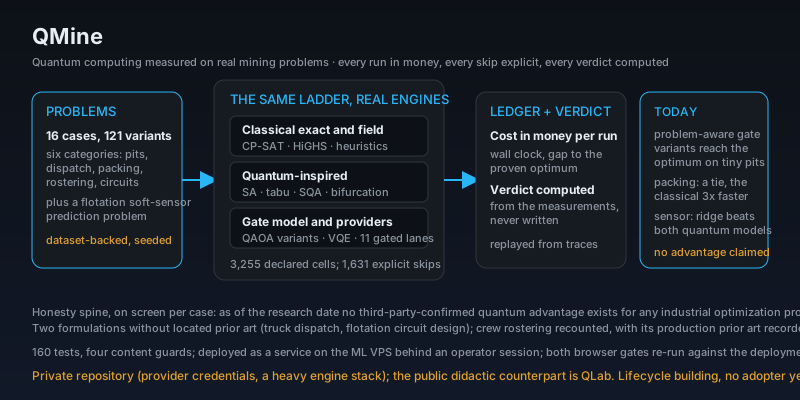
The ladder, on real engines
A Problem by Solver by Instance abstraction: a problem owns its dataset-backed instances, its audited QUBO encoding, its native constrained model with hard constraints, its evaluation and its baselines; a solver is a thin adapter over one real engine. OR-Tools CP-SAT, HiGHS, networkx max-closure and a treewidth-bounded exact decomposition; field heuristics and a random floor; dwave-samplers simulated annealing, tabu, steepest descent, path-integral quantum annealing and rotor-model annealing; dwave-hybrid; Torch simulated bifurcation; QAOA with warm-start, CVaR, recursive, DCQO and BF-DCQO variants, a hardware-efficient VQE and an independent PennyLane implementation; a quantum kernel and a variational regressor for a flotation soft sensor with leakage-safe temporal splits. Eleven provider lanes wired and credential-gated. Sixteen cases, 121 variants, 3,255 declared solver cells, baked completely with 1,631 explicit skips and zero completeness problems.
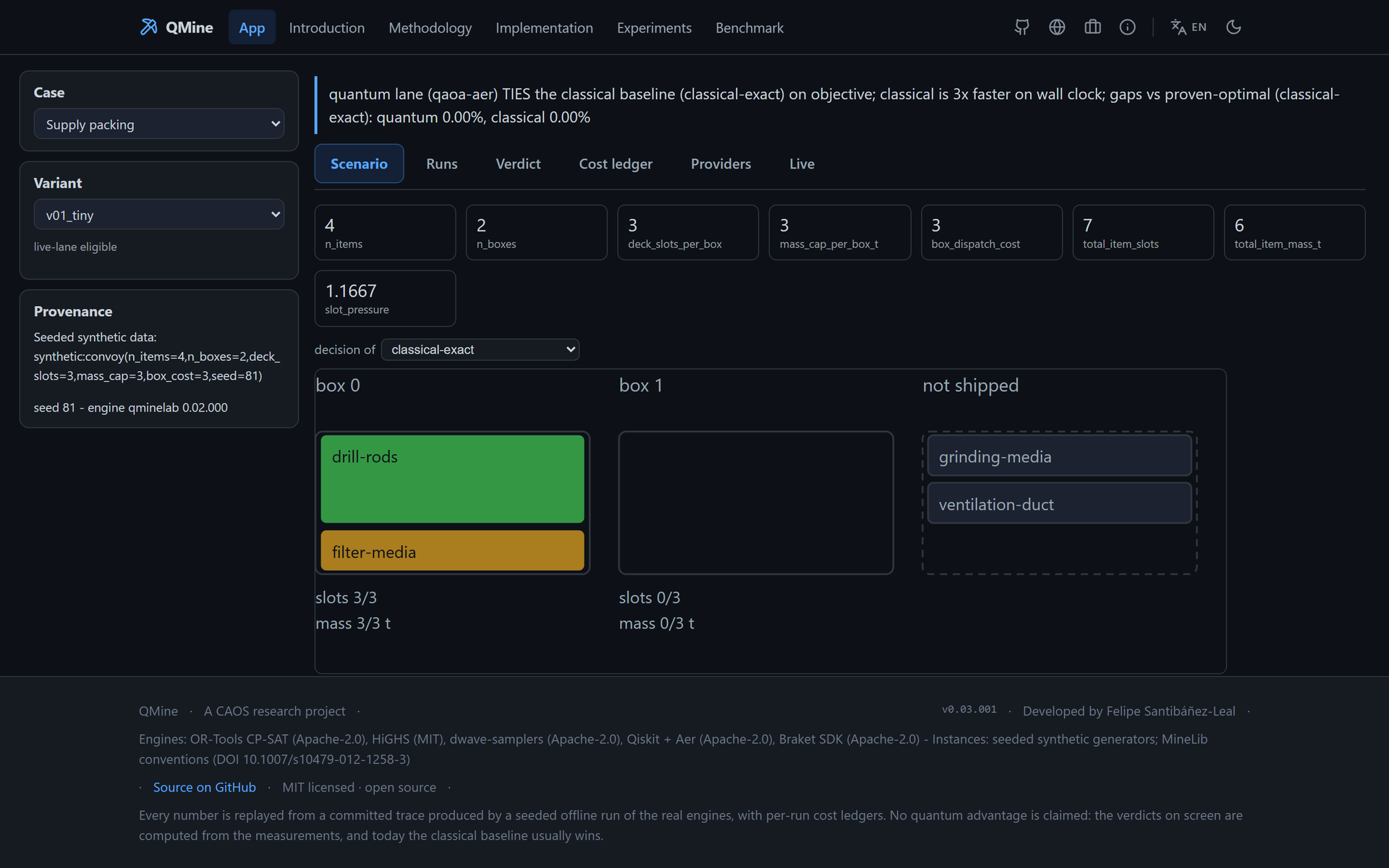
What the measurements say today
On tiny pit instances the problem-aware gate variants reach the proven optimum where plain QAOA and the problem-agnostic VQE do not; on supply packing the quantum lane ties the classical baseline while the classical solver is three times faster; on the flotation soft sensor ridge regression beats both quantum models and the quantum kernel is worse than the persistence floor. The honesty spine is on screen per case: as of the research date there is no third-party-confirmed quantum advantage for any industrial optimization problem. Two formulations have no located prior art (truck dispatch, flotation circuit design); crew rostering was miscounted as a third and its production prior art is recorded on its own case page. Deployed as a service on the ML VPS behind an operator session, with both browser gates re-run against the deployment; the repository stays private because the backend holds provider credentials. No adopter yet, and the lifecycle stays building.
Live (operator session)