
RotorVitals, Rotating-Machinery Condition Monitoring & Prognostics
Published:
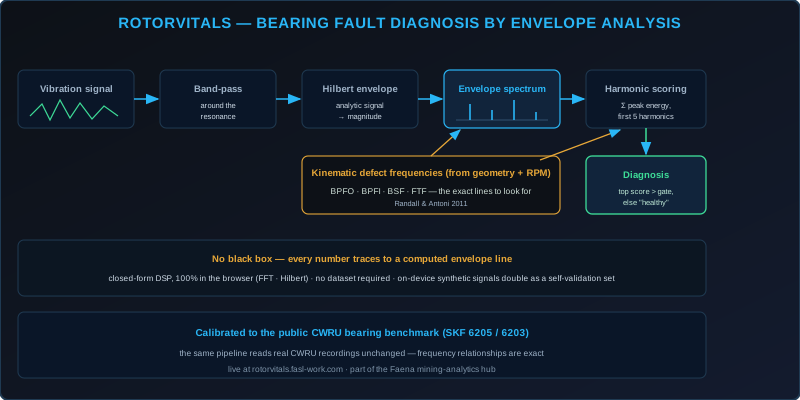
An in-browser condition-monitoring and prognostics workbench for rotating machinery, bearings-first, running on real measured vibration. Envelope analysis (the classic bearing-fault method) is now one tier inside it. Live at rotorvitals.fasl-work.com, part of the Faena mining-analytics hub.
A source selector drives the whole workbench
- Synthetic (with controls), a physically-grounded generator; fault type, severity, rpm and SNR are live knobs. Severities here are synthetic and labelled as such.
- Real: diagnosis segment: a measured window from CWRU (the classifier’s native domain), Ottawa (time-varying speed, computed-order-tracked → a real Campbell/order view), or MaFaulDa.
- Real: run-to-failure, a real trajectory from FEMTO / XJTU / IMS; a life slider scrubs measured windows healthy → failure, and RUL projects against the experiment’s true failure time.
Three tiers, run live
A classical DSP chain (envelope/SES, kurtogram, cyclostationary, cepstrum, Campbell/order, ISO zones); a learned tier (a WDCNN classifier + a deep-autoencoder health indicator, both ONNX); and a four-model RUL ladder (exponential → particle filter → Gaussian process → deep-RUL CNN), benchmarked on 36 real run-to-failure trajectories (GP gives the lowest aggregate error, ≈1 h MAE, with the transparent exponential a close second).
The model’s limits
The learned classifier is trained on CWRU and shown in-domain there; everywhere else it is cross-domain-labelled, with its failures on display: it collapses on an unseen severity (27.8%) and scores near chance cross-rig on MFPT (0% outer-race recall), while the training-free envelope analysis transfers almost perfectly. The lesson, shown not claimed: deep learning wins in-distribution, physics wins out-of-distribution. Frequency relations are exact; scope is rotating machinery, bearings-first (no gear claim).