
CutoffGrade Studio, Lane’s Optimal Cut-off Grade
Published:
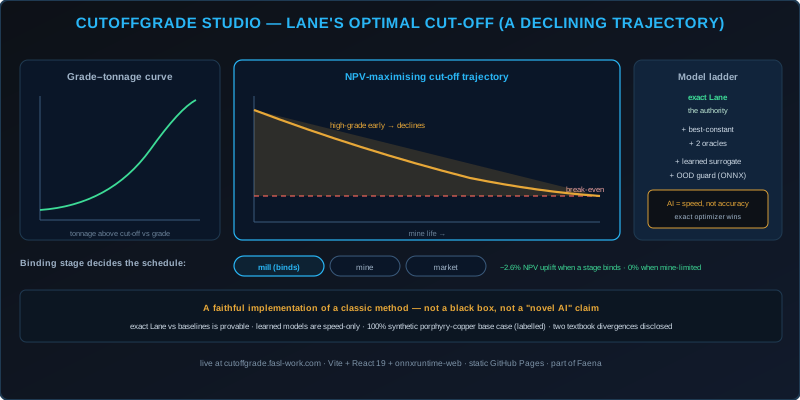
An open, explainable studio for Lane’s optimal cut-off grade, the NPV-maximising cut-off that declines over a mine’s life and is set by whichever stage (mine, mill or market) is the binding constraint. Feed a grade-tonnage curve plus prices, costs and three stage capacities, and it returns the trajectory, NPV, mine life and cashflow, live in the browser. Live at cutoffgrade.fasl-work.com, part of the Faena mining-analytics hub.
Exact method as the authority
The engine implements Lane’s method exactly, the six characteristic cut-offs, the balancing (Dagdelen) medians, and a year-by-year NPV simulator run to a fixed point, and shows it against a best-constant baseline and closed-form oracles, so the ~2.6% NPV uplift it finds when a processing stage binds (and 0% when the mine is the limit, exactly as theory predicts) is provable, not asserted. A real ten-tab workbench reacting to a case selector and live sliders, equations on screen.
The AI layer and the data
Two small models run live via onnxruntime-web, a surrogate that reproduces the trajectory instantly and an out-of-distribution guard, but they are for speed and sanity, not to improve the answer (the exact optimizer is always the authority). The base case is 100% synthetic (a porphyry-copper example, openly labelled), and the repo discloses its two small divergences from textbook Lane. A faithful classic method, made legible, no “novel-beyond-SOTA” claim.