
Laminario, an Open Collection of Microscope Slides in the Spirit of iNaturalist
Published:
Microscope slides are among the most numerous objects in natural-history and teaching collections; the Natural History Museum in London alone holds about 2.5 million. A growing share is digitised and openly licensed, but it is published as records in portals or files in deposits: nobody can browse slides as slides, across plants, animals, microbes, rocks, minerals and crystals, or add their own. Laminario is built to do both.
A slide as an object, standards on the way out
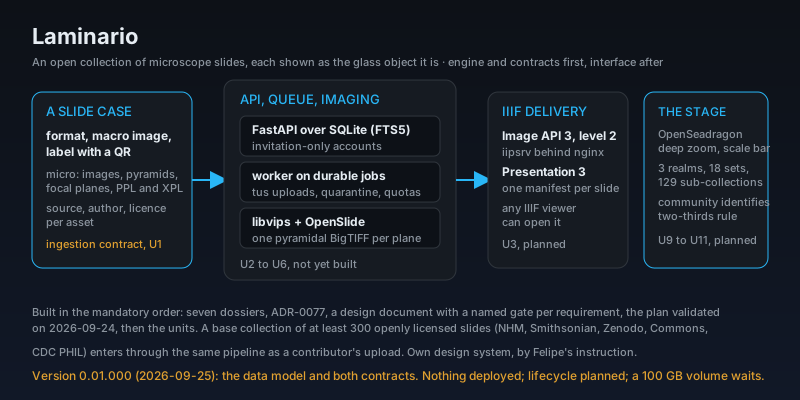
Every case is shown as the glass object it is: true format and size, the macro image under the coverslip, a printed label with a QR that opens the slide’s page; behind the glass, the micro assets, single images, deep-zoom pyramids, focal planes and polarisation states. The collection tree has three realms (life, earth, matter), 18 collections and 130 sub-collections and groups with 186 hand-drawn icons, anchored on GBIF, the IMA mineral list, the crystal systems and the materials. Imagery is written by libvips with OpenSlide as one pyramidal BigTIFF per plane and served over the IIIF Image API 3 at level 2, with a IIIF Presentation 3 manifest per slide, so any IIIF viewer can open it; multi-gigabyte scanner files (NDPI, SVS, MRXS, DICOM) arrive through resumable tus uploads with quarantine, sniffing, checksum and quotas. Source, author and licence are recorded per asset, and a base collection of at least 300 openly licensed slides enters through the same pipeline as a contributor’s upload.
Built in the mandatory order, and described as it is
Seven research dossiers, an architecture decision (ADR-0077), a design document with a named verification gate per requirement, the plan validated on 2026-09-24, then the units. Version 0.01.000 (2026-09-25) was the repository base and the data model with both contracts. On 28 and 29 September the units followed in order, each with its verdict page, up to 0.15.000: the imaging engine, delivery over IIIF, the worker, resumable uploads, invitation-only accounts, the collection tree, a base collection of 505 slides over the 18 collections from open sources (Wikimedia Commons, the Natural History Museum’s Data Portal, Smithsonian Open Access, Zenodo’s NMNH focal stacks, the OpenSlide test data; 14 whole-slide scans and a polarised pair for every rock family, each image with its licence, author, source record and SHA-256), the visual system, Explore, the slide and its stage, Contribute, Identify with iNaturalist’s community-taxon rule read from its source, the cabinet with label sheets printed at 1:1, and About. The deployment (0.16.000, 30 September) runs the API, the worker, the upload server and the tile server on the ML VPS behind HTTPS, with the base collection imported and checked file by file against its bake, and a production gate of 22 checks passing against the live site. The glass-slide interface (0.17.000) draws every set of the collection as realistic glass slides in 3D at each slide’s own format, with the photograph of the real glass where a scanner stored one, in four arrangements the visitor chooses (a carousel, a filing-cabinet drawer, a slide box, a folder), keyboard-navigable and drawn flat where WebGL is missing; 0.17.002 puts one real slide from each collection on the landing. The lifecycle is planned, and the product carries its own design system rather than the shared shell, by Felipe’s instruction.