
LDA-HSI, Wordification Design-Space Platform
Published:
The current state of the hyperspectral topic-modelling line that began as a 2022 conference paper. LDA-HSI is a local-first research and validation platform that treats spectral variability as a corpus, pixel spectra become documents of quantised spectral tokens, and then asks the question the original paper only gestured at: which “wordification” should a topic model actually see, and does that choice change the conclusions? The offline experiments are the product; the public web app is a validated projection of their outputs.
Business impact
In hyperspectral analysis almost all of the methodological attention goes to the model and almost none to the representation fed into it. LDA-HSI is built to show that the representation is not a detail, it can flip which method “wins”. By systematically sweeping 19 wordification recipes across four topic-model backbones and scoring every combination on a multi-axis battery, the platform turns an unexamined modelling assumption into a measured design space, and produces a defensible, reproducible recommendation: which recipe to use when reproducibility matters, and which when you can afford to scale topic count under a fixed backbone.
| Metric | Baseline | With platform |
|---|---|---|
| Wordification recipes compared | 1 (the field default) | 19 (V1–V15, V17–V20) |
| Topic-model backbones swept | 1 (LDA) | 4 (LDA, HDP, ProdLDA, ETM) |
| Evaluation axes | accuracy only | 12-axis battery + extended F-axes |
| Benchmark scenes | ad-hoc | 6 public labelled scenes + HIDSAG mineral subsets |
| Reproducible artefacts | , | ~1726 committed JSON/figures; live API smoke 133/133 |
Strategic context
The defensible headline is not a single accuracy record, it is a finding about methodology: the wordification choice materially changes the conclusions, and there is no universal winner. The platform identifies two poles and a non-discriminating axis, which is a more useful result for a practitioner than a leaderboard. It also demonstrates engineering maturity: a fully reproducible offline experiment grid (100% populated at the base setting), a hierarchical-Bayesian dominance test per axis rather than cherry-picked wins, and a public surface that never claims more than the artefacts support, including walking back an earlier over-claim once an internal audit caught it.
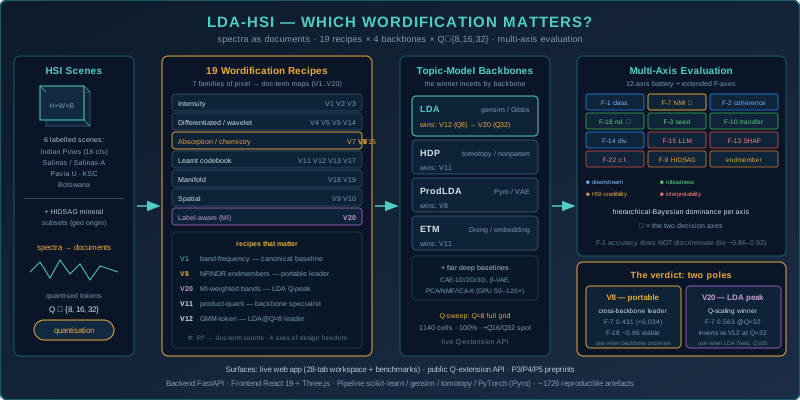
Key Performance Indicators, the two-pole verdict
| Numbers below are the audited ground truth (tie threshold | Δ | < 0.005); they deliberately avoid the retired over-claims. |
| Finding | Recipe | Result | When to use it |
|---|---|---|---|
| Portability / reproducibility leader | V8 (NFINDR endmembers) | Highest cross-backbone F-7 NMI 0.431 (+0.034 over rank 2); reseed reliability F-18 ≈0.96, stable across Q | When the backbone is uncertain or reproducibility matters |
| LDA Q-scaling peak | V20 (MI-weighted bands) | F-7 NMI climbs to 0.563 @ Q=32; trails V12 at Q=8, then the ranking inverts and V20 leads V12 by +0.030 at Q=32 (5/6 scenes) | When LDA is fixed and Q ≥ 16 is affordable |
| Backbone specialist | V11 (product quantisation) | Wins HDP (0.571) and ETM (0.530) outright, collapses under LDA/ProdLDA | When the backbone is fixed to HDP or ETM |
| Non-discriminating axis | , | F-1 macro-F1 is a tie (~0.86–0.92 across recipes); no recipe headlines an accuracy win | Don’t pick a recipe on accuracy alone |
The challenge
Comparing representations fairly is harder than comparing models. Each of the 19 recipes maps a pixel spectrum to a different doc-term vocabulary (band intensities, wavelet responses, absorption/endmember fractions, learnt codebooks, manifold coordinates, spatial regions, label-aware MI weights) and they have to be evaluated on the same footing across four very different topic-model families (a Gibbs LDA, a nonparametric HDP, and two neural variants, ProdLDA and ETM) and three quantisation levels. The platform handles this with a single offline grid (the Q=8 base is 1140 cells, 100% populated) plus a Q=16/32 spot-check, and a battery of axes (coherence, topic–label mutual information, seed stability, reliability, diversity, counterfactual robustness, cross-scene transfer, spatial coherence, endmember and LLM-judge baselines) each adjudicated by a hierarchical-Bayesian dominance test rather than a single run.
Datasets covered
Where the 2022 work used a few small private mineral sets, the platform spans a deliberately broad data surface so a representation’s win has to hold across very different sensors and scene types, Indian Pines is just the headline scene, not the benchmark:
- 6 public labelled scenes (the V-sweep panel): Indian Pines (AVIRIS, 16 classes: headline), Salinas, Salinas-A, Pavia University (ROSIS), Kennedy Space Center, Botswana (EO-1 Hyperion).
- Public spectral libraries: USGS splib07 (~2450 spectra), ECOSTRESS.
- Unmixing benchmarks (Borsoi): Samson, Jasper Ridge, Urban.
- HIDSAG mineral subsets (GEOMET, MINERAL1/2, GEOCHEM, PORPHYRY), the bridge back to the geometallurgy origin and the 2022 work.
- MicaSense MSI field samples (RedEdge-3 + Altum).
System architecture
- Input: the multi-family data surface above: six public labelled HSI scenes (Indian Pines the headline, not the only one), public spectral libraries, unmixing benchmarks, the HIDSAG mineral subsets, and MSI field data.
- Wordification (design-space fan-out): 19 recipes (V1..V20, V16 reserved) in 7 families convert spectra to doc-term counts, with a Q ∈ {8, 16, 32} quantisation knob.
- Topic-model backbones (4-way branch): LDA (gensim), HDP (tomotopy), ProdLDA and ETM (Pyro), with GPU deep baselines (CAE-1D/2D/3D, β-VAE, PCA/NMF/ICA-K) for fair K-dim comparison.
- Evaluation battery (fan-in): a 12-axis battery (classification, coherence, topic–label NMI, seed stability, reliability, diversity, counterfactual robustness, cross-scene transfer, spatial coherence, endmember baseline, LLM-judge) with per-axis Bayesian dominance.
- Surfaces: a React/Vite web app (28-tab interactive workspace + benchmarks), a public Q-extension API, the P3/P4/P5 preprints, and ~1726 committed reproducible artefacts.
Technology stack
- Data pipeline: NumPy/SciPy/scikit-learn; gensim + tomotopy (LDA/HDP/CTM/DMR); PyTorch + Pyro (ProdLDA/ETM/VAE); pysptools (NFINDR/ATGP/SAM unmixing); PyWavelets, nanopq, umap-learn, SHAP, Optuna; spectral/rasterio/h5py for HSI I/O
- Backend: FastAPI + uvicorn, ORJSON + GZip; stateless, read-only, serves committed JSON
- Frontend: React 19 + Vite 6 + TypeScript, Three.js / @react-three/fiber (3D embedding views), KaTeX, TanStack Query, XState, bilingual EN/ES
- Deployment: Hetzner VPS, nginx + systemd; ships continuously behind 133/133 API smoke checks
Live application
▶ Live demo, lda-hsi.fasl-work.com, explore the recipes, backbones, and the full evaluation battery in an interactive workspace.
View on GitHub · companion manuscripts (P3 nineteen-recipe sweep, P4 backbone factorial, P5 interpretability) in preparation.