
Finn, Personal Finance & Market Forecasting
Published:
A full-stack personal-finance and market-analytics platform: track instruments, build watchlists and portfolios, run statistical and ML forecasts, review risk, and read finance-aware news sentiment, behind a fast, server-rendered UI. What separates Finn from the average finance dashboard is what it refuses to fake.
Business impact
Finance tooling tends to split into two camps: polished dashboards with shallow analytics, or powerful quant libraries with no usable interface. Neither serves someone who wants real forecasting and risk analysis, cost-aware backtesting, and coverage of Latin American markets, which mainstream tools largely ignore, without standing up a research environment from scratch. Finn packages a research-grade analytics stack behind a clean web app, and its credibility comes from two deliberate engineering choices most demos skip: forecasts validated the way they would actually be traded, and backtests that charge the costs of trading.
| Metric | Result |
|---|---|
| Forecasting models | ARIMA/SARIMA, Holt-Winters, GARCH, Random Forest, Gradient Boosting + HMM regimes |
| Validation | Walk-forward cross-validation (no future leakage) |
| Backtesting | Transaction-cost-aware (cost_bp): net, not gross, equity |
| Market coverage | US + LATAM (IPSA universe, Chilean macro, Banco Central de Chile) |
| News sentiment | FinBERT (finance-tuned), not a general sentiment model |
Strategic context
A quant demo that defaults to US tickers and frictionless backtests looks impressive and quietly misleads (strategies that only worked because they traded for free, and accuracy numbers inflated by future leakage. Finn is built to be the opposite: a tool you could hand to an analyst because it validates forecasts the way they would be traded and charges trading costs, and relevant because it covers the markets it was built in. As a portfolio piece it demonstrates depth across time-series econometrics, portfolio optimization, NLP, and full-stack delivery) and the judgment to know which guarantees actually make a market tool trustworthy.
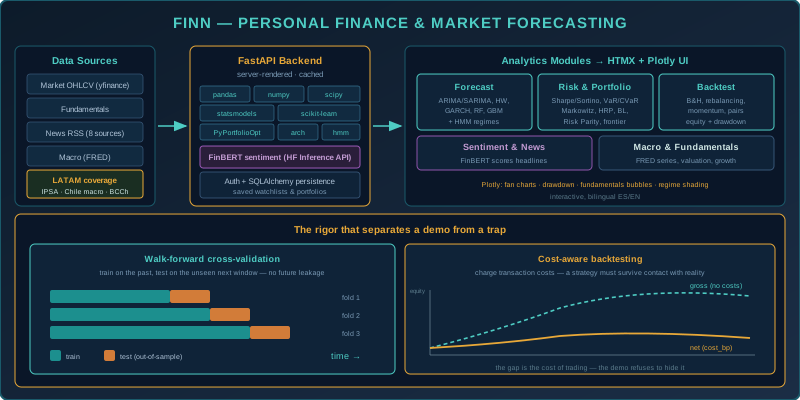
Key Performance Indicators, what makes it trustworthy
The headline isn’t a return number, it’s the integrity of the analytics behind every screen.
| KPI | Baseline (typical demo) | With Finn | Impact |
|---|---|---|---|
| Forecast validation | In-sample fit (future leaks in) | Walk-forward cross-validation | Reported error is genuinely out-of-sample |
| Backtest realism | Zero-cost trades | Transaction costs charged (cost_bp) | Strategies must survive contact with reality |
| News sentiment | General-purpose model | FinBERT finance-tuned | “missed guidance” vs “raised guidance” read correctly |
| Market coverage | US tickers only | IPSA + Chile macro + BCCh | Usable for Latin American markets |
| State | Stateless toy | Auth-backed watchlists & portfolios | Persisted, multi-instrument workflows |
The challenge
Bringing research-grade quantitative finance to a responsive web app means three problems at once: a heavy numerical stack (pandas, NumPy, SciPy, statsmodels, PyPortfolioOpt, arch, hmmlearn) that must answer fast; methodological rigor that resists the usual demo shortcuts; and a UI that stays snappy while rendering econometric charts. Finn solves the speed/weight tension with a server-rendered HTMX architecture and cached computation, and solves the rigor problem head-on: walk-forward cross-validation trains on the past and tests on the unseen next window (rolling forward, never leaking the future into the fit), and the backtester charges transaction costs, the fastest way to kill a strategy that only looked good because it traded for free.
System architecture
- Data layer: market OHLCV via yfinance, fundamentals, an 8-source financial news RSS aggregator, and macro series from FRED: plus a first-class LATAM extension (IPSA universe, Chilean macro series, a Banco Central de Chile stub).
- Analytics core (FastAPI): a quant stack exposed as cached endpoints: forecasting (ARIMA/SARIMA, Holt-Winters, GARCH, RF, Gradient Boosting; HMM regime detection), a full risk battery (volatility, Sharpe/Sortino/Calmar, VaR/CVaR), and portfolio optimization (Markowitz, HRP, Black-Litterman, Risk Parity, efficient frontier + Monte Carlo).
- Sentiment: FinBERT scores headlines via the HF Inference API and folds finance-aware sentiment into the view.
- Backtesting: Buy & Hold, periodic rebalancing, momentum, mean-reversion and pairs strategies, each evaluated with transaction costs and the full risk metric suite, reporting net equity and drawdown.
- Frontend & persistence: Jinja2 + HTMX server rendering with interactive Plotly charts (fan charts, drawdown, fundamentals bubbles, regime shading); auth-backed watchlists and portfolios persist per user; bilingual ES/EN.
Technology stack
- Backend: FastAPI, Pydantic v2, Uvicorn; SQLAlchemy persistence + auth
- Quant: pandas, NumPy, SciPy, statsmodels, scikit-learn, PyPortfolioOpt, arch, hmmlearn
- Data: yfinance, FRED / pandas-datareader, feedparser; FinBERT via HF Inference API
- Frontend: Jinja2, HTMX, Plotly.js, custom dark-theme CSS
- Deployment: systemd + nginx on a Hetzner VPS
Live application
▶ Live demo, finn.fasl-work.com, forecasting, risk, portfolios, and news sentiment in one app.
Educational demonstration: not financial advice, investment recommendation, or an offer to buy or sell.