
Fisura, Materials-Damage Vision Lab (Crack Detection to Engineering Units)
Published:
A public research lab on seeing damage in built materials. One image of a concrete wall, a pavement, a masonry facade or an industrial surface goes in; Fisura detects the damage, quantifies it in engineering units (width, length, orientation, density, growth between inspection epochs), and shows how every method family gets there. Live at fisura.fasl-work.com.
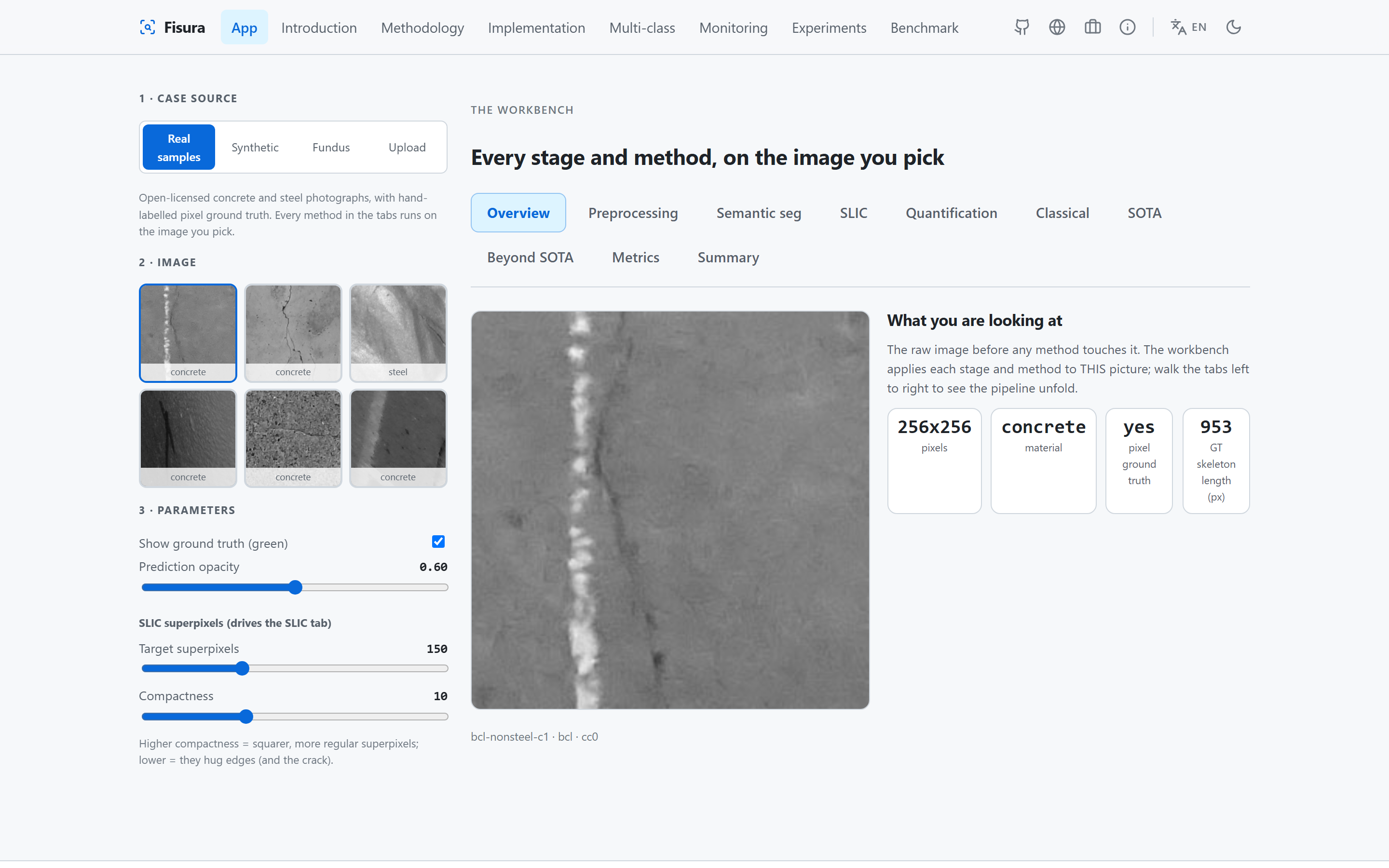
Masks are never the deliverable
Computer-vision papers stop at a segmentation mask and a benchmark score. An inspector needs a number in millimetres with a stated method. So the measurement layer turns masks into pixel-to-mm calibrated crack width and length, orientation, density, change detection across epochs, and vision-based deformation via 2D digital image correlation.
The whole ladder, compared on the same cases
Classical pipelines (illumination correction, Hessian ridge filters, morphological path operators, skeleton geometry), learned SOTA (encoder-decoder and transformer segmentation), beyond-SOTA (promptable foundation models, unsupervised anomaly detection), all on the same open cases with the same metrics, with accuracy and measurement reported separately. It runs an offline heavy lane plus a browser live lane where the photo never leaves the device. Scope: a method-comparison research lab, not a certified inspection tool, with the full open data kept outside the repo, and under active build-out one vertical slice at a time.