
Dynamic Holographic Optical Tweezers
Published:
A web application for real-time computation and visualization of holographic phase masks used in optical tweezers systems. Originally developed during my time at the Center for Optics and Photonics (CEFOP), Universidad de Concepcion, this project bridges computational optics with interactive visualization.
The problem
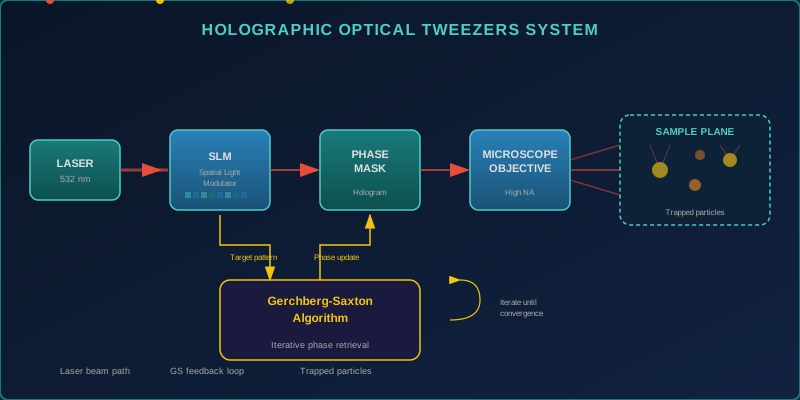
Holographic optical tweezers (HOT) use a Spatial Light Modulator (SLM) to shape a laser beam into multiple focused traps capable of holding and manipulating microscopic particles. Computing the required phase mask in real time is the core challenge: given desired trap positions in 3D space, determine the phase pattern that produces the correct intensity distribution at the focal plane.
The approach
The system implements the weighted Gerchberg-Saxton (GS) algorithm, an iterative Fourier-transform method that alternates between the SLM plane and the focal plane, enforcing amplitude constraints at each step. Weights are adjusted per trap to equalize intensities across all targets, converging to a solution that distributes light evenly among the desired positions.
Technical highlights
- Backend: Python/FastAPI serving the GS computation with NumPy for FFT operations
- Frontend: HTML5 Canvas for dual visualization — interactive trap placement and real-time phase mask rendering
- Communication: REST API + WebSocket for streaming convergence data
- Legacy preservation: The original C++/.NET version (2010) is preserved alongside the modern rewrite
- Testing: 59 automated tests covering optical computation, API endpoints, and frontend interactions
From the lab to the browser
The original implementation ran on lab hardware controlling a physical SLM. The modern version recreates the full computational pipeline as an interactive web tool, making it accessible for teaching and exploration without specialized equipment.