
Sondara: the drillholes stay on the machine, and the estimate shows its doubt
Published:
Sondara: the drillholes stay on the machine, and the estimate shows its doubt
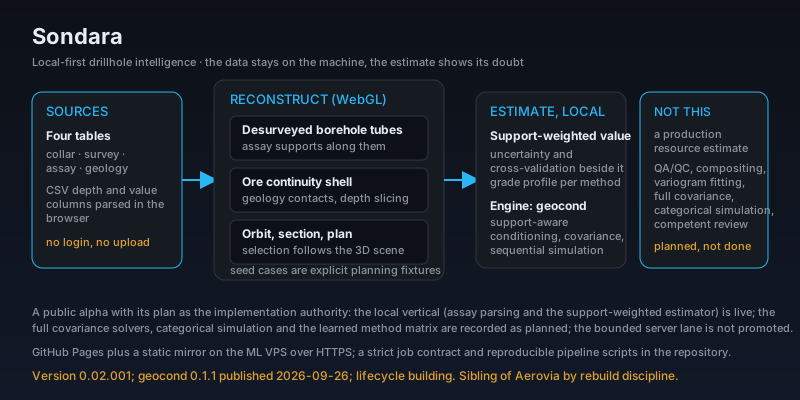
Sondara v0.2.0 is public today, with no login. Drillhole data is where a mineral project’s value is decided and where its data is most fragmented: a collar table, a survey table, assay intervals and geology logs that only make sense desurveyed together and looked at in three dimensions. The commercial workbenches that do this are desktop products; the open alternatives ask for a server or a notebook.
Sondara does the reconstruction in the browser: surveyed borehole tubes, assay supports, an ore continuity shell, geology contacts, depth slicing, orbit, section and plan views, with a selection that follows the 3D scene. The source loader parses assay CSV depth and value columns into the browser-side support set, and uploaded data stays on the machine. The local estimate action recomputes support-weighted values, uncertainty, cross-validation and the grade profile for the selected method, so the number and its doubt appear together.
QA and QC, compositing, variogram fitting, full covariance solvers, categorical simulation and competent-person review are outside the public workbench; the learned method matrix and the bounded numerical server lane are recorded as planned, not shown as done.
The spatial-conditioning engine is a separate package, geocond, with the boundary set deliberately: support-aware conditioning, covariance estimation and sequential simulation, published from its own repository; the product declares no package of its own.
A public alpha with its plan as the implementation authority, on GitHub Pages plus a static mirror on the ML VPS, grown from the same rebuild discipline as Aerovia.