FragmentIQ: 116 recovered against 70 true, and the number stays on the page
Published:
FragmentIQ: 116 recovered against 70 true, and the number stays on the page
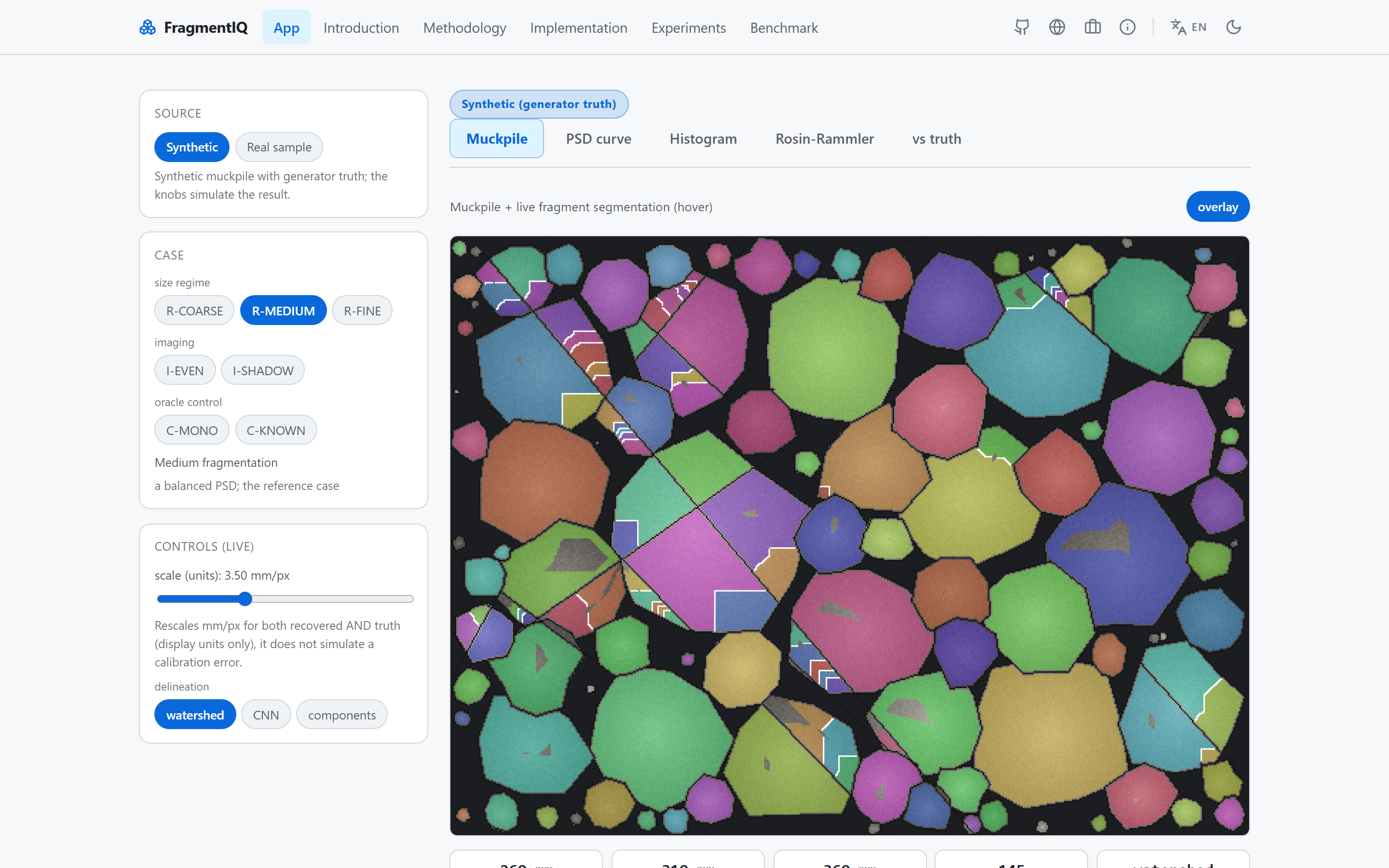
FragmentIQ turns a muckpile photograph into a mass-weighted particle-size distribution: Otsu, distance transform, marker non-maximum suppression, watershed, connected components, then a mass weighting by diameter cubed, a Rosin-Rammler least-squares fit and P10/P50/P80, live in the browser.
Delineating touching rock fragments is a problem where a method can look excellent and be wrong, so the failure is shipped in the artifact rather than described in prose:
Over-segmentation, visible in the case, not buried in a caveat.
The synthetic cases are scored against per-pixel generator truth, which is the only place an exact fragment count exists at all.
The learned layer is reported at the strength the sample size allows. A boundary CNN cuts P50 error from 27.2 percent to 23.8 percent with hyperparameters selected on a disjoint tune bank and reported on a disjoint test bank, and at n=8 that is labelled indicative rather than significant, because eight cases cannot carry a stronger word.
The real photographs get the same treatment. Five post-blast images from the Gole-Gohar iron-ore mine (CC BY 4.0) are marked RELATIVE in English and Spanish: the scale is unset and there is no sieve ground truth, so every real number is pixel-relative and none of them is a millimetre claim. Kuz-Ram, Swebrec and SAM are cited in the literature and explicitly not implemented, rather than name-dropped as if they were. Live · source.