
A shape catalogue for well tests, honest about what its labels are
Published:
A shape catalogue for well tests, honest about what its labels are
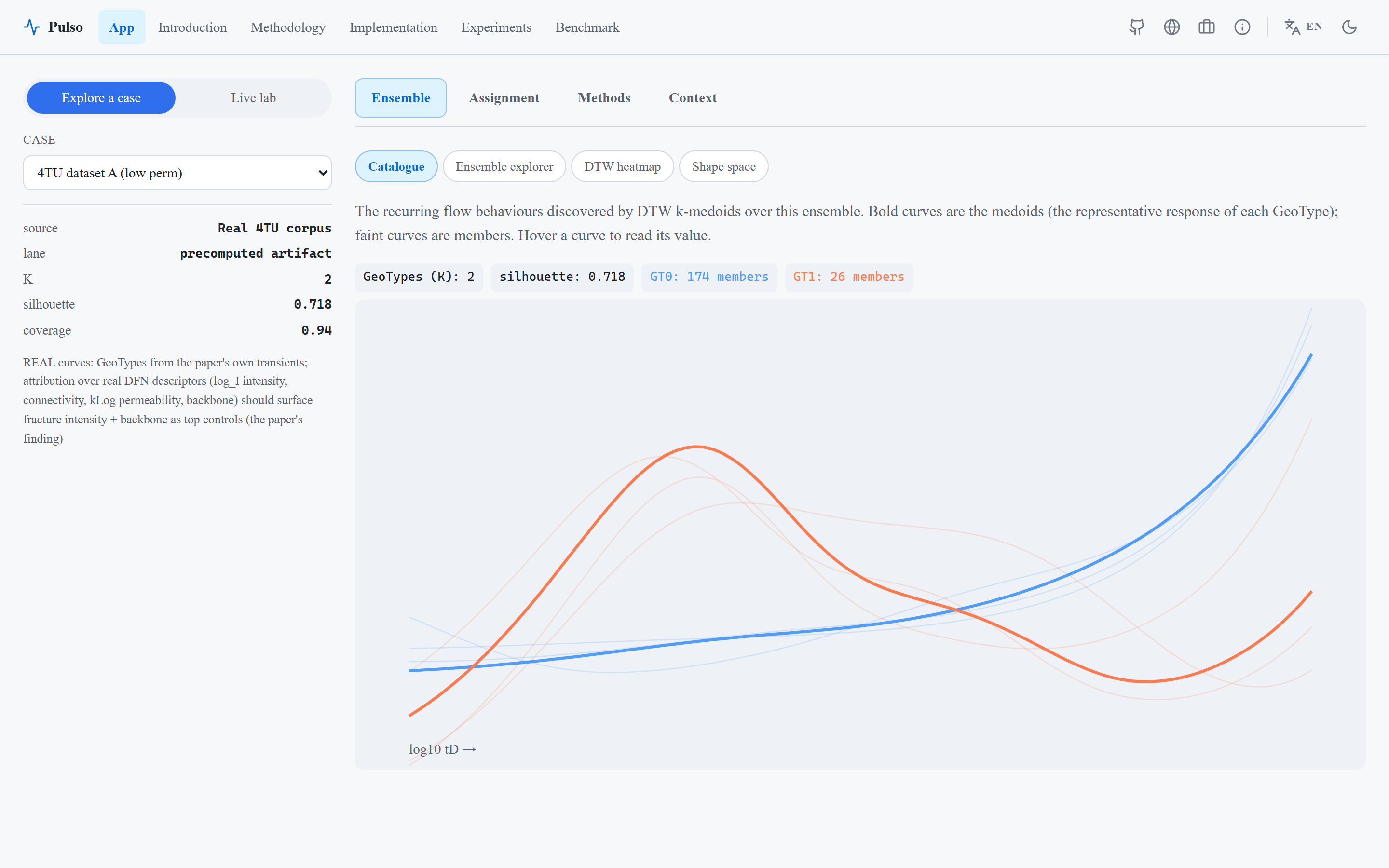
Pulso is an unsupervised catalogue of flow-behaviour classes (“GeoTypes”) for fractured reservoirs. It takes the diagnostic Bourdet derivative of a pressure-transient response, clusters the curves by shape with DTW k-medoids, and attributes each class to the fracture-network descriptors that control it. The result I want to lead with is not the clustering score. It is the caveat I had to keep attached to the learned tier.
Four neural models (InceptionTime, PatchTST, an autoencoder, an embedding) are exported to ONNX and run in the browser, and they report a good test accuracy: InceptionTime 0.911, PatchTST 0.902. That number is easy to misread. It is measured against the pipeline’s own k-medoids cluster labels, not an external ground truth, and the training-set silhouette there is a weak 0.190. So the nets are accurate at reproducing a weakly-separated clustering, not at classifying against reality. That distinction stays on the card.
The clustering itself, though, is real, and the reason I trust it is the control sitting next to it:
low-perm 0.72 · mid-perm 0.86
single-regime control 0.137 (the null: no structure, so it finds none)
A noisy family degrades to 0.172 as it should, and a DARTS analytic gate passes at relative L2 0.0108 against a 0.05 tolerance. The null is what makes the 0.72 mean something.
The corpus is real and licensed: a 4TU well-test corpus of roughly 4768 dimensionless Bourdet-derivative curves plus about 5000 DFN descriptor rows, vault-only, alongside simulated GeoDFN and open-DARTS ensembles, for 22 baked case studies. It reproduces and extends Kamel Targhi et al. 2026 (Computational Geosciences 30, 57).
Two more limits stay in view. The real low-perm case is k=2 with one rare class (a [174, 26] split), so I describe it as two behaviour classes, one rare, not a rich catalogue. And the transfer to real aquifer pumping tests is a shape-diagnostic proof only: those are a different physical system, transmissivity and storativity are unknown, and where a field site has only eight curves the attribution is skipped outright.
The physics core (Bourdet derivative plus a Warren-Root dual-porosity model via Stehfest inversion) is also the Pyodide live lane, so a pasted curve is classified against the baked medoids in the browser with conformal prediction. Live · source.