Two Lines
Published:
Two Lines
There is a specific kind of editing that happens when you take a project from the portfolio site and land it on the Research CV. The portfolio entry for Mine Pile Visualizer carries a bilingual excerpt, a challenge paragraph, an approach paragraph, three KPIs with baselines and results and impact framing, four technical metrics, a stack of eleven libraries, and a long Markdown body. The CV entry for the same project is one bullet. Two lines of LaTeX, wrapped to fit the column.
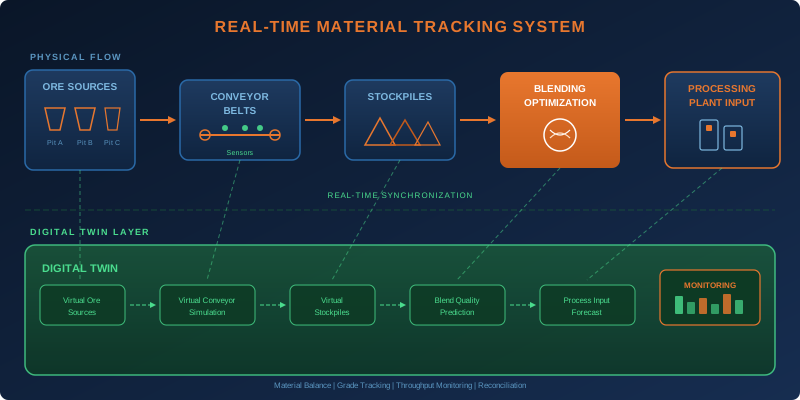
Everything you care about as a developer (the instanced mesh rendering trick, the Apache Arrow schema, the Zod runtime contracts, the dagre auto-layout) collapses into a phrase. “Local-first web platform for mining circuit topology, 3D stockpile voxels, and live material state.” The rest is compressed into what the bullet has to earn: the one specific technical claim that makes the reader’s eyes stop for a moment. Sub-second loading of thousands of voxels via React Three Fiber. That’s the hook.
portfolio excerpt (160 chars) + challenge (430) + approach (390) + 3 KPI rows + 4 metric rows → 1 cventry bullet (~250 chars)
Ten years ago I would have written the CV bullet first, from what I remembered. Today the compression direction runs the other way: rich source, curated output.
The Research CV was missing three projects today, Mine Pile Visualizer, FeelIT 2.0, and the PhD Thesis itself. All three were already on the portfolio site, the online CV, the personal website. Only the LaTeX CV was behind, because it is the surface I touch least often. The drift audit that came out of the sync runbook caught it. Two hours later, six new \cventry blocks (three each in the EN and ES variants), both PDFs rebuilt, same six-page length, no overflow. FASL_Writing_Resume#37.
The harder edit is not the LaTeX. It’s picking which technical claim survives the compression. That one you cannot automate.