
Making Equations Visible
Published:
Making equations visible
Spent the day rethinking how technical content should look on my personal website. The rollings and blog posts had been mostly text — fine for casual notes, but the engineering work I’m doing deserves better visual representation.
The approach
Created a set of purpose-built SVG diagrams for each technical topic. Not generic illustrations — these are specific to the actual algorithms and parameters in the code.
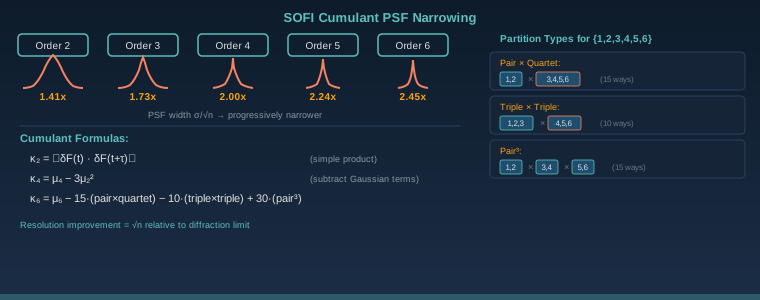
For equations, instead of plain unicode in paragraph text, I’m using styled HTML blocks that give them a visual identity:
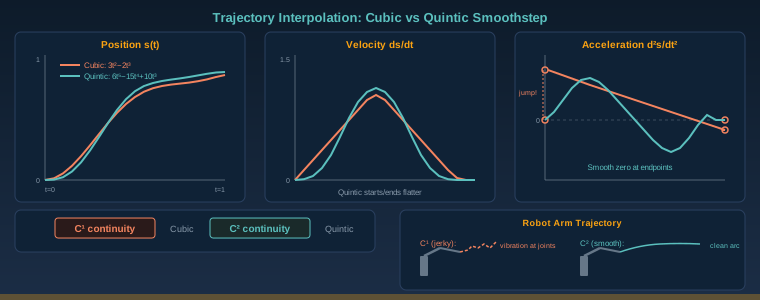
s(t) = 6t⁵ - 15t⁴ + 10t³
Zero velocity AND acceleration at endpoints: s'(0)=s'(1)=s''(0)=s''(1)=0
The difference between a rolling that says “I implemented quintic smoothstep” and one that shows the polynomial, its derivatives, and a comparison graph against cubic is significant. The reader — future me, a colleague, or anyone exploring these projects — gets a much richer picture of what was actually built.
What worked well: the dark-background SVGs with blue/teal/orange accents match the equation cards, creating a consistent visual language across all technical content. What didn’t: getting SVG rendering right across browsers required strict XML validation — no HTML entities like —, only numeric references.
Each diagram is hand-crafted to match the actual code parameters. The spring constant in the haptic simulation SVG is k=0.2 because that’s what the code uses. The phase scale α≈π comes from real SLM parameters. Nothing is generic.