
Forecasts, not predictions, two weeks of building honesty into the product
Published:
Forecasts, not predictions
The last two weeks had one quiet thread running through everything I shipped, and it wasn’t a technology, it was a discipline. Honesty, made structural. Not as a value statement on an About page, but as a gate in the pipeline that won’t let me lie even when it would be flattering to.
The clearest expression of it went live: CAOS Seismic, a probabilistic earthquake forecaster. The word is load-bearing. A prediction is a deterministic “an earthquake will / will not happen”; a forecast is a probability strictly between 0 and 1. Deterministic earthquake prediction is, by the physics, effectively impossible (Geller et al., 1997): so I built the honest alternative, Operational Earthquake Forecasting: a bounded, calibrated probability of an event in a region and magnitude band over the next 1, 2, or 7 days, always shown next to its long-term baseline.
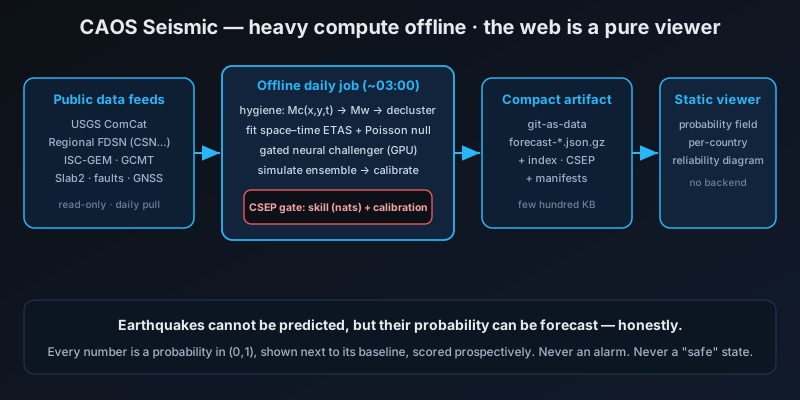
Honesty as a release gate
It is easy to say a model is good. CAOS Seismic is built so that saying it isn’t enough. Three rules do the work:
1. Calibration is a release blocker. An uncalibrated probability does not ship; the reliability diagram ("when we said 5%, it happened ~5% of the time") is the headline artifact.
2. Skill is measured, not asserted. Information gain per earthquake in nats, via CSEP, against both a Poisson null and ETAS. ROC/AUC is banned, it's blind to calibration.
3. A stronger model must earn the map. The neural challenger only replaces the ETAS baseline if it wins prospectively and stays calibrated.
This fortnight the context-conditioned neural challenger cleared the in-loop gate (+0.075 nats per earthquake over ETAS, calibrated) after I fixed a ~490× absolute-rate over-forecast by calibrating on the same grid the gate uses. It is a real result. It is also not enough: pseudo-prospective validation is still pending, so ETAS still owns the public map. The gate held even though I wanted to walk through it. That’s the point of a gate.
The same discipline, in a research surface
The seismic gate has a sibling in my hyperspectral topic-modelling work. A deep review this fortnight found that an earlier write-up had claimed a clean “triple-axis win” for one spectral representation. An audit knocked two of the three axes down to ties, and the honest, surviving claim is narrower and less impressive. I corrected it on the live app and in the manuscripts. A research surface that overclaims is worse than one that’s a little behind, because the overclaim costs you the only thing that compounds: trust. (There was also a beautiful bug, a NaN from a 0/0 in normalized pointwise mutual information was silently choosing the number of topics. Fixed by taking the analytic limit.)
And the unglamorous part
Honesty in infrastructure looks like not leaving secrets lying around. I gave a batch of my private apps a second deployment target on Azure Container Apps, dual-target alongside their VPS, with no long-lived credentials anywhere: OIDC federated identity for CI (a short-lived token exchanged at run time, nothing stored), and a user-assigned managed identity with a narrow AcrPull role so the container pulls its own image with no registry admin creds. Bicep describes it; scale-to-zero keeps idle cost near nothing. It produced no demo you can fly through, which is fine, some weeks the deliverable is that nothing can leak.
Why this is the thread
I keep relearning the same manager’s lesson: the deliverable is knowing which claims are true, and being structurally unable to ship the ones that aren’t. A forecast next to its baseline. A skill number with its uncertainty. A research result with its corrections visible. A deploy with no secret to steal. None of it is the flashiest version of the work, and all of it is the version I’d actually stand behind. The seismic product just happens to be the place where that discipline is the entire product.
Live: seismic.fasl-work.com · source · wiki.