CAOS Seismic, Probabilistic Earthquake Forecasting
Published:
A probabilistic seismic forecaster that reads the recent state of global seismicity and publishes bounded, calibrated, conditional probabilities of earthquakes over short horizons (1 / 2 / 7 days), for a region and a magnitude band, always shown next to the long-term baseline and evaluated prospectively against reality. It is a forecaster, never an alarm: every number is a probability strictly in (0, 1). Live at seismic.fasl-work.com.
Earthquakes cannot be predicted, but their probability can be forecast: reported with uncertainty, evaluated against reality, never as an alarm and never as a promise of safety.
Why “forecast”, not “prediction”
Following the ICEF definition (Jordan et al., 2011), a prediction is a deterministic statement that an event will or will not occur; a forecast gives a probability strictly between 0 and 1. Deterministic earthquake prediction is effectively impossible, whether a small rupture cascades into a great one depends on unmeasurably fine detail of the crust (Geller et al., 1997). What is achievable is Operational Earthquake Forecasting (OEF): conditional probabilities that stay low in absolute terms even when the relative gain during an active sequence is one-to-three orders of magnitude. A single outcome neither validates nor invalidates a probabilistic forecast, a 3% forecast is not wrong when the 3% outcome occurs.
What every forecast must pass here
- A defensible baseline. A maximum-likelihood space–time ETAS model (Ogata 1998), plus the mandatory smoothed-seismicity Poisson null any time-dependent model must beat.
- Skill is proven, not asserted. Every model is scored with the field-standard CSEP framework (pyCSEP): consistency tests (N/M/S/L/CL) and comparison tests on information gain per earthquake, in nats, against both the null and ETAS. ROC/AUC is banned as a skill metric (it is calibration-blind).
- Calibration is a release blocker. An uncalibrated probability does not ship. The live reliability diagram (“when we said 5%, it happened ~5% of the time”) is the headline artifact.
- Leakage is structurally impossible. A strict forecast clock hands the model only the catalog up to issue time; every past forecast is byte-reproducible and scored against the catalog as it was at issue time.
- A stronger model must earn the map. A GPU-trained, context-conditioned neural temporal point process is a gated challenger, it reaches the public map only if it beats ETAS in our own prospective CSEP harness and is calibrated. In June it cleared the in-loop gate (+0.075 nats/eq, calibrated), with pseudo-prospective validation still pending; until that passes, ETAS is what ships.
Architecture
Heavy compute runs once per day, offline; the runtime is a pure static viewer with no processing backend.
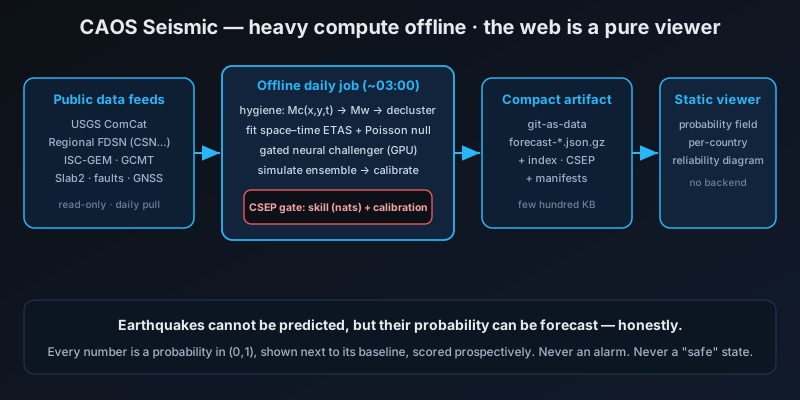
A local GPU workstation pulls public feeds (USGS ComCat + regional FDSN), runs the mandatory hygiene order (time-varying completeness Mc → moment-magnitude homogenization → dual declustering), fits ETAS and the gated challenger, simulates an ensemble, calibrates, runs the CSEP gate, and commits one compact gzipped artifact to a public repo. A Vite + React + TypeScript viewer reads the committed JSON, no server computes anything, so hosting is near-free and every forecast is auditable straight from the git history.
Global by design
The model trains on global seismicity and runs inference across many countries, high-seismicity (Chile, Japan, Indonesia, Mexico, Türkiye, California, New Zealand) and low-seismicity (UK, Germany, Australia, Brazil), precisely so the forecast can be audited for bias toward active zones. The single public exceedance formula P = 1 − e^(−N) never changes; only the quality of the conditional intensity improves.
The limits
This is an independent research and education tool that complements official agencies (in Chile, the CSN; civil protection, SENAPRED): it never replaces them, never issues an alarm or a countdown, and never declares a “safe” state. Blank on the map means no forecast / out of coverage, never “safe”. The hardest part of any risk product is communicating uncertainty responsibly; the lesson of L’Aquila (2009) is that false reassurance is what causes harm, and this product is built to never over-reassure.
Live application
▶ seismic.fasl-work.com: the world probability field, per-country drill-down, the reliability diagram, the multi-model back-analysis, and the experiment journey, negative results included.