
PINN-Lab, A Runnable Catalogue of Physics-Informed Neural Networks
Published:
A runnable catalogue of 19 Physics-Informed Neural Network cases. Each is trained offline with DeepXDE/PyTorch, validated against an analytic, benchmark, or real-data anchor, and exported to ONNX, then the static web app loads that ONNX and re-infers it live in the browser (onnxruntime-web). Because the physical parameter is a network input, you move a slider and the trained network re-solves the PDE client-side, in real time. Live at pinnlab.fasl-work.com.
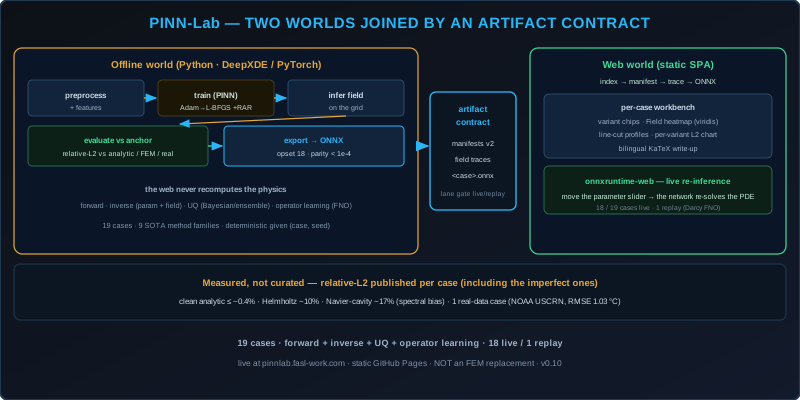
The full method ladder
It is not one forward problem: it exercises the real range of scientific ML: forward PDE solving, inverse problems (parameter and field recovery), uncertainty quantification (Bayesian / ensemble), and operator learning (a Fourier Neural Operator generalizing across coefficient fields). Nine SOTA method families appear, each in a per-case workbench with an interactive field heatmap, a live slider, a per-variant error chart, and a bilingual write-up with the governing equations in KaTeX.
Accuracy and scope
Benchmarks are measured, not curated: ONNX parity is < 1e-4 everywhere, and relative-L2 is published per case, including the cases that sit at known PINN limits (Helmholtz ~10%, Navier-cavity ~17%, a soil-barrier case ~19% from spectral bias and the CPU training lane). PINN-Lab is not an FEM/FVM replacement, not an industrial digital twin, and not trained on real industrial data, only one of the 19 cases (soil heat, NOAA USCRN) uses real measurements; the rest are analytic anchors or synthetic-illustrative reduced models, all labeled as such. It is deliberately a 0.x release while predominantly synthetic.