Lidar3D, Streaming 3D Reconstruction Lab
Published:
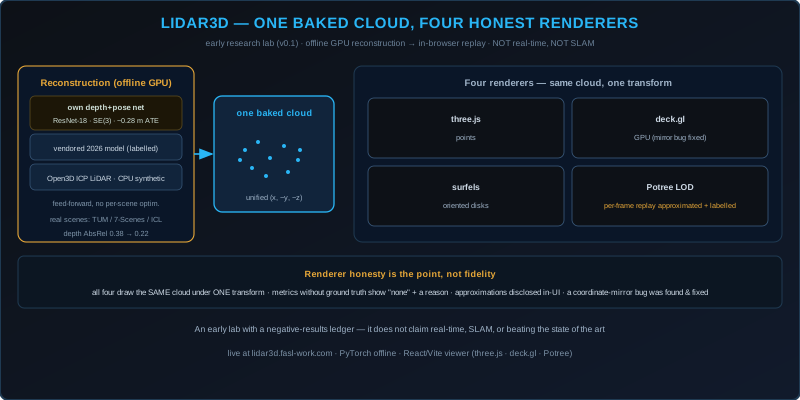
An early research lab for feed-forward streaming 3D reconstruction: an ordered RGB or LiDAR stream becomes a camera trajectory, dense metric depth and a fused colored point cloud, with no per-scene optimization. The heavy engine runs offline on a GPU; the public site is a static SPA that replays the baked cloud across four point-cloud renderers. Live at lidar3d.fasl-work.com.
What is actually wired
Two reconstruction engines: a from-scratch depth-and-pose network (ResNet-18 backbone, a Siamese SE(3) pose head, aleatoric depth) with a real ~0.28 m held-out trajectory error on TUM, reconstructing eight real indoor scenes (TUM / 7-Scenes / ICL); and a genuinely vendored 2026 model (kept clearly labelled as vendored) for four outdoor scenes. Plus Open3D ICP LiDAR odometry and a CPU synthetic engine.
Renderer parity is the headline
Four renderers (three.js, deck.gl, surfels and Potree LOD) all draw the same baked cloud under one unified (x, −y, −z) transform (a deck.gl mirror bug was found and fixed). Where a renderer physically cannot do per-frame replay, the app approximates and says so in the UI rather than faking it, and any metric without ground truth is shown as “none” with a reason.
Scope
A lab, framed as one: it replays baked artifacts (it is not real-time and not SLAM by default: loop closure and global bundle adjustment are opt-in), it does not claim to beat the state of the art, the outdoor model is vendored not ours, and there is no textured mesh or Gaussian-splat output. The value is the discipline and the negative-results ledger, not a fidelity claim.