ImageLab, One Image Across Eleven Mathematical Representations
Published:
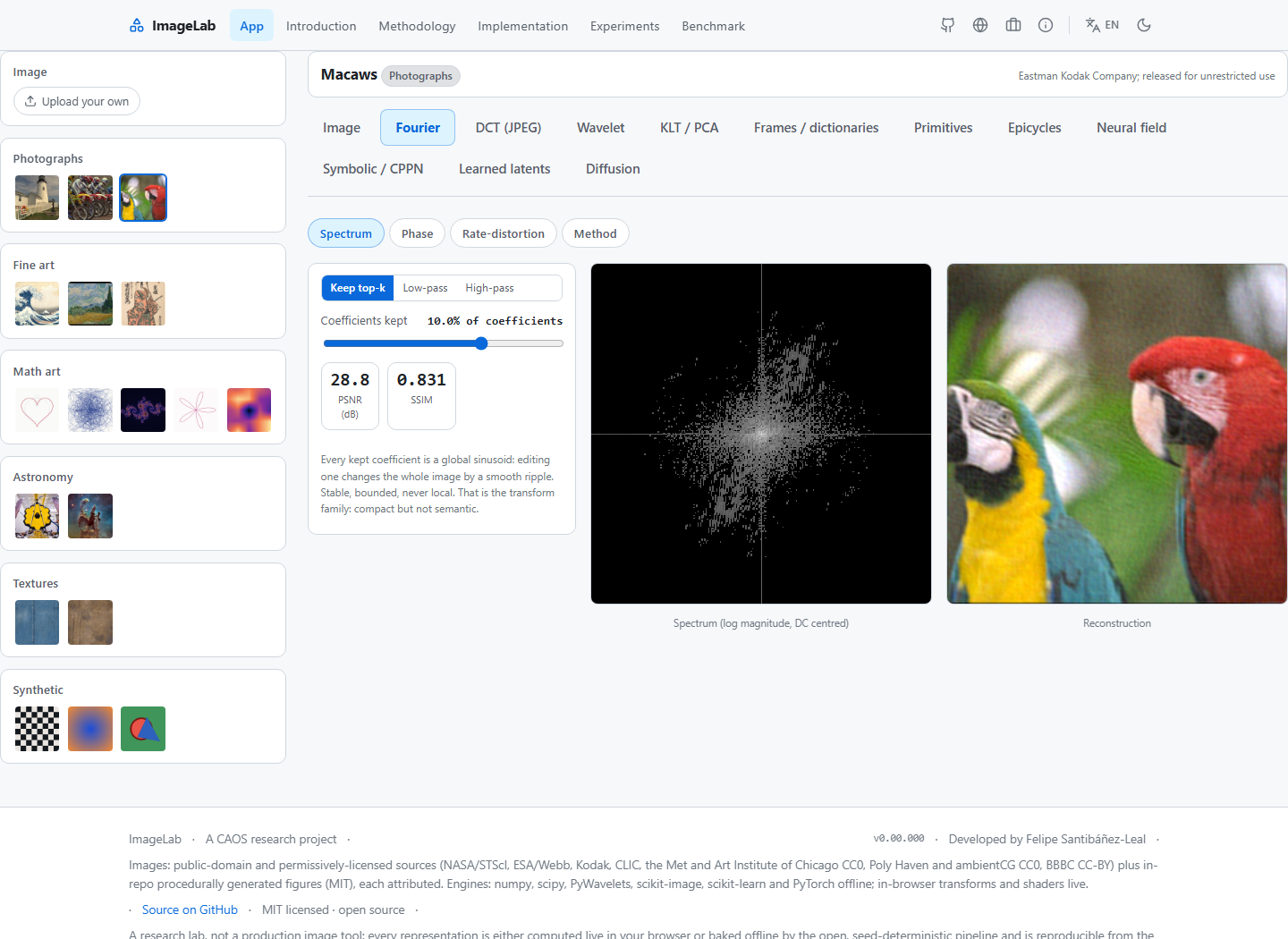
An interactive lab that represents a single image in eleven ways and lets you edit each representation’s parameters directly. It spans the full arc from designed orthonormal transforms to learned generative manifolds, so you can read one representation against another on the same image. Live at imglab.fasl-work.com.
The eleven representations
Four orthonormal transforms (Fourier, DCT, wavelet, KLT), overcomplete sparse dictionaries, geometric primitives, an implicit neural field (SIREN), symbolic CPPN formula art, Fourier-descriptor epicycles, and two learned generative latents (a VAE and a diffusion model). Each is a tab with live parameter controls, the governing math in KaTeX, and a bilingual (EN/ES) write-up. Everything is either computed live in the browser (TypeScript + WebGL2 shaders) or baked offline by an open, seed-deterministic Python pipeline (numpy, scipy, PyWavelets, scikit-image, scikit-learn, PyTorch, diffusers).
The organizing thesis, editability is U-shaped
Measured on the Experiments and Benchmark pages: editability peaks at the designed-structure pole (local, exact edits) and again at the learned-manifold pole (semantic, entangled edits), and collapses to noise between them. The cross-family benchmark makes this concrete, an editability-locality metric where KLT and wavelet score ~1.0 (local, exact edits) against Fourier and DCT at ~0.16-0.23 (global, entangled edits), alongside a rate-distortion curve and a fixed-budget fidelity table.
Shared measurement
PSNR / SSIM / MS-SSIM are computed the same way in Python and in TypeScript, so the browser numbers match the offline bake. Bilingual EN/ES, light/dark, static GitHub Pages deploy. It is a CAOS Research-group lab (educational and research, not a commercial product) a sibling of PINN-Lab, QLab, ChronoScope and SimLab.