
Hyperspectral Mineral Classification Platform
Published:
A machine learning platform for classifying minerals and estimating their abundances from hyperspectral imagery (VNIR/SWIR), designed for deployment at mining and exploration sites.
The challenge
Hyperspectral cameras capture hundreds of narrow spectral bands across the visible, near-infrared, and short-wave infrared ranges. Each pixel in the resulting raster encodes a spectral signature that can reveal the mineral composition of rock samples, drill core, or conveyor belt material. However, translating raw spectral data into reliable mineral maps requires careful calibration, robust models, and domain-aware constraints – particularly the requirement that predicted mineral abundances at each pixel must sum to 100%.
System architecture
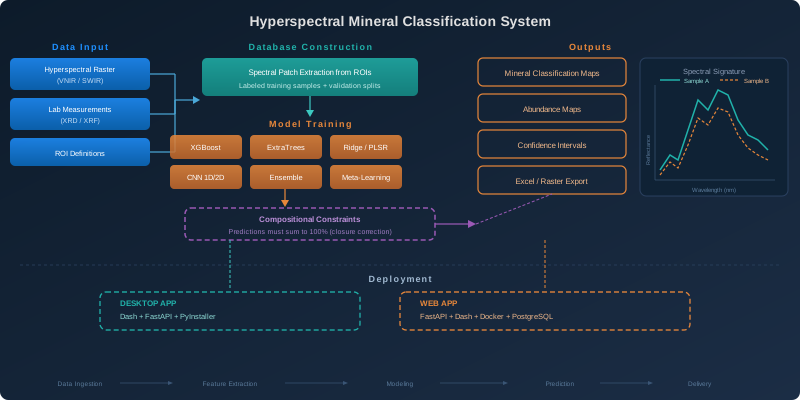
- Data ingestion: The platform accepts hyperspectral rasters from VNIR/SWIR cameras alongside laboratory reference measurements (XRD for mineral phases, XRF for elemental composition). Regions of interest (ROIs) are defined to link spectral patches with ground-truth mineral labels.
- Spectral patch database: ROI-aligned spectral patches are extracted and organized into training databases, with augmentation and normalization pipelines to handle varying illumination and sensor conditions.
- Multi-model training: Several model architectures are trained in parallel – XGBoost, ExtraTrees, Ridge regression, Partial Least Squares Regression (PLSR), and 1D/2D Convolutional Neural Networks. An ensemble layer and meta-learning strategies combine predictions across models and datasets.
- Compositional constraints: A post-processing layer enforces that predicted mineral abundances satisfy closure (summing to 100%) and non-negativity, using constrained optimization techniques.
- Output products: Mineral classification maps, per-pixel abundance estimates with confidence intervals, and summary statistics for geological interpretation.
Minerals handled
The system has been applied to a range of mineral assemblages relevant to mining and exploration, including clays (kaolinite, chlorite, smectite, muscovite), sulfates (alunite), iron oxides (limonite), and various phyllosilicates. Model configurations are adapted per mineral system.
Technology stack
- ML: XGBoost, ExtraTrees, scikit-learn, TensorFlow/Keras for CNN architectures
- Backend: FastAPI (Python), NumPy, SciPy for spectral processing
- Frontend/Visualization: Dash for interactive mineral maps and model exploration
- Desktop deployment: Packaged for field use at sites with limited connectivity
- Data: HDF5 and GeoTIFF for raster storage, pandas for tabular data
Note: This description reflects the general type and architecture of systems I have built as a consultant for industrial clients. Specific client details, operational data, and proprietary methodologies are omitted.