
Floraria, a Continuous Botanical Scene from Museum Scans to Cells
Published:
Teaching what a flower is made of usually means a labelled drawing at one scale; going from the bloom to a tissue, a cell and a compartment means changing books. Floraria is one continuous scene: aim at a part and scroll in, and the enclosing structures open.
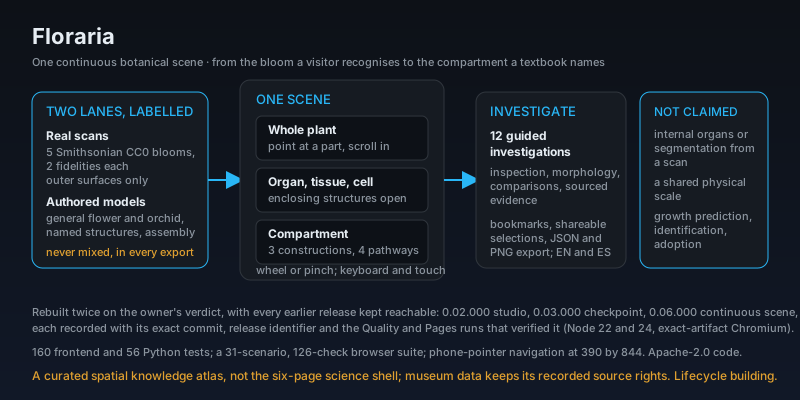
Two lanes, kept apart
Five Smithsonian CC0 bloom specimens, each at two delivery fidelities (five biological examples, not ten), show outer surfaces and establish nothing internal. Two authored educational component models, a general flower and an orchid, carry named structures, assembly and explosion, isolation and explanatory views; they are diagrams, not segmented scans. The two lanes are labelled in the interface and in every export.
The scene
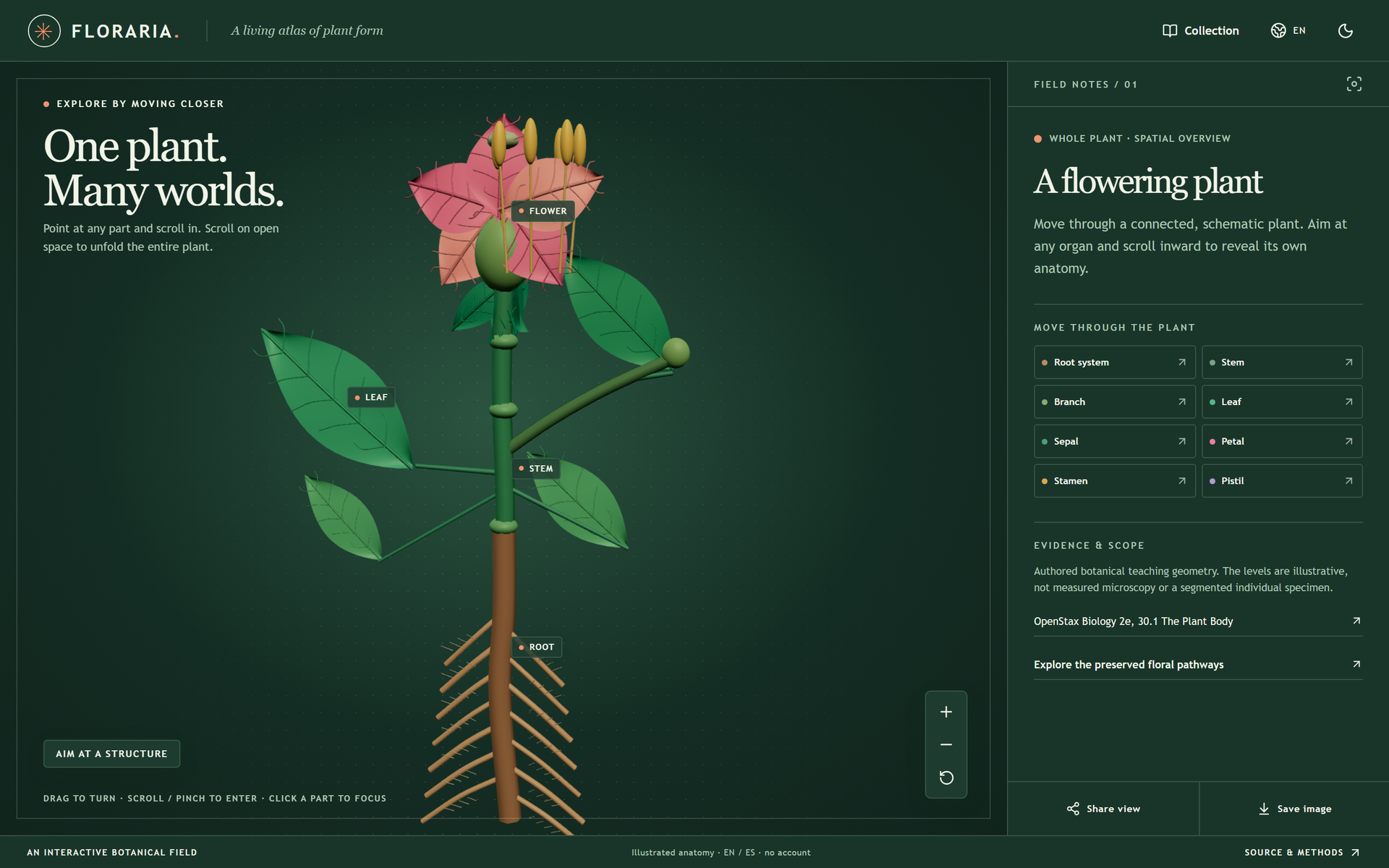
Three floral constructions and four connected pathways reveal geometry, qualitative processes and sourced context as the level changes by wheel or pinch; twelve guided investigations connect inspection, morphology, comparisons and the documented evidence; keyboard and touch controls, persistent preferences, bookmarks, shareable selections, JSON and PNG export; English and Spanish, light and dark. The product follows a curated spatial atlas archetype rather than the six-page science shell, and the record says so.
Rebuilt on my own verdict
The first two versions, a studio of separate views, were below the bar; the continuous scene replaced them, and 0.02.000, 0.03.000 and 0.06.000 are each recorded with their exact commits, release identifiers and the Quality and Pages runs that verified them. 160 frontend and 56 Python tests; a 31-scenario, 126-check browser suite; phone-pointer navigation at 390 by 844. Not claimed: internal organs or measurement from a scan, a shared physical scale, growth prediction, identification, adoption. Apache-2.0 code; museum data keeps its recorded source rights; the lifecycle stays building.