
Destello, the Whole Fly Nervous System Working Through Its Two Real Eyes
Published:
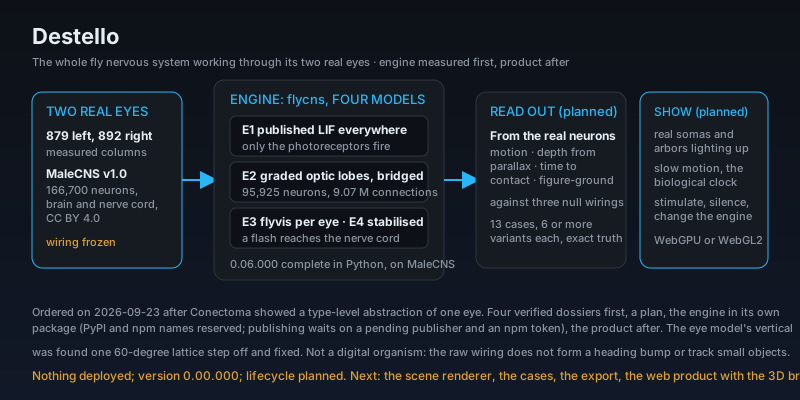
Destello was ordered on 2026-09-23 after Conectoma showed a type-level abstraction of one eye instead of the real connectome working. It drives the whole measured nervous system, neuron by neuron, through both real compound eyes (879 left and 892 right measured columns), with the published neuron models, a graded optic lobe and a leaky integrate-and-fire model elsewhere, and nothing learned inside the wiring.
Engine first
The engine is flycns, its own repository and package: it compiles fly connectome releases into simulation-ready signed graphs with positions and per-eye column maps, models the two compound eyes, and simulates the whole central nervous system in Python and, since 0.07.000, in the browser: a CPU engine that reproduces the Python reference spike for spike, the whole CNS included, and WebGPU kernels that fire the same neurons the same number of times. Version 0.06.000 coupled the whole CNS in four engines, each measured on MaleCNS: the published leaky integrate-and-fire model everywhere (only the photoreceptors fire, because histaminergic inhibition of silent spiking neurons carries nothing); flyvis’s trained numbers on the MaleCNS optic lobes (95,925 neurons, 9.07 million connections) bridged to the spiking model; flyvis’s own network per eye mapped onto MaleCNS; and the hybrid with stabilisers. A flash reaches the nerve-cord motor neurons. The eye model’s vertical was found one 60-degree lattice step off, which T4 tuning revealed and the dorsal rim now sets.
What it will be, and what it is today
The plan holds three null wirings, readouts for motion, depth from parallax, time to contact and figure-ground (two of them learned), a three.js scene on WebGPU with the WebGL2 fallback, and a deployment decided by the measured export. Today: four verified dossiers, the plan, the engine complete in Python and in the browser, and the visual world (Destello 0.01.000): an analytic renderer of what each ommatidium of both eyes sees, with the exact truth (depth, object, optic flow, time to contact), and the thirteen cases with their 222 stimuli. The engine runs over the cases, the export and the web product are not built; nothing is deployed; version 0.01.001. The engine is published as flycns on PyPI and as @fasl-work/flycns on npm (0.7.0, 2026-09-26). Not a digital organism: the raw wiring under these models does not form a heading bump, turn toward objects or track small objects, and the product shows those as open with their named reason.