
Conectoma, a Fly Connectome Used as a Frozen Vision Network, Measured Against Its Own Nulls
Published:
Lappalainen et al. (Nature 2024) constrained a network with the optic-lobe connectome and trained it on optic flow, which is what fly vision evolved for. Conectoma asks whether the same frozen wiring supports dense prediction tasks it did not evolve for, on a newer and larger connectome, with the controls that make the attribution testable.
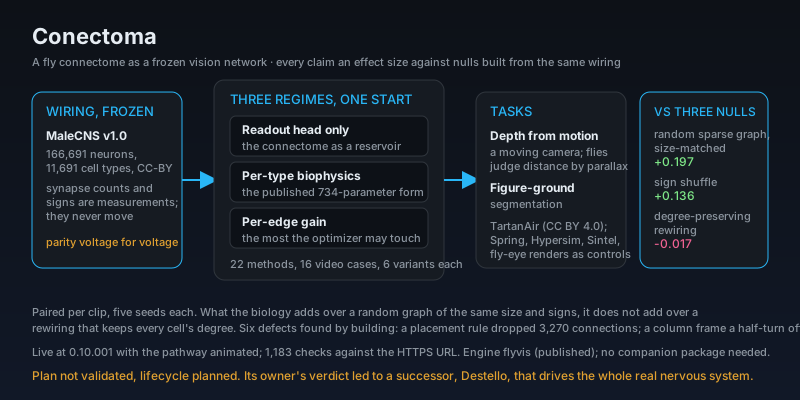
The wiring is a measurement and never moves
The MaleCNS v1.0 wiring is compiled in memory by a compiler identical to flyvis’s on the published connectome and frozen: wiring, synapse counts and signs stay fixed, with parity to the published model voltage for voltage. Three regimes share one starting point and differ only in what is learned: a readout head alone, the per-cell-type biophysics in the published 734-parameter form, or a per-edge gain. Null controls are matched in size at the level of cells: degree-preserving rewiring, a size-matched random sparse graph, a sign shuffle. Twenty-two methods plus three controls over sixteen video cases with six physical variants each, on TartanAir with Spring, Hypersim, Sintel and rendered fly-eye scenes as transfer and control domains.
The number that matters is the third one
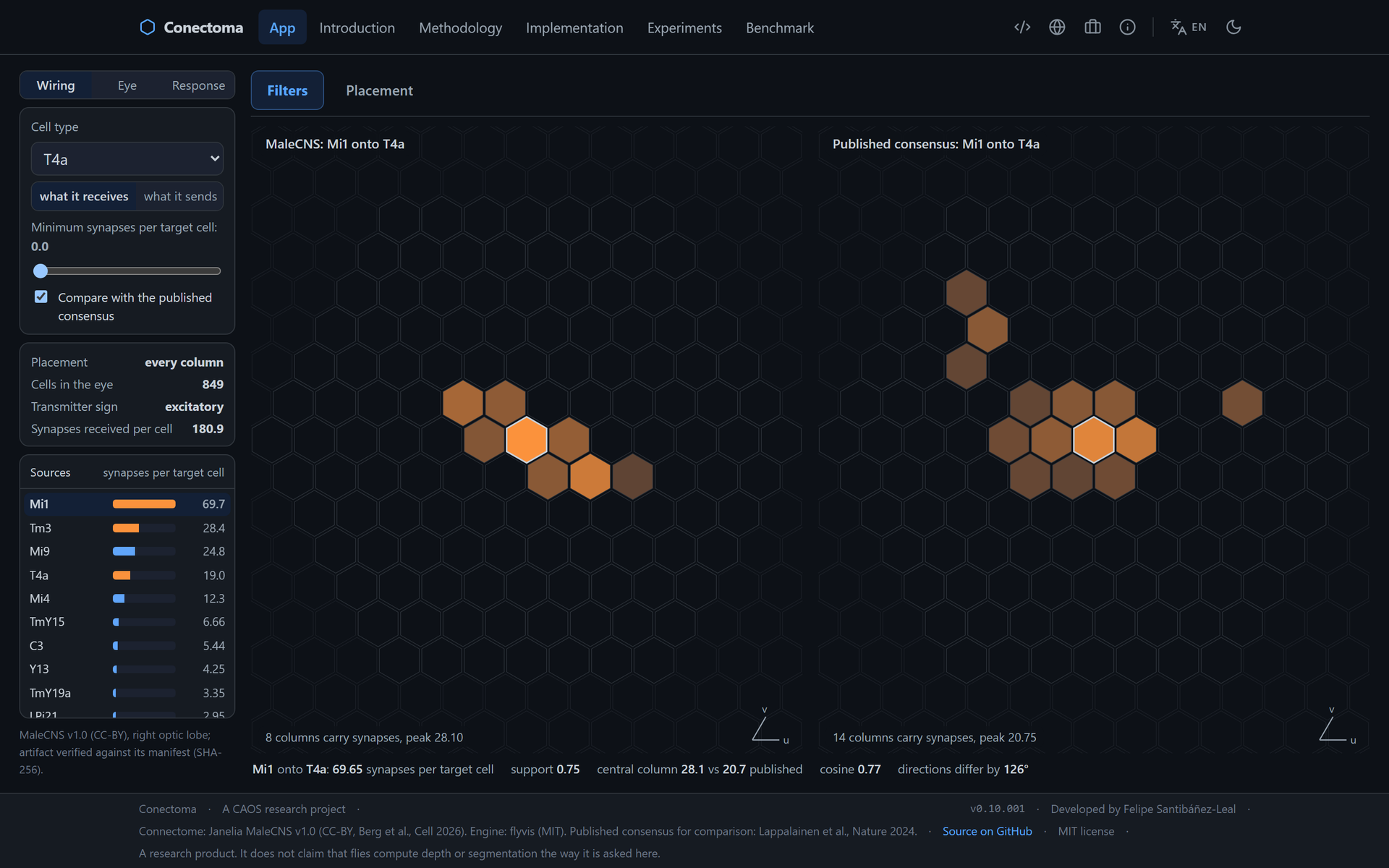
With the connectome as a reservoir and a trained readout, paired per clip on the cases: +0.197 [+0.173, +0.214] against a size-matched random sparse graph, +0.136 [+0.121, +0.168] against a sign shuffle, and -0.017 [-0.021, -0.008] against a degree-preserving rewiring. What the biology adds over a random graph of the same size and the same signs, it does not add over a rewiring that keeps every cell’s degree. Building it exposed six defects, two inherited: a placement rule that dropped 3,270 connections and a column frame a half-turn off the engine’s.
Live, measured, and superseded on purpose
Live at its custom domain with 1,183 checks run against the HTTPS URL and all sixteen clips verified against their manifests; version 0.10.001 animates the pathway. Its plan was not validated, so the lifecycle reads planned. My own verdict after 0.10 was that it showed a type-level abstraction of one eye rather than the real connectome working, and a successor, Destello, was ordered to drive the whole nervous system through both real eyes; Conectoma stays as it is. It does not claim that flies perform semantic segmentation or single-image depth estimation, and a negative answer to its central question is a valid outcome.