
ChronoScope, Univariate Forecasting Atlas with a Foundation-Model Tier
Published:
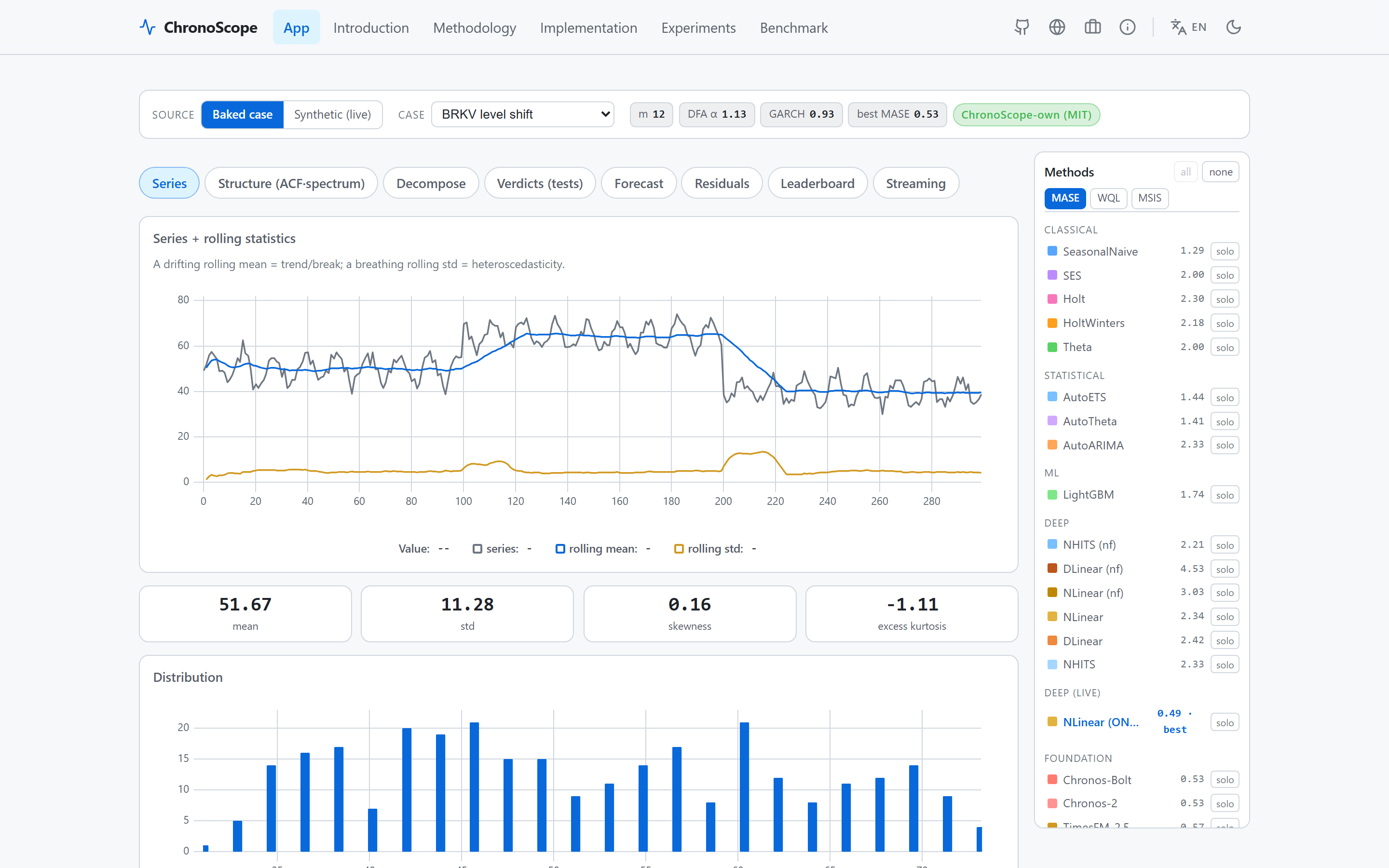
A univariate time-series forecasting atlas. Fifteen diagnostic cases, each forecast by the same 19-method ladder and scored by backtested MASE / sMAPE / interval coverage, so you can read one method against another on the same footing. Live at chronoscope.fasl-work.com.
One ladder, four tiers
Classical and statistical baselines (SeasonalNaive, Theta, AutoARIMA, AutoETS), a gradient-boosting tier (LightGBM), deep nets (NHITS, DLinear, NLinear), and a foundation-model tier: Chronos-Bolt, Chronos-2, TimesFM-2.5 and TiRex-2, run zero-shot. TiRex-2 needs a purpose-built WSL2/CUDA lane because its kernels have no Windows wheels.
Real data, and its limits
Four cases are real and licensed (UCI Electricity, UCI Beijing PM2.5, Monash/M4 hourly and daily, all CC-BY-4.0); the other eleven are seeded synthetic with a licence guard that blocks non-redistributable sources. The foundation models run offline only (the browser lane is numpy, not an in-browser transformer). And the atlas shows where the hype breaks: on real M4-hourly a one-line SeasonalNaive (MASE 0.641) beats TimesFM-2.5 (0.729), while TiRex-2 gives the best 0.476. White-noise and random-walk controls are on the board too.