
ChargeCascade, Tumbling-Mill Charge Motion & Power Studio
Published:
A live, in-browser 3D studio for tumbling-mill charge motion and power (SAG / ball / rod). Move a slider (speed, filling, ball load, mill size) and watch the charge shift between cascading, cataracting and centrifuging, with toe/shoulder angles and net power recomputing instantly and the governing equations on screen. Live at chargecascade.fasl-work.com, part of the Faena mining-analytics hub.
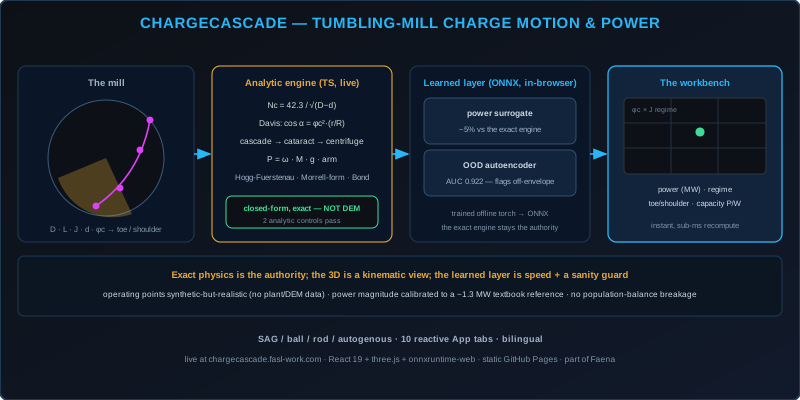
Exact physics as the authority
A dependency-free TypeScript engine implements the published closed-form equations exactly and recomputes on every control change: critical speed Nc = 42.3/√(D−d), the Davis regime bands, toe/shoulder geometry, and net power as the centre-of-mass torque arm (Hogg-Fuerstenau, a Morrell-form, Bond). Two exact analytic controls pass (an empty mill draws 0 kW; at critical speed the charge centrifuges), so the engine is verified, not asserted.
A thin learned layer
Run offline, the exact engine labels a synthetic operating envelope on which two small models are trained (PyTorch → ONNX) and served live via onnxruntime-web: a power surrogate (~5% error vs the exact engine) for instant envelope sweeps, and an out-of-distribution autoencoder (AUC 0.922) that flags off-envelope inputs. The exact engine stays the authority.
What it is not
The 3D is a kinematic animation of the closed-form engine, not a DEM / N-body simulation, and there is no population-balance breakage model. All operating points are synthetic-but-realistic; the power magnitude is calibrated to a ~1.3 MW textbook reference, not validated against a real mill. It is a fast design-intuition studio, not a plant model.