
CardioPINN, Physics-Informed Cardiac Inverse-Problem Lab
Published:
A two-case lab in physics-informed cardiac reconstruction, run entirely on real measured data (EDGAR torso-tank and in-situ ECGi beats; one thoracic-aorta 4D-flow MRI scan), and scoped as a complement to classical methods, not a replacement. Live at cardiopinn.fasl-work.com.
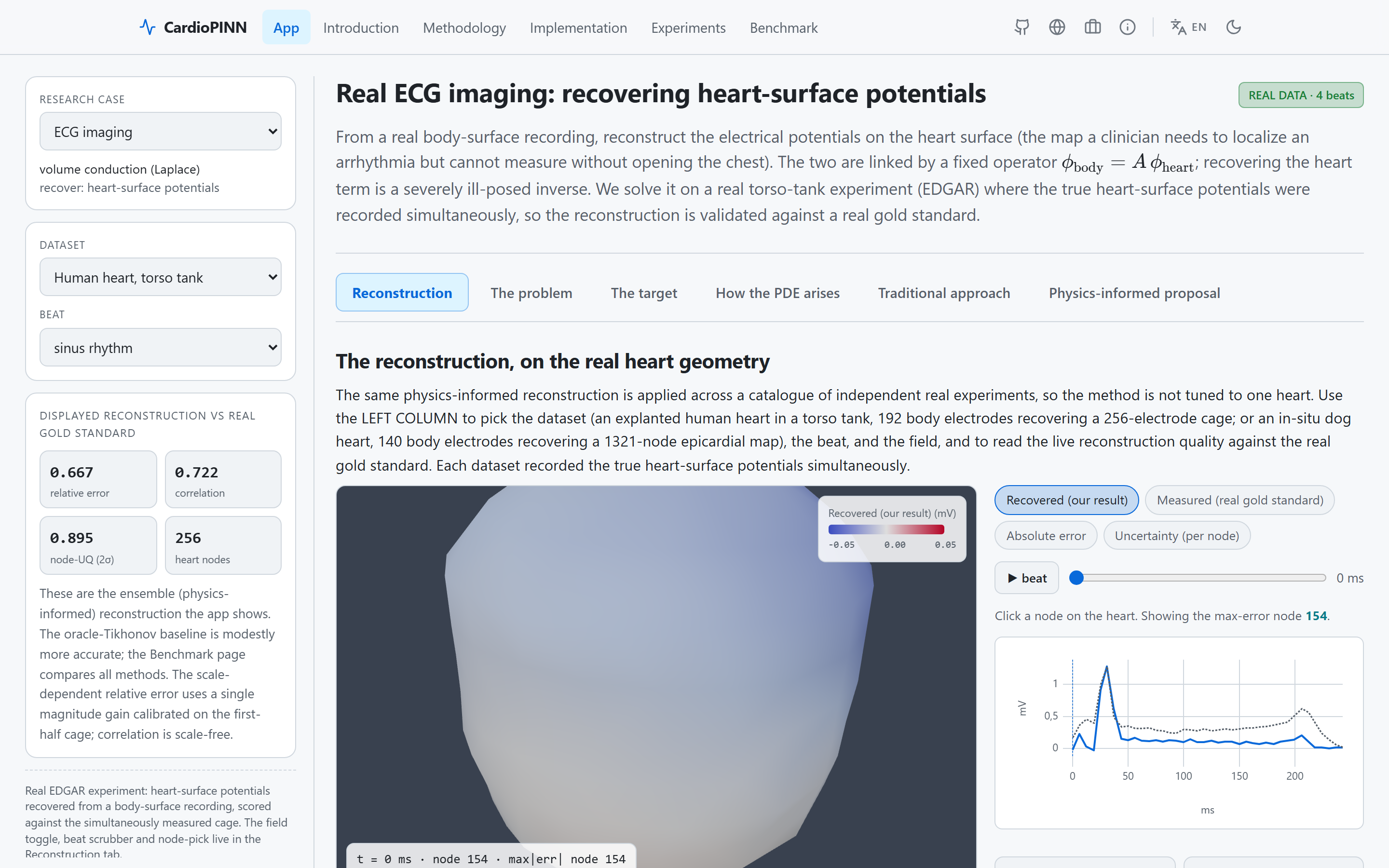
The right scorecard
Point accuracy sits at parity with a well-tuned Tikhonov baseline on all four beats, and the app states it, by design: replacing classical accuracy was never the goal. What the physics adds is what the deterministic estimate structurally cannot:
- a calibrated per-node uncertainty (2-sigma coverage 0.89-0.90 across all four real beats), so you see not just a reconstruction but where to trust it;
- a resolved relative-pressure field from a well-posed solve on the 4D-flow side, a different output class than the one-number Bernoulli estimate used clinically.
Tested advances, published nulls
Candidate advances are validated on known-answer analytic flows (the real data has no invasive gold standard). Two are confirmed and CI-tested: spatial analytic-autograd source and flux (pressure-drop error 0.066 vs 4.19 mmHg, 6 of 6, roughly 63x) and temporal analytic-autograd dv/dt (scale ~1.0, correlation above 0.99 down to ~6 frames per cycle, where 3-frame finite differences lose amplitude by sinc aliasing). Three nulls are published alongside, including a hard divergence-free construction that was refuted. The ECGi case states its own method: it is regularized least squares plus a graph prior and a deep ensemble, not a PINN; only the 4D-flow case is.